QUESTION IMAGE
Question
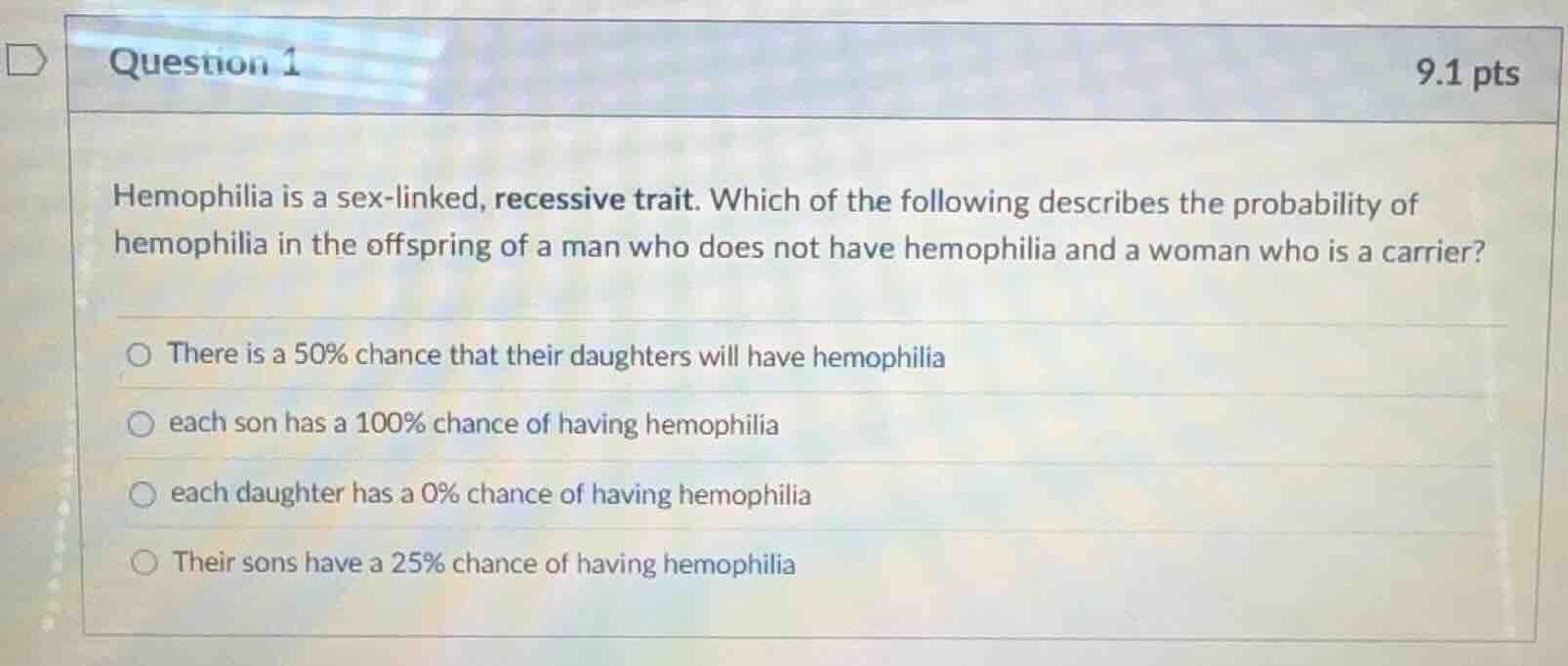
question 1 9.1 pts hemophilia is a sex - linked, recessive trait. which of the following describes the probability of hemophilia in the offspring of a man who does not have hemophilia and a woman who is a carrier? there is a 50% chance that their daughters will have hemophilia each son has a 100% chance of having hemophilia each daughter has a 0% chance of having hemophilia their sons have a 25% chance of having hemophilia
Brief Explanations
- First, recall the inheritance of sex - linked recessive traits. Hemophilia is an X - linked recessive disorder. Let the normal allele be \(X^H\) and the hemophilia allele be \(X^h\).
- A man who does not have hemophilia has the genotype \(X^HY\) (since he has one X and one Y chromosome, and the Y chromosome does not carry the hemophilia - related allele).
- A woman who is a carrier has the genotype \(X^HX^h\) (she has one normal X and one X with the hemophilia allele).
- Now, analyze the possible offspring genotypes:
- For daughters: The father donates \(X^H\) and the mother can donate either \(X^H\) or \(X^h\). So the possible genotypes of daughters are \(X^HX^H\) (homozygous normal) and \(X^HX^h\) (carrier). Since hemophilia is recessive and daughters need two \(X^h\) alleles to have hemophilia (and they can only get one \(X^h\) from the mother and \(X^H\) from the father), the probability of daughters having hemophilia is 0%.
- For sons: The father donates \(Y\) and the mother can donate either \(X^H\) or \(X^h\). The possible genotypes of sons are \(X^HY\) (normal) and \(X^hY\) (has hemophilia). The probability of a son having hemophilia is 50% (because there are two possible X alleles from the mother, and one of them is \(X^h\)). But let's analyze each option:
- Option 1: Daughters have 0% chance of hemophilia, not 50%, so this is wrong.
- Option 2: Sons have a 50% chance, not 100%, so this is wrong.
- Option 3: As we saw, daughters get \(X^H\) from father and either \(X^H\) or \(X^h\) from mother. Since hemophilia is recessive, they need two \(X^h\) to be affected, which is impossible here. So each daughter has a 0% chance of having hemophilia. This option is correct.
- Option 4: Sons have a 50% chance, not 25%, so this is wrong.

Snap & solve any problem in the app
Get step-by-step solutions on Sovi AI
Photo-based solutions with guided steps
Explore more problems and detailed explanations
C. each daughter has a 0% chance of having hemophilia