QUESTION IMAGE
Question
question 7
1 pts
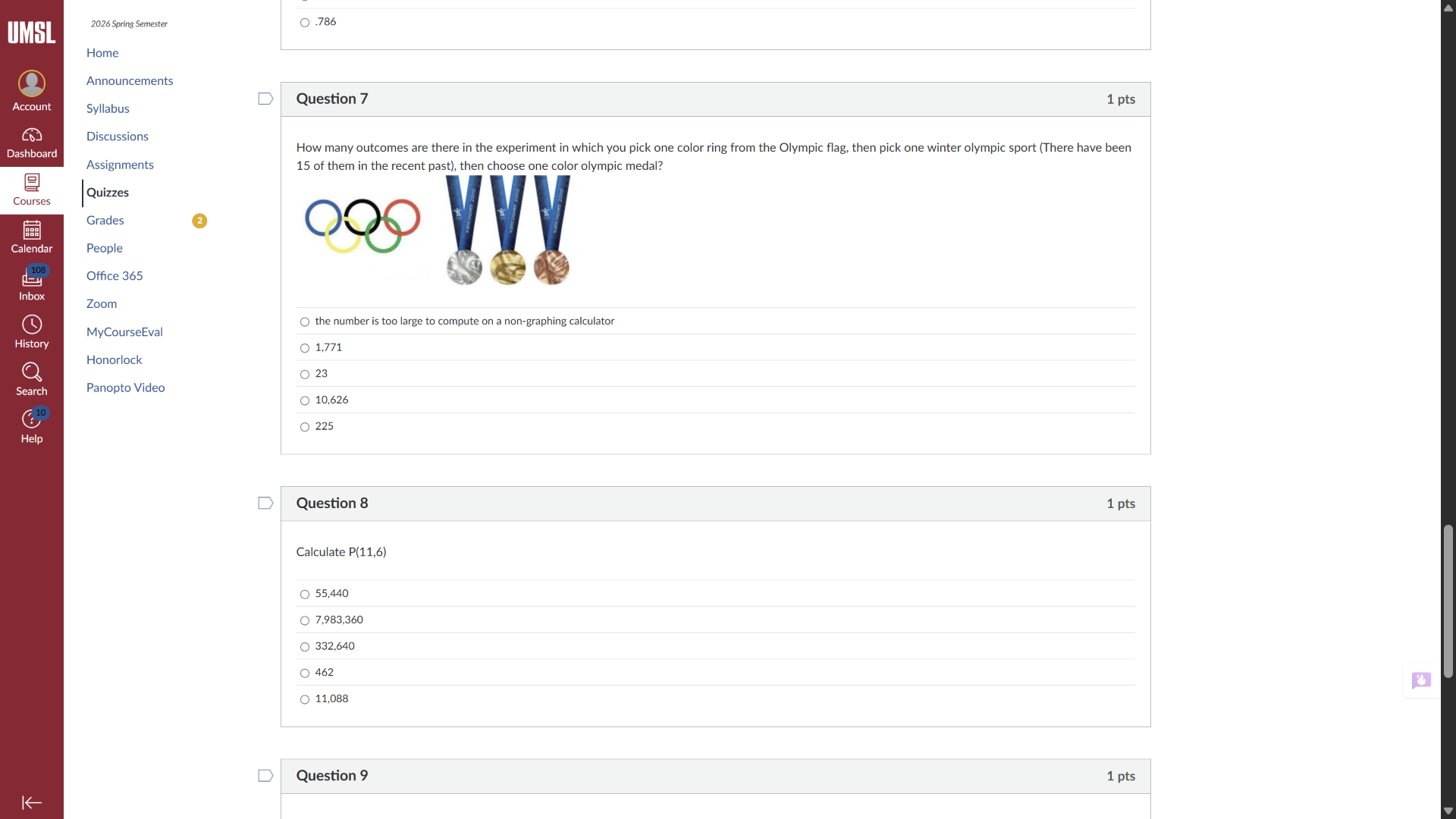
how many outcomes are there in the experiment in which you pick one color ring from the olympic flag, then pick one winter olympic sport (there have been 15 of them in the recent past), then choose one color olympic medal?
question 8
1 pts
calculate p(11,6)
55,440
7,983,360
332,640
462
11,088
question 9
1 pts
Question 7
Step1: Identify number of choices for each event
- Olympic flag color rings: 5 (blue, black, red, yellow, green)
- Winter Olympic sports: 15
- Olympic medal colors: 3 (gold, silver, bronze)
Step2: Apply multiplication principle
The total number of outcomes is the product of the number of choices for each event. So, we calculate \( 5 \times 15 \times 3 \).
First, calculate \( 5 \times 15 = 75 \). Then, calculate \( 75 \times 3 = 225 \). Wait, no, wait: Wait, medal colors: looking at the image, there are 3 medals (silver, gold, bronze)? Wait, no, the Olympic medal colors are gold, silver, bronze – 3? Wait, no, the problem says "choose one color olympic medal" – the medals are gold, silver, bronze – 3? Wait, but let's recheck:
Wait, the Olympic flag has 5 rings. Winter sports: 15. Medal colors: how many? The image shows three medals (silver, gold, bronze) – so 3. So total outcomes: \( 5 \times 15 \times 3 \). Wait, \( 5 \times 15 = 75 \), \( 75 \times 3 = 225 \)? But wait, maybe I made a mistake. Wait, no, let's recalculate: 5 (rings) 15 (sports) 3 (medals) = 515=75, 753=225. But wait, the options include 225? Wait, no, the options are: 1,771; 23; 10,626; 225. Wait, 5153=225? Wait, no, wait: maybe the medal colors are 3? Wait, the image shows three medals (silver, gold, bronze) – so 3. So 5153=225. But wait, maybe I miscounted the medal colors. Wait, no, the Olympic medals are gold, silver, bronze – three colors. So 5 (rings) 15 (sports)3 (medals) = 225. But wait, let's check again. Wait, maybe the medal colors are 3? So 515=75, 753=225. So the answer is 225? Wait, but let's check the options. The options are: the number is too large...; 1,771; 23; 10,626; 225. So 225 is an option. Wait, but maybe I made a mistake. Wait, no, 515=75, 753=225. So that's one of the options. But wait, maybe the medal colors are more? Wait, no, the image shows three medals. So that's 3. So the total is 5153=225. But wait, maybe I messed up. Wait, no, let's do it again: 5 (rings) 15 (sports) 3 (medals) = 225. So the answer is 225? Wait, but let's check the options. Yes, 225 is an option. So that's the answer.
Wait, but wait, maybe the medal colors are 3? So the calculation is 5153=225. So the answer is 225.
Question 8
Step1: Recall permutation formula
The permutation formula is \( P(n, r) = \frac{n!}{(n - r)!} \), where \( n = 11 \) and \( r = 6 \).
Step2: Calculate \( P(11, 6) \)
First, expand the factorials:
\( P(11, 6) = \frac{11!}{(11 - 6)!} = \frac{11!}{5!} \)
Since \( n! = n \times (n - 1) \times \dots \times 1 \), we can simplify \( \frac{11!}{5!} = 11 \times 10 \times 9 \times 8 \times 7 \times 6 \) (because \( 11! = 11 \times 10 \times 9 \times 8 \times 7 \times 6 \times 5! \), so the \( 5! \) in the numerator and denominator cancels out).
Now, calculate the product:
\( 11 \times 10 = 110 \)
\( 110 \times 9 = 990 \)
\( 990 \times 8 = 7920 \)
\( 7920 \times 7 = 55440 \)
\( 55440 \times 6 = 332640 \)
Wait, wait, that's not right. Wait, 1110=110, 1109=990, 9908=7920, 79207=55440, 55440*6=332640. But the options are 55,440; 7,983,360; 332,640; 462; 11,088. Wait, 332,640 is an option. Wait, let's recalculate:
\( 11 \times 10 \times 9 \times 8 \times 7 \times 6 \)
11*10=110
110*9=990
990*8=7920
7920*7=55440
55440*6=332640
Yes, that's 332,640. So the answer is 332,640.
Step1: Determine choices per event
- Olympic rings: 5 colors.
- Winter sports: 15 options.
- Medal colors: 3 (gold, silver, bronze).
Step2: Apply multiplication principle
Total outcomes = \( 5 \times 15 \times 3 \).
Calculate \( 5 \times 15 = 75 \), then \( 75 \times 3 = 225 \). Wait, no—wait, the medal colors: looking at the image, there are 3 medals (silver, gold, bronze), so 3 choices. Thus, \( 5 \times 15 \times 3 = 225 \).

Snap & solve any problem in the app
Get step-by-step solutions on Sovi AI
Photo-based solutions with guided steps
Explore more problems and detailed explanations
s: