QUESTION IMAGE
Question
question 7
1 pts
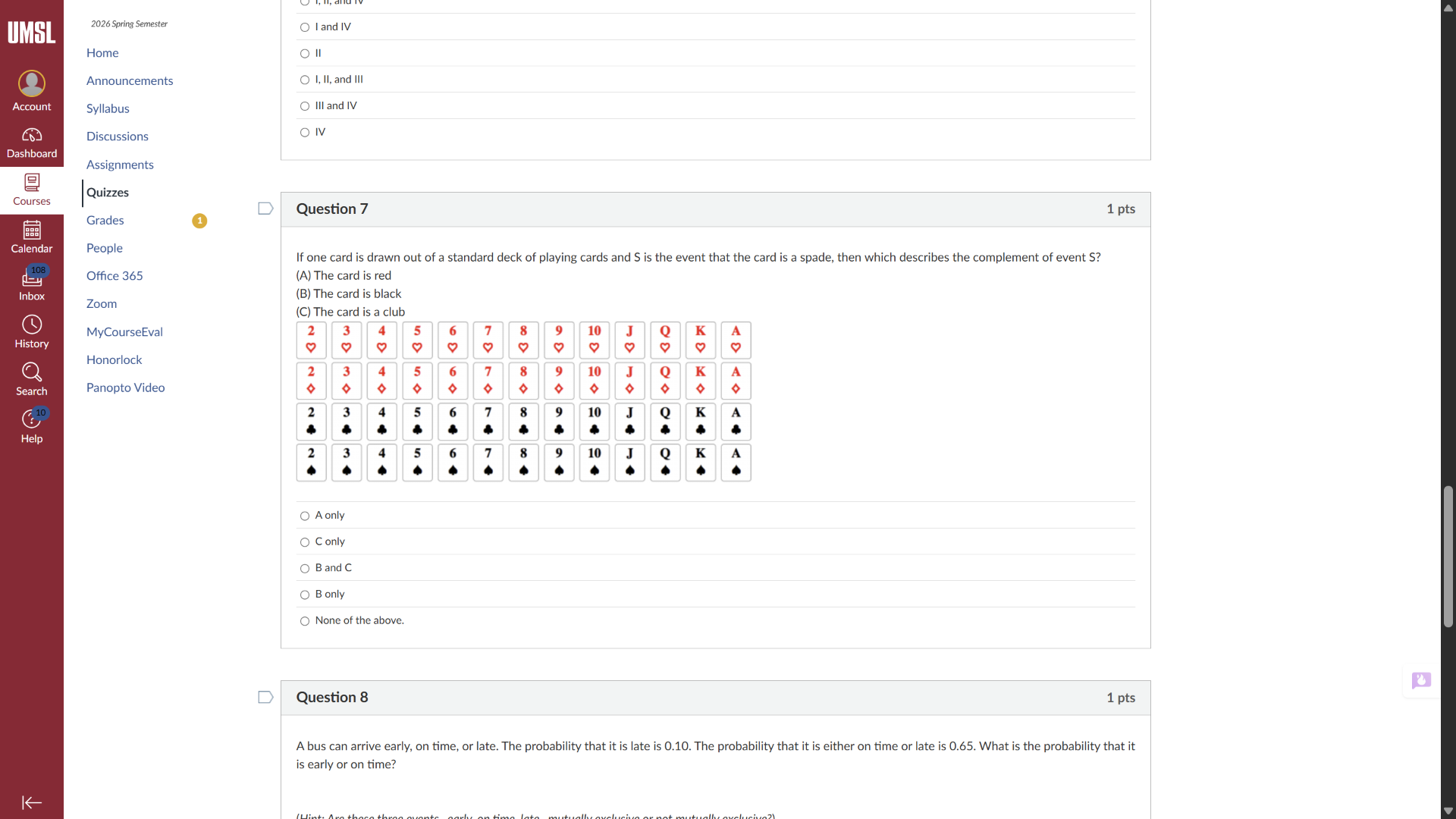
if one card is drawn out of a standard deck of playing cards and s is the event that the card is a spade, then which describes the complement of event s?
(a) the card is red
(b) the card is black
(c) the card is a club
image of a standard deck of playing cards
a only
c only
b and c
b only
none of the above.
question 8
1 pts
a bus can arrive early, on time, or late. the probability that it is late is 0.10. the probability that it is either on time or late is 0.65. what is the probability that it is early or on time?
(hint: are these three events early on time late mutually exclusive or not mutually exclusive?)
Question 7
- First, recall the definition of the complement of an event: The complement of an event \( S \) (denoted as \( S' \)) consists of all outcomes in the sample space that are not in \( S \).
- In a standard deck of 52 cards, event \( S \) is "drawing a spade". Spades are one of the four suits, with 13 spades. The other suits are hearts (red), diamonds (red), and clubs (black).
- The complement of drawing a spade (\( S' \)) is drawing a card that is not a spade. Cards that are not spades include hearts (red), diamonds (red), and clubs (black).
- Analyze the options:
- Option A: "The card is red" – Hearts and diamonds are red and not spades, but clubs are black and also not spades. So this is not the full complement.
- Option B: "The card is black" – Clubs are black and not spades, but hearts and diamonds are red and not spades. So this is not the full complement.
- Option C: "The card is a club" – Only clubs are not spades? No, hearts and diamonds are also not spades. Wait, no—wait, spades are black (along with clubs), and hearts/diamonds are red. Wait, no: Spades (black), hearts (red), diamonds (red), clubs (black). So the complement of spades (13 cards) is the other 39 cards: hearts (13), diamonds (13), clubs (13). So the complement of \( S \) (spade) is "not spade", which includes red cards (hearts, diamonds) and clubs (black). Wait, but let's re - evaluate the options. Wait, the options are about the description of the complement. Wait, maybe I made a mistake. Wait, spades are black (13 spades, 13 clubs are black; 13 hearts, 13 diamonds are red). So the complement of spade is non - spade. Non - spade cards are hearts (red), diamonds (red), clubs (black). So:
- Option A: "The card is red" – includes hearts and diamonds (which are non - spade), but not clubs (which are also non - spade). So A is not the full complement.
- Option B: "The card is black" – includes clubs (non - spade) and spades (which are in \( S \), so not in the complement). Wait, no: Spades are black, so "card is black" includes spades (which are in \( S \)), so B is incorrect.
- Option C: "The card is a club" – only clubs, but non - spade also includes hearts and diamonds. Wait, this is confusing. Wait, maybe the question has a different approach. Wait, maybe the options are mis - analyzed. Wait, let's re - express:
- The complement of \( S \) (spade) is "not spade". So the cards that are not spades are hearts, diamonds, and clubs. So "red cards" (hearts + diamonds) and "clubs" (black non - spade) together make up the complement? Wait, no—hearts (red, non - spade), diamonds (red, non - spade), clubs (black, non - spade). So the complement of spade is all cards except spades: red (hearts, diamonds) and clubs (black). Wait, but the options are A (red), B (black), C (club). Wait, maybe the question has a typo or I'm misinterpreting. Wait, no—wait, spades are black (13), clubs are black (13), hearts red (13), diamonds red (13). So the complement of spade (13) is 39 cards: 26 red (hearts + diamonds) and 13 clubs (black). So the complement of \( S \) is "not spade", which can be described as "red or club"? Wait, no—red cards (hearts, diamonds) are not spades, and clubs are not spades. But the options are A (red), B (black), C (club). Wait, maybe the original question's options are different. Wait, looking back: The options after the main question are:
- A only
- C only
- B and C
- B only
- None of the above.
Wait, maybe I made a mistake. Let's re - do:
- Event \( S \): card is spade (13 cards, b…
Step1: Identify the events and their probabilities
Let \( E \) be the event that the bus is early, \( O \) be the event that the bus is on time, and \( L \) be the event that the bus is late. We know that \( P(L)=0.10 \) and \( P(O\cup L) = 0.65 \). Also, the events \( E \), \( O \), and \( L \) are mutually exclusive (a bus can't be early, on time, and late at the same time). For mutually exclusive events, \( P(A\cup B)=P(A)+P(B) \).
Step2: Find \( P(O) \)
Since \( O \) and \( L \) are mutually exclusive, \( P(O\cup L)=P(O)+P(L) \). We can solve for \( P(O) \):
\[
\]
Step3: Find the total probability of all events
Since the bus can only be early, on time, or late, the sum of their probabilities is 1: \( P(E)+P(O)+P(L)=1 \). We can solve for \( P(E) \):
\[
\]
Step4: Find \( P(E\cup O) \)
Since \( E \) and \( O \) are mutually exclusive, \( P(E\cup O)=P(E)+P(O) \). Substitute the values of \( P(E) \) and \( P(O) \):
\[
\]

Snap & solve any problem in the app
Get step-by-step solutions on Sovi AI
Photo-based solutions with guided steps
Explore more problems and detailed explanations
None of the above.