QUESTION IMAGE
Question
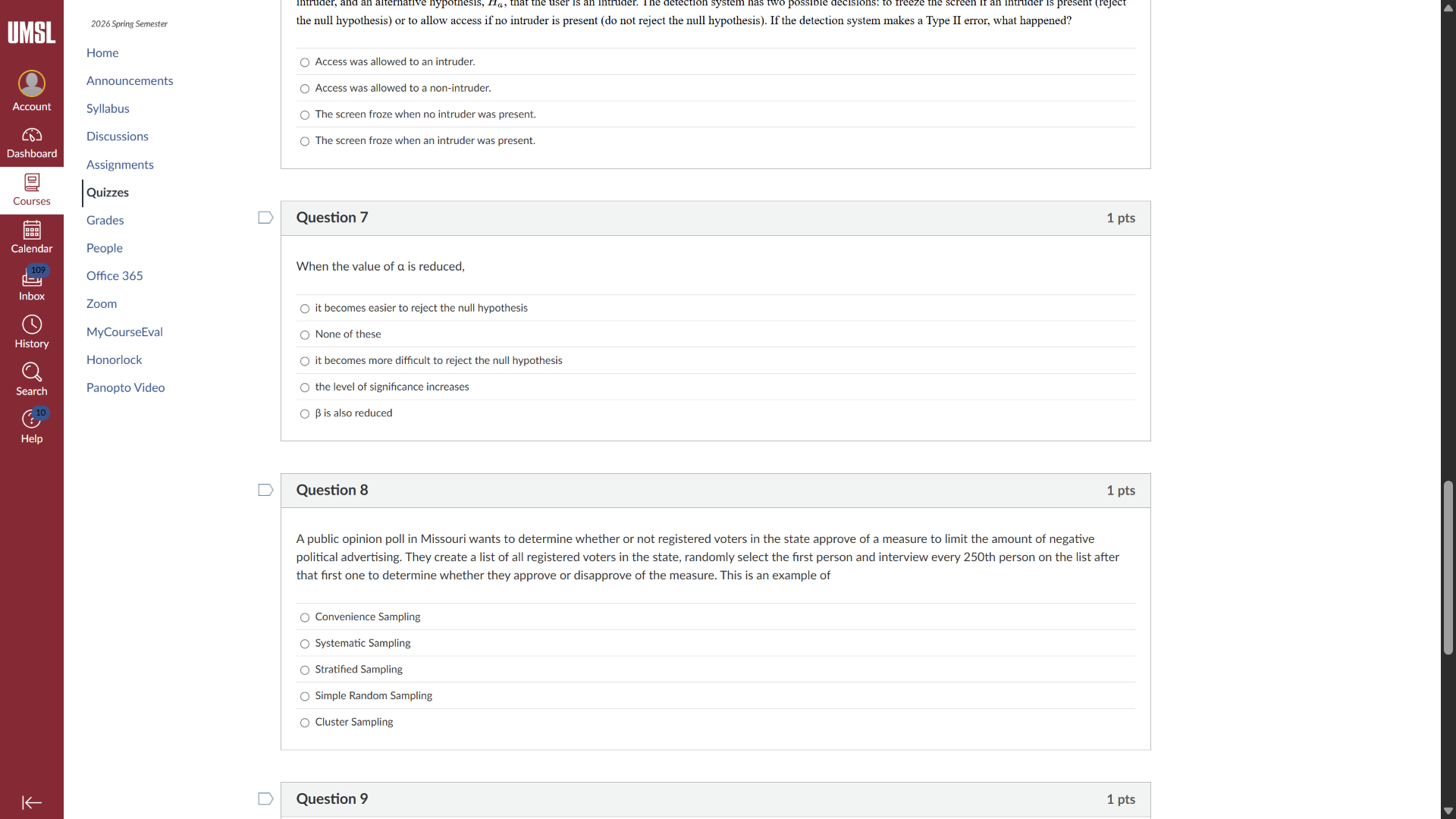
question 7
1 pts
when the value of a is reduced,
it becomes easier to reject the null hypothesis
none of these
it becomes more difficult to reject the null hypothesis
the level of significance increases
β is also reduced
question 8
1 pts
a public opinion poll in missouri wants to determine whether or not registered voters in the state approve of a measure to limit the amount of negative political advertising. they create a list of all registered voters in the state, randomly select the first person and interview every 250th person on the list after that first one to determine whether they approve or disapprove of the measure. this is an example of
convenience sampling
systematic sampling
stratified sampling
simple random sampling
cluster sampling
question 9
1 pts
Question 7
In hypothesis testing, $\alpha$ (significance level) is the probability of rejecting the null hypothesis when it's true. Reducing $\alpha$ means the rejection region becomes smaller, so it's harder to reject the null hypothesis.
- "It becomes easier to reject..." is wrong (smaller $\alpha$ makes rejection harder).
- "Level of significance increases" is wrong (reducing $\alpha$ decreases significance level).
- "$\beta$ is also reduced" is wrong (reducing $\alpha$ usually increases $\beta$).
- "None of these" is wrong as the correct effect is harder to reject. So the correct option is "it becomes more difficult to reject the null hypothesis".
- Convenience Sampling: Uses easily accessible subjects (not this case).
- Systematic Sampling: Selects every kth element from a list. Here, every 250th voter is interviewed after a random start, matching systematic sampling.
- Stratified Sampling: Divides population into strata, samples from each (not done here).
- Simple Random Sampling: Randomly selects without a pattern (not every 250th).
- Cluster Sampling: Divides into clusters, samples clusters (not done here). So the correct option is "Systematic Sampling".

Snap & solve any problem in the app
Get step-by-step solutions on Sovi AI
Photo-based solutions with guided steps
Explore more problems and detailed explanations
it becomes more difficult to reject the null hypothesis