QUESTION IMAGE
Question
question 2
0.5 pts
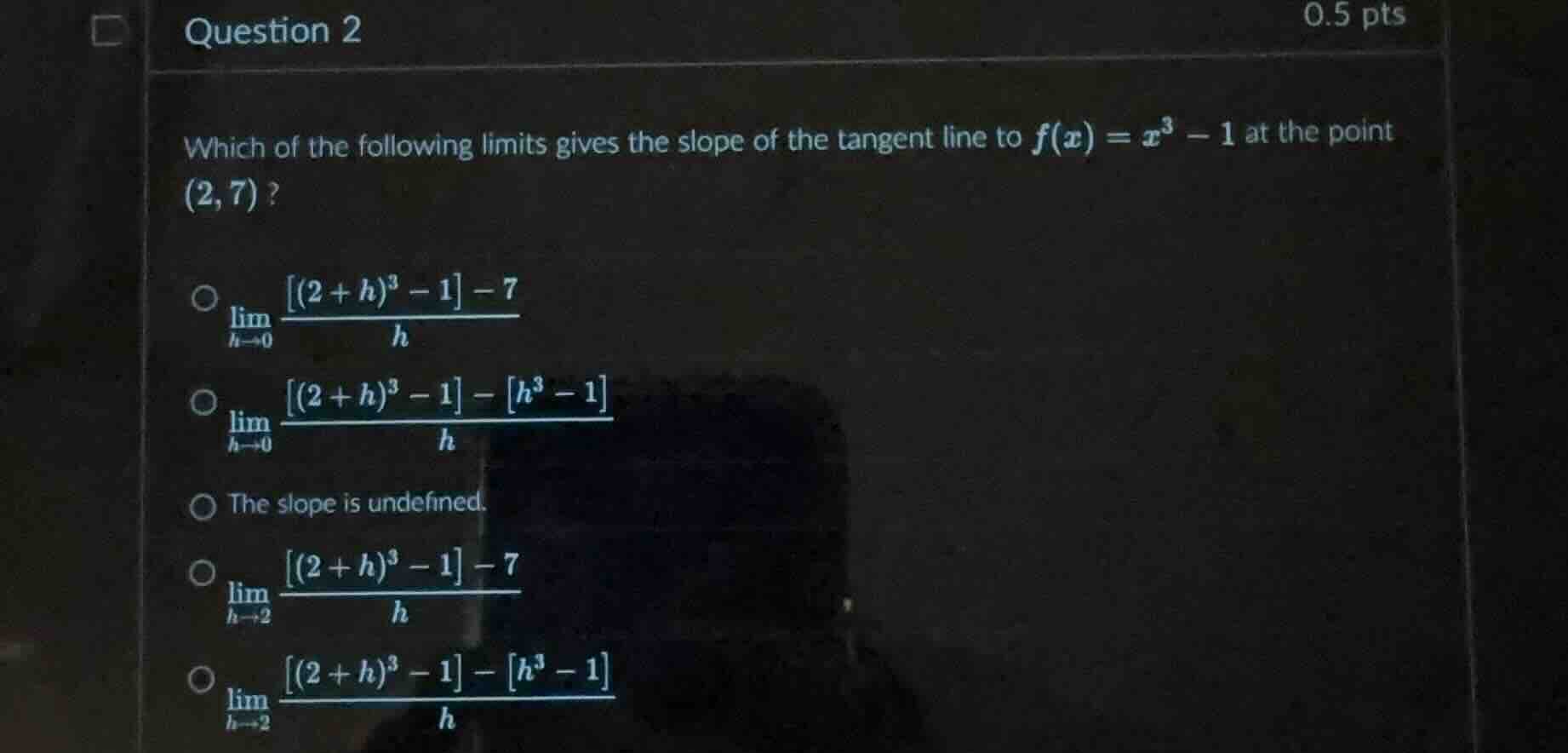
which of the following limits gives the slope of the tangent line to $f(x) = x^3 - 1$ at the point $(2, 7)$?
$\lim\limits_{h\to 0}\frac{(2 + h)^3 - 1 - 7}{h}$
$\lim\limits_{h\to 0}\frac{(2 + h)^3 - 1 - h^3 - 1}{h}$
the slope is undefined.
$\lim\limits_{h\to 2}\frac{(2 + h)^3 - 1 - 7}{h}$
$\lim\limits_{h\to 2}\frac{(2 + h)^3 - 1 - h^3 - 1}{h}$
Step1: Recall the definition of the derivative (slope of tangent)
The slope of the tangent line to a function \( f(x) \) at a point \( (a, f(a)) \) is given by the limit definition of the derivative:
\[
f'(a)=\lim_{h
ightarrow0}\frac{f(a + h)-f(a)}{h}
\]
Here, the function is \( f(x)=x^{3}-1 \), and the point is \( (2, 7) \), so \( a = 2 \) and \( f(a)=f(2)=2^{3}-1 = 8 - 1=7 \).
Step2: Substitute into the limit formula
Substitute \( a = 2 \), \( f(a)=7 \), and \( f(a + h)=f(2 + h)=(2 + h)^{3}-1 \) into the limit formula:
\[
\lim_{h
ightarrow0}\frac{[(2 + h)^{3}-1]-7}{h}
\]
We analyze the other options:
- The second option has \( f(h) \) instead of \( f(a) \), which is incorrect.
- The third option is wrong because the function \( f(x)=x^{3}-1 \) is a polynomial and differentiable everywhere, so the slope is defined.
- The fourth and fifth options have \( h
ightarrow2 \) instead of \( h
ightarrow0 \), which is incorrect for the limit definition of the derivative (we take \( h
ightarrow0 \) to make the secant line approach the tangent line).

Snap & solve any problem in the app
Get step-by-step solutions on Sovi AI
Photo-based solutions with guided steps
Explore more problems and detailed explanations
\(\boldsymbol{\lim\limits_{h\to0} \frac{[(2 + h)^{3}-1]-7}{h}}\) (the first option)