QUESTION IMAGE
Question
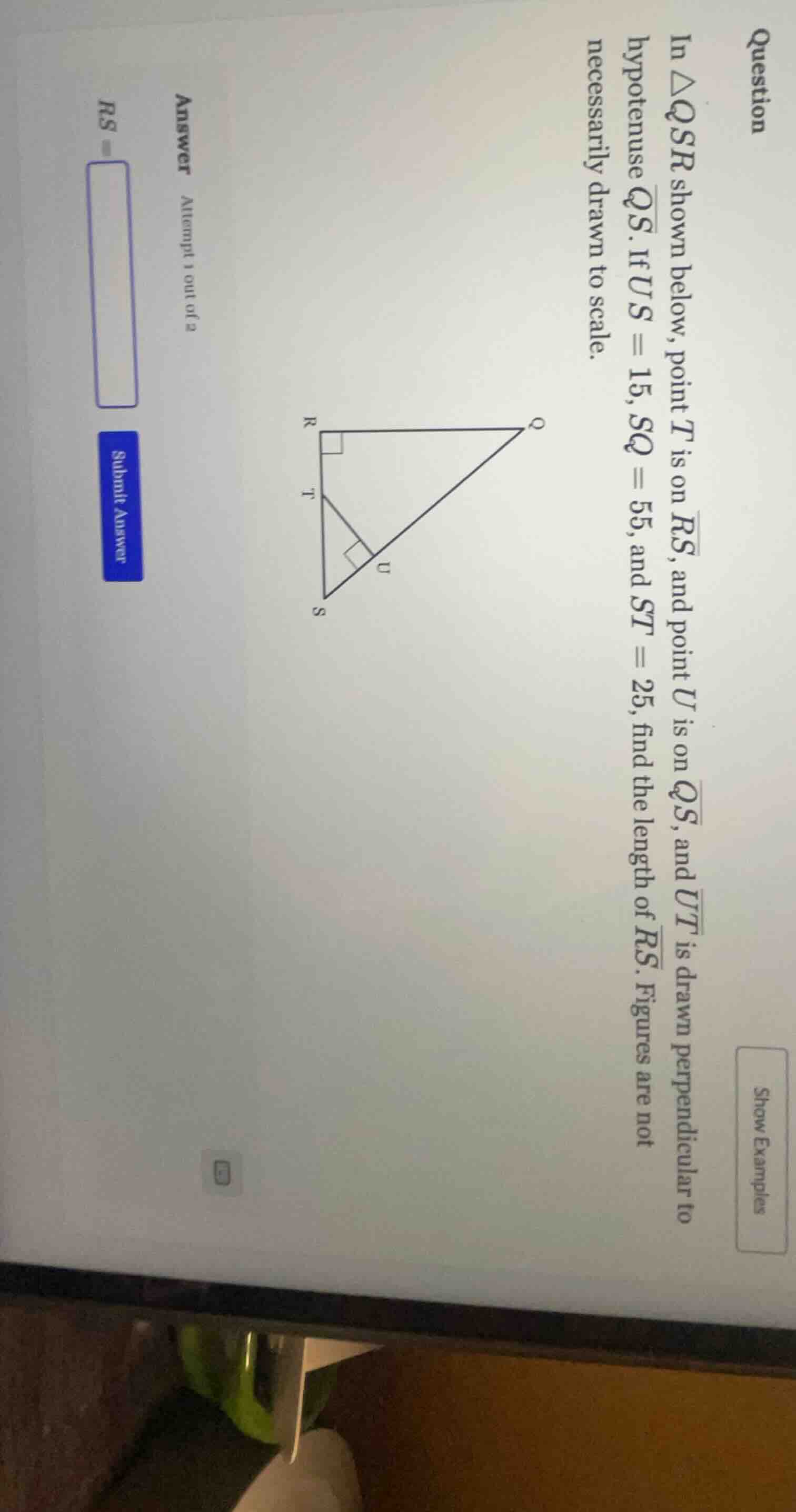
question in △qsr shown below, point t is on (overline{rs}), and point u is on (overline{qs}), and (overline{ut}) is drawn perpendicular to hypotenuse (overline{qs}). if (us = 15), (sq = 55), and (st = 25), find the length of (overline{rs}). figures are not necessarily drawn to scale.
answer attempt 1 out of 2
rs =
submit answer
show examples
Step1: Identify the geometric theorem
We can use the geometric mean (or altitude-on-hypotenuse) theorem in right triangles. In a right triangle, the length of the altitude drawn to the hypotenuse is the geometric mean of the lengths of the two segments that the hypotenuse is divided into. Also, the length of each leg of the right triangle is the geometric mean of the length of the hypotenuse and the length of the segment of the hypotenuse adjacent to that leg.
In right triangle \( \triangle QSR \) with right angle at \( R \), and \( UT \perp QS \), we have the relationship for the leg \( ST \) (wait, actually \( RS \) is a leg, \( SQ \) is the hypotenuse, and \( SU \) is a segment of the hypotenuse. Wait, let's correct:
The geometric mean theorem (also known as the altitude-on-hypotenuse theorem) states that in a right triangle, if an altitude is drawn from the right angle to the hypotenuse, then:
- \( ST^2 = SU \times SQ \) (Wait, no, actually, let's define the triangles. Let's see, \( \triangle QSR \) is right-angled at \( R \), \( \triangle STU \) is right-angled at \( U \), and \( \triangle QTR \) is right-angled at \( R \)? Wait, no, \( UT \perp QS \), so \( \angle TUS = 90^\circ \), and \( \angle R = 90^\circ \). So triangles \( \triangle SUT \) and \( \triangle SRQ \) are similar (by AA similarity, since both are right triangles and share \( \angle S \)).
So by AA similarity, \( \triangle SUT \sim \triangle SRQ \). Therefore, the ratios of corresponding sides are equal.
So \( \frac{ST}{SQ} = \frac{SU}{SR} \)? Wait, no, let's list the angles:
In \( \triangle SUT \) and \( \triangle SRQ \):
- \( \angle S \) is common.
- \( \angle SUT = \angle SRQ = 90^\circ \).
Therefore, \( \triangle SUT \sim \triangle SRQ \) (AA similarity).
Therefore, the ratio of corresponding sides: \( \frac{ST}{SQ} = \frac{SU}{SR} \)? Wait, no, let's check the correspondence.
\( \triangle SUT \): right angle at \( U \), angle \( S \) common.
\( \triangle SRQ \): right angle at \( R \), angle \( S \) common.
So the correspondence is \( S \to S \), \( U \to R \), \( T \to Q \).
Therefore, \( \frac{ST}{SQ} = \frac{SU}{SR} = \frac{UT}{RQ} \).
We know \( SU = 15 \)? Wait, no, the problem says \( US = 15 \)? Wait, the problem states: \( US = 15 \), \( SQ = 55 \), \( ST = 25 \). Wait, no, the problem says: "If \( US = 15 \), \( SQ = 55 \), and \( ST = 25 \), find the length of \( RS \)". Wait, let's re-express the given:
Given:
- \( US = 15 \) (segment of hypotenuse \( SQ \), from \( U \) to \( S \))
- \( SQ = 55 \) (hypotenuse of \( \triangle QSR \))
- \( ST = 25 \) (leg of \( \triangle STU \))
Wait, no, actually, the geometric mean theorem for the leg: In a right triangle, the square of a leg is equal to the product of the hypotenuse and the adjacent segment. Wait, the correct formula from the geometric mean theorem is:
In right triangle \( \triangle ABC \) with right angle at \( C \), and altitude \( CD \) to hypotenuse \( AB \), then:
\( AC^2 = AD \times AB \)
\( BC^2 = BD \times AB \)
\( CD^2 = AD \times BD \)
So in our case, \( \triangle QSR \) is right-angled at \( R \), and \( UT \) is an altitude to hypotenuse \( SQ \)? Wait, no, \( UT \) is perpendicular to \( SQ \), but \( R \) is the right angle. Wait, maybe \( RT \) is not the altitude, but \( UT \) is perpendicular to \( SQ \). Wait, maybe I made a mistake. Let's re-express the problem:
We have right triangle \( QSR \) with \( \angle R = 90^\circ \), hypotenuse \( QS = 55 \). Point \( U \) is on \( QS \), \( UT \perp QS \), point \( T \) is on \( RS \). So \( \triangle STU…

Snap & solve any problem in the app
Get step-by-step solutions on Sovi AI
Photo-based solutions with guided steps
Explore more problems and detailed explanations
\( \boxed{33} \)