QUESTION IMAGE
Question
question 4
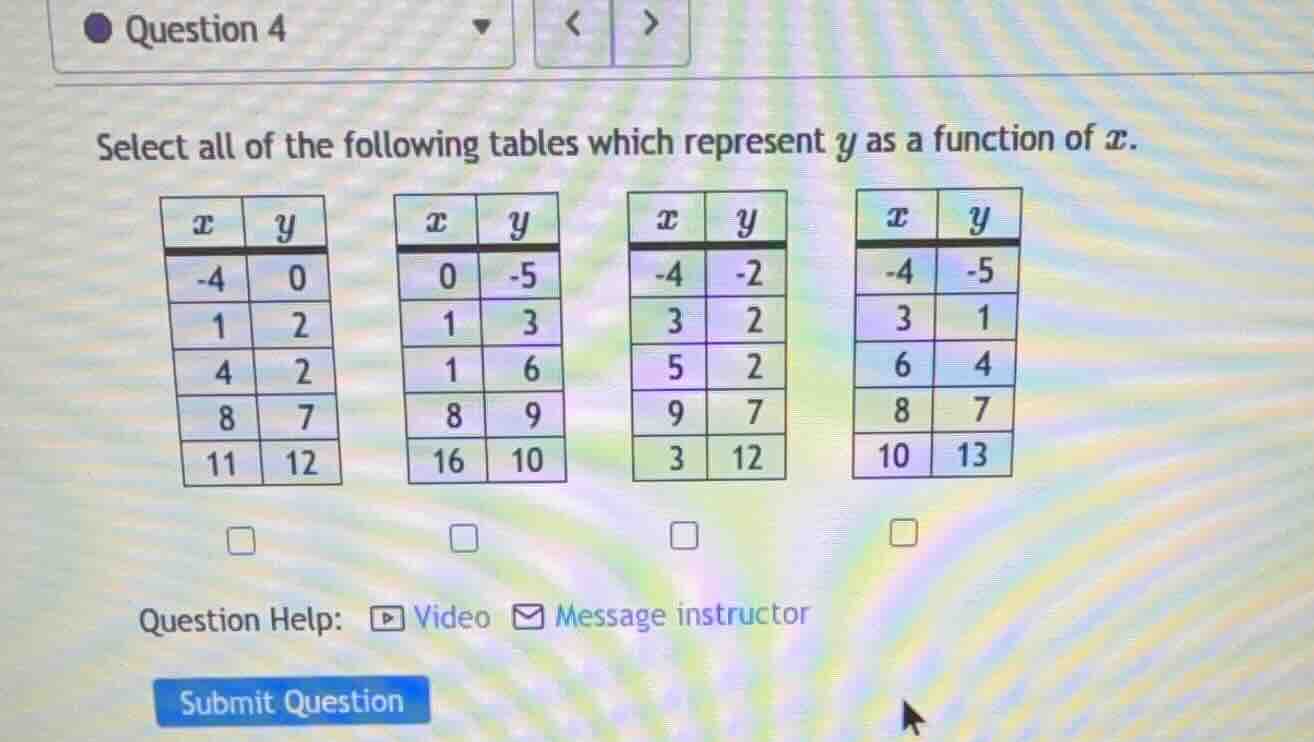
select all of the following tables which represent y as a function of x.
| x | y | x | y | x | y | x | y | |||
| -4 | 0 | 0 | -5 | -4 | -2 | -4 | -5 | |||
| 1 | 2 | 1 | 3 | 3 | 2 | 3 | 1 | |||
| 4 | 2 | 1 | 6 | 5 | 2 | 6 | 4 | |||
| 8 | 7 | 8 | 9 | 9 | 7 | 8 | 7 | |||
| 11 | 12 | 16 | 10 | 3 | 12 | 10 | 13 |
question help: video message instructor
submit question
To determine if a table represents \( y \) as a function of \( x \), we use the definition of a function: for every input \( x \), there is exactly one output \( y \). In other words, no two \( y \)-values can correspond to the same \( x \)-value.
Step 1: Analyze the first table
| \( x \) | \( y \) |
|---|---|
| 1 | 2 |
| 4 | 2 |
| 8 | 7 |
| 11 | 12 |
Check for repeated \( x \)-values: All \( x \)-values (-4, 1, 4, 8, 11) are unique. So, each \( x \) has exactly one \( y \). This is a function.
Step 2: Analyze the second table
| \( x \) | \( y \) |
|---|---|
| 1 | 3 |
| 1 | 6 |
| 8 | 9 |
| 16 | 10 |
Check for repeated \( x \)-values: The \( x \)-value 1 appears twice, with \( y \)-values 3 and 6. Since one \( x \) has two different \( y \)-values, this is not a function.
Step 3: Analyze the third table
| \( x \) | \( y \) |
|---|---|
| 3 | 2 |
| 5 | 2 |
| 9 | 7 |
| 3 | 12 |
Check for repeated \( x \)-values: The \( x \)-value 3 appears twice, with \( y \)-values 2 and 12. Since one \( x \) has two different \( y \)-values, this is not a function.
Step 4: Analyze the fourth table
| \( x \) | \( y \) |
|---|---|
| 3 | 1 |
| 6 | 4 |
| 8 | 7 |
| 10 | 13 |
Check for repeated \( x \)-values: All \( x \)-values (-4, 3, 6, 8, 10) are unique. So, each \( x \) has exactly one \( y \). This is a function.

Snap & solve any problem in the app
Get step-by-step solutions on Sovi AI
Photo-based solutions with guided steps
Explore more problems and detailed explanations
The first table (with \( x \)-values -4, 1, 4, 8, 11) and the fourth table (with \( x \)-values -4, 3, 6, 8, 10) represent \( y \) as a function of \( x \). So, the selected tables are the first and the fourth ones (the first checkbox and the fourth checkbox should be marked).