QUESTION IMAGE
Question
question
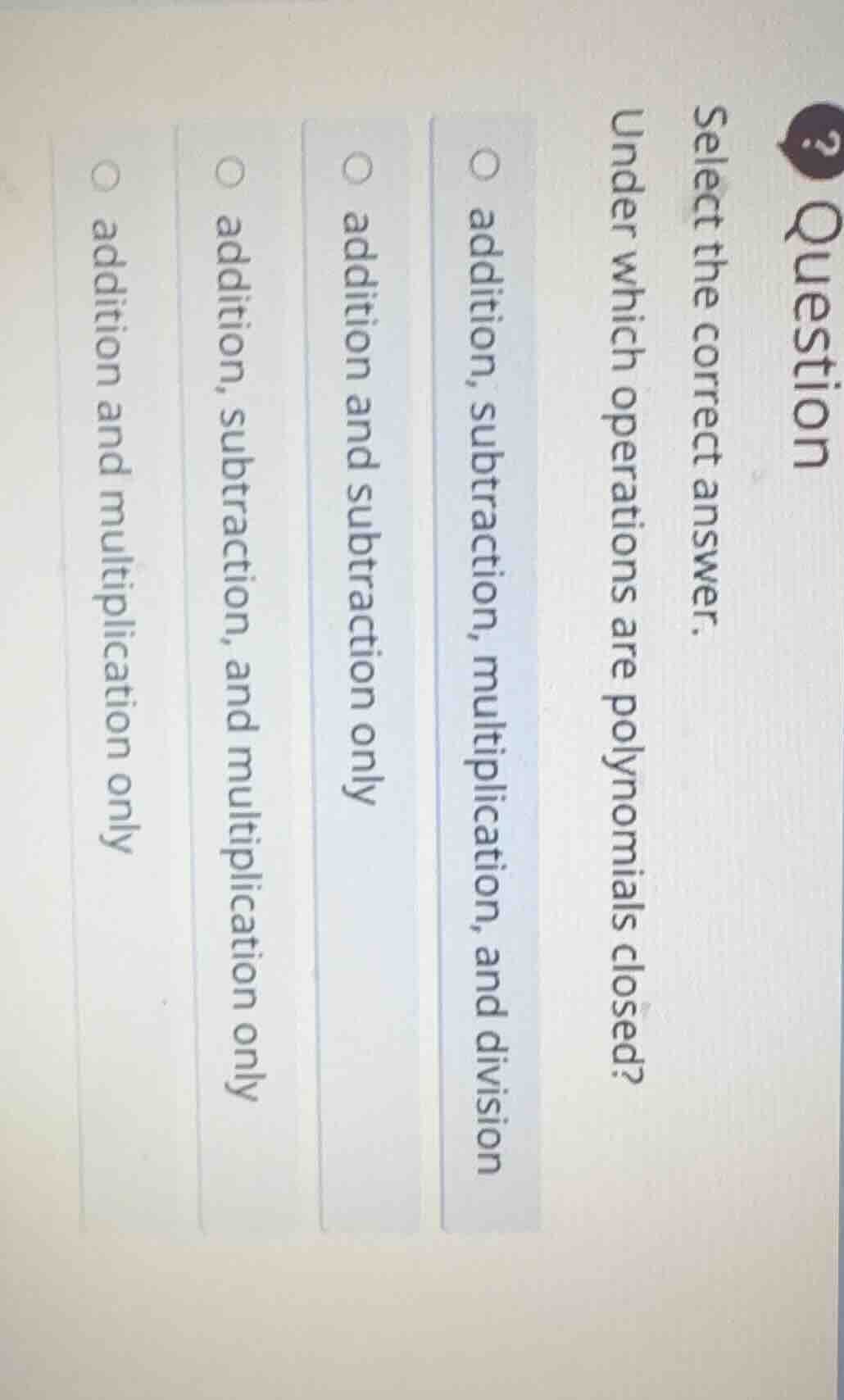
select the correct answer.
under which operations are polynomials closed?
○ addition, subtraction, multiplication, and division
○ addition and subtraction only
○ addition, subtraction, and multiplication only
○ addition and multiplication only
Step1: Recall the closure property of polynomials
A set is closed under an operation if performing the operation on two elements of the set results in another element of the same set. For polynomials:
- Addition: If we add two polynomials \(a(x)\) and \(b(x)\), the result \(a(x)+b(x)\) is also a polynomial. For example, \((x + 1)+(x^2-2)=x^2+x - 1\), which is a polynomial.
- Subtraction: If we subtract two polynomials \(a(x)-b(x)\), the result is also a polynomial. For example, \((x^2 + 2x+1)-(x + 1)=x^2+x\), which is a polynomial.
- Multiplication: If we multiply two polynomials \(a(x)\) and \(b(x)\), the result \(a(x)\times b(x)\) is also a polynomial. For example, \((x + 1)(x - 1)=x^2-1\), which is a polynomial.
- Division: Polynomials are not closed under division. For example, if we divide the polynomial \(x\) by the polynomial \(x + 1\), we get \(\frac{x}{x + 1}\), which is a rational function, not a polynomial.
So polynomials are closed under addition, subtraction, and multiplication only.

Snap & solve any problem in the app
Get step-by-step solutions on Sovi AI
Photo-based solutions with guided steps
Explore more problems and detailed explanations
addition, subtraction, and multiplication only (the third option from the left, with the text "addition, subtraction, and multiplication only")