QUESTION IMAGE
Question
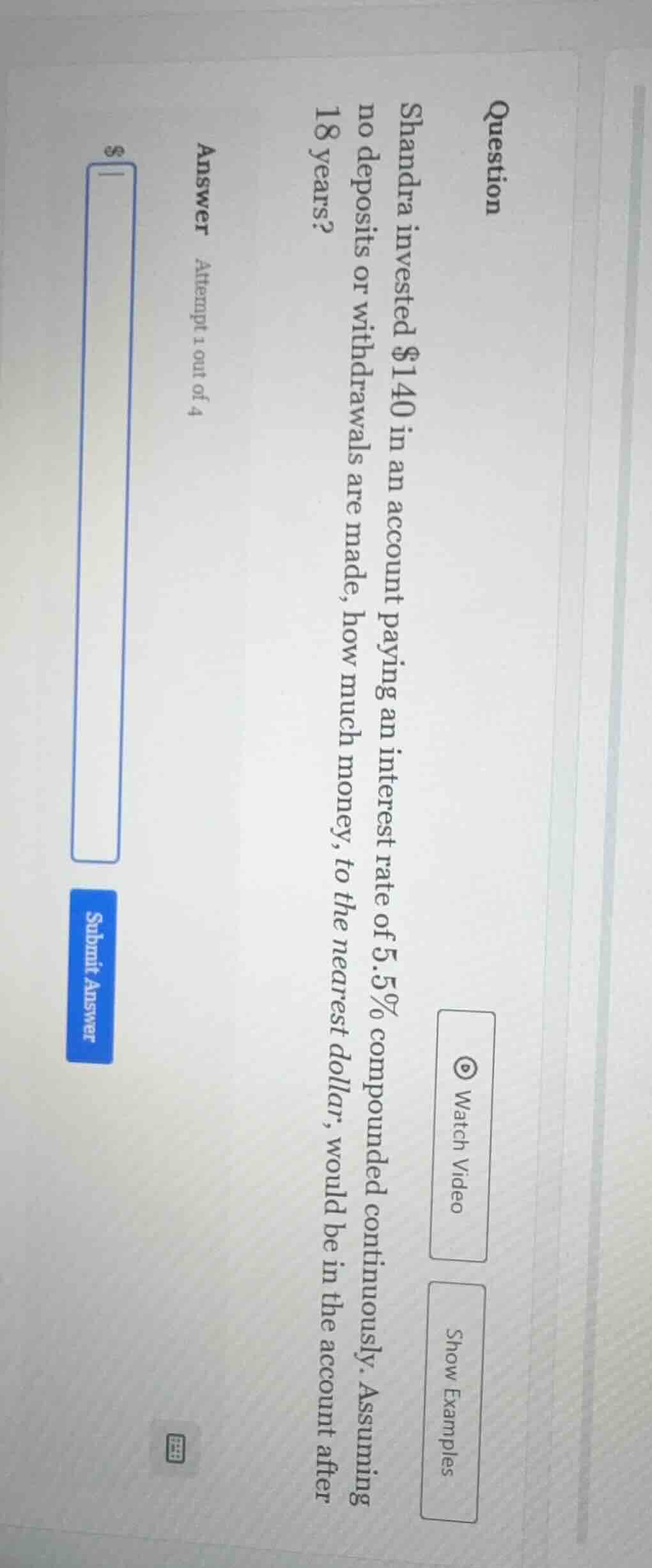
question shandra invested $140 in an account paying an interest rate of 5.5% compounded continuously. assuming no deposits or withdrawals are made, how much money, to the nearest dollar, would be in the account after 18 years? answer attempt 1 out of 4 $ submit answer watch video show examples
Step1: Recall the formula for continuous compounding
The formula for continuous compounding is $A = Pe^{rt}$, where $P$ is the principal amount, $r$ is the annual interest rate (in decimal), $t$ is the time in years, and $e$ is the base of the natural logarithm (approximately 2.71828).
Here, $P = 140$, $r = 0.055$ (since 5.5% = 0.055), and $t = 18$.
Step2: Substitute the values into the formula
Substitute $P = 140$, $r = 0.055$, and $t = 18$ into the formula $A = Pe^{rt}$:
$A = 140 \times e^{(0.055 \times 18)}$
Step3: Calculate the exponent
First, calculate the exponent: $0.055 \times 18 = 0.99$
Step4: Calculate $e^{0.99}$
Using a calculator, $e^{0.99} \approx 2.6915$
Step5: Calculate the final amount
Multiply 140 by 2.6915: $A = 140 \times 2.6915 \approx 376.81$

Snap & solve any problem in the app
Get step-by-step solutions on Sovi AI
Photo-based solutions with guided steps
Explore more problems and detailed explanations
377 (rounded to the nearest dollar)