QUESTION IMAGE
Question
question
show examples
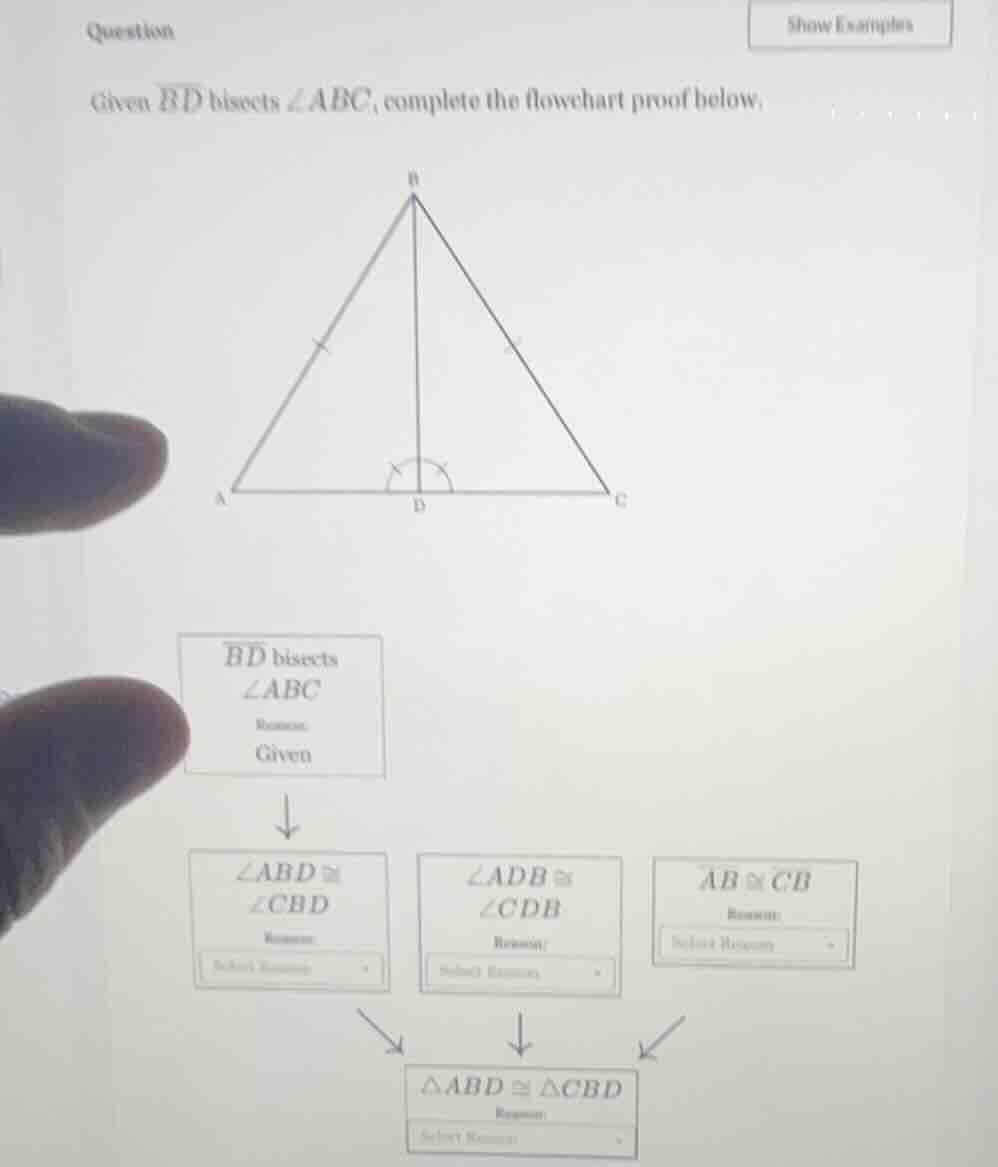
given (overline{bd}) bisects (angle abc), complete the flowchart proof below.
(overline{bd}) bisects (angle abc)
reason:
given
(angle abd cong angle cbd)
reason:
select reason
(angle adb cong angle cdb)
reason:
select reason
(overline{ab} cong overline{cb})
reason:
select reason
(\triangle abd cong \triangle cbd)
reason:
select reason
Step1: Reason for ∠ABD ≅ ∠CBD
A bisector of an angle divides the angle into two congruent angles. Since \( \overline{BD} \) bisects \( \angle ABC \), by the definition of angle bisector, \( \angle ABD \cong \angle CBD \).
Step2: Reason for ∠ADB ≅ ∠CDB
From the diagram, \( \angle ADB \) and \( \angle CDB \) are right angles (they form a linear pair and are equal, so each is \( 90^\circ \)) or we can see that \( BD \perp AC \) (implied by the diagram with the right angle symbol). So, by the definition of perpendicular lines, they form congruent right angles, hence \( \angle ADB \cong \angle CDB \) (all right angles are congruent, or by the definition of perpendicular lines creating congruent angles).
Step3: Reason for \( \overline{AB} \cong \overline{CB} \)
From the diagram, the sides \( AB \) and \( CB \) have tick marks, which indicate that they are congruent. So, by the definition of congruent segments (or the tick mark notation meaning congruent sides), \( \overline{AB} \cong \overline{CB} \).
Step4: Reason for \( \triangle ABD \cong \triangle CBD \)
We have \( \angle ABD \cong \angle CBD \) (from step 1), \( \overline{BD} \cong \overline{BD} \) (common side, reflexive property), and \( \angle ADB \cong \angle CDB \) (from step 2). So, by the ASA (Angle - Side - Angle) congruence criterion, \( \triangle ABD \cong \triangle CBD \). Or, if we use the sides \( AB \cong CB \), \( \angle ABD \cong \angle CBD \), and \( BD \cong BD \), it could also be SAS (Side - Angle - Side). But with the right angles, ASA is more direct here.

Snap & solve any problem in the app
Get step-by-step solutions on Sovi AI
Photo-based solutions with guided steps
Explore more problems and detailed explanations
- \( \angle ABD \cong \angle CBD \): Definition of Angle Bisector
- \( \angle ADB \cong \angle CDB \): All Right Angles are Congruent (or Definition of Perpendicular Lines)
- \( \overline{AB} \cong \overline{CB} \): Definition of Congruent Segments (Tick Mark Notation)
- \( \triangle ABD \cong \triangle CBD \): ASA (Angle - Side - Angle) Congruence Criterion (or SAS depending on the order of sides/angles)