QUESTION IMAGE
Question
question 1
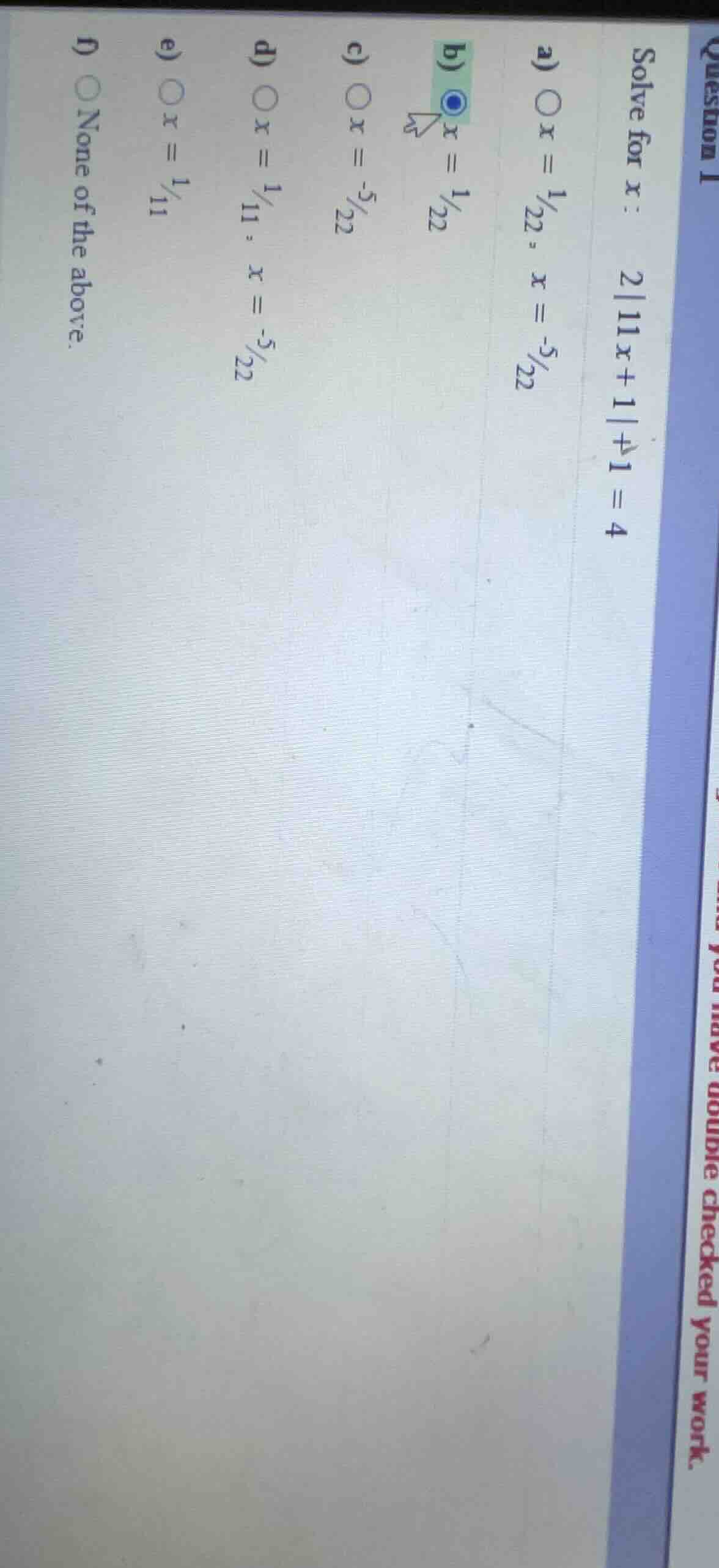
solve for x: ( 2|11x + 1| + 1 = 4 )
a) ( circ x = \frac{1}{22}, x = -\frac{5}{22} )
b) ( \bullet x = \frac{1}{22} )
c) ( circ x = -\frac{5}{22} )
d) ( circ x = \frac{1}{11}, x = -\frac{5}{22} )
e) ( circ x = \frac{1}{11} )
f) ( circ ) none of the above.
Step1: Isolate the absolute value
Start with the equation \( 2|11x + 1| + 41 = 4 \). Subtract 41 from both sides:
\( 2|11x + 1| = 4 - 41 \)
\( 2|11x + 1| = -37 \)
Step2: Analyze the absolute value equation
The absolute value of a number is always non - negative (i.e., \( |a| \geq 0 \) for any real number \( a \)). So, \( 2|11x + 1| \) is also non - negative because it is 2 times a non - negative number. But we have \( 2|11x + 1|=-37 \), and the right - hand side is negative. There is no real number \( x \) that can satisfy this equation.
Step3: Check the options
Since there is no solution for \( x \) among the given options (a to e), the correct option is the one that says "None of the above".

Snap & solve any problem in the app
Get step-by-step solutions on Sovi AI
Photo-based solutions with guided steps
Explore more problems and detailed explanations
f) None of the above (Note: In the original problem, the option is labeled as f? No, in the given problem the last option is "f) None of the above"? Wait, in the user's problem, the last option is "f) None of the above"? Wait, in the provided image, the last option is "f) None of the above"? Wait, the user's problem shows the options as a) to f)? Wait, in the user's problem, the options are a) \( x=\frac{1}{22},x =-\frac{5}{22} \), b) \( x=\frac{1}{22} \), c) \( x =-\frac{5}{22} \), d) \( x=\frac{1}{11},x =-\frac{5}{22} \), e) \( x=\frac{1}{11} \), f) None of the above? Wait, in the user's problem, the last option is "f) None of the above"? Wait, the user's problem as presented has options a) to f) (the last one is "None of the above"). Since our analysis shows that there is no solution among a - e, the correct option is: