QUESTION IMAGE
Question
question
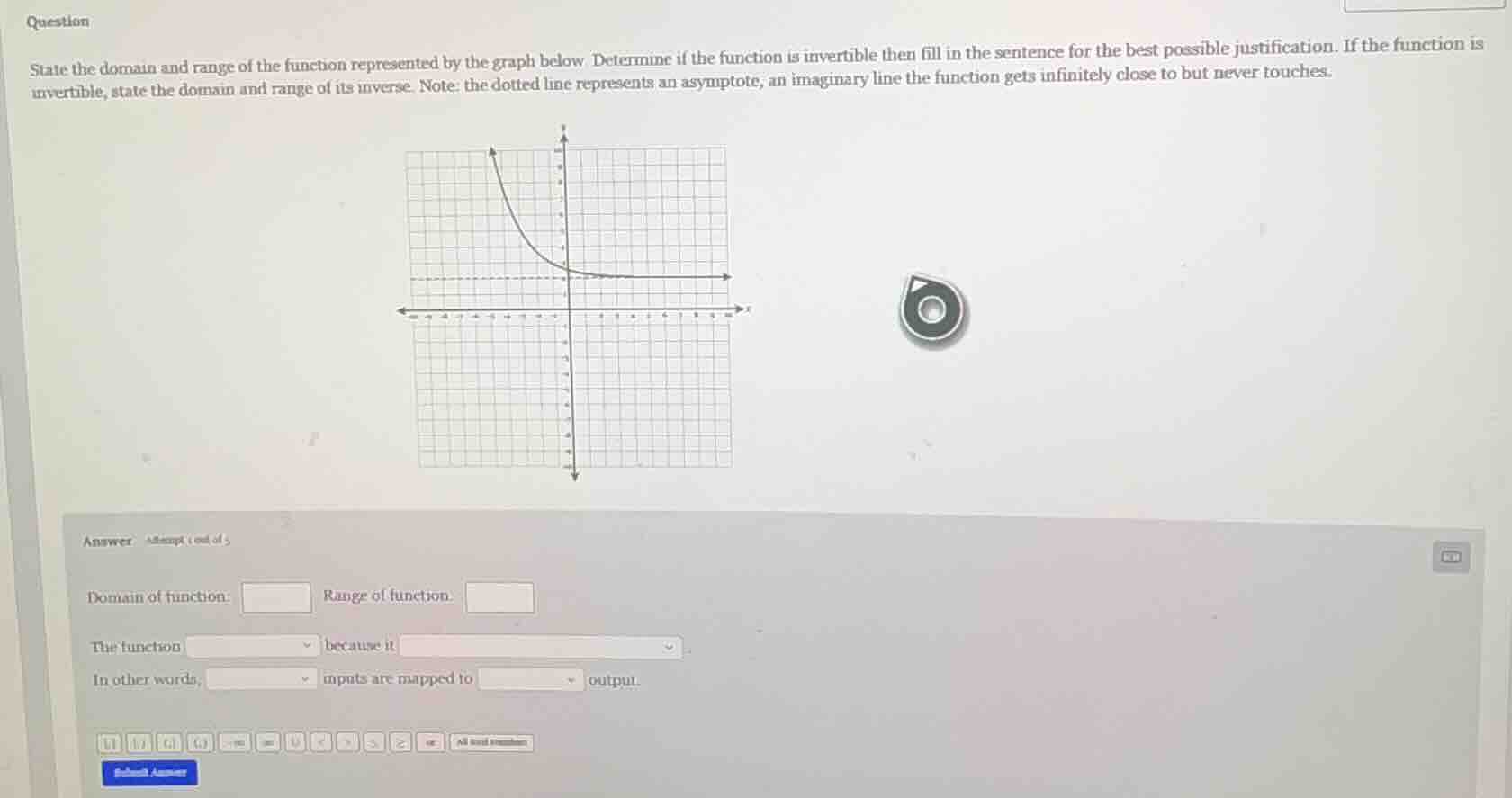
state the domain and range of the function represented by the graph below determine if the function is invertible then fill in the sentence for the best possible justification. if the function is invertible, state the domain and range of its inverse. note: the dotted line represents an asymptote, an imaginary line the function gets infinitely close to but never touches.
answer attempt 1 out of 3
domain of function:
range of function:
the function
because it
in other words,
inputs are mapped to
output.
1 1 (1) (1) -∞ ∞ (1) < > ≤ ≥ or all real numbers
submit answer
Step1: Analyze the graph's domain
The graph is a curve (likely an exponential or similar function) that extends to the left and right, but looking at the x - values. Since there's no break in the x - direction (the function is defined for all real x - values? Wait, no, wait. Wait, the graph: let's see, the curve is on the left (negative x) and positive x? Wait, no, the graph as drawn: the vertical asymptote? Wait, no, the dotted line is a horizontal asymptote. Wait, the domain of a function is all the x - values for which the function is defined. Looking at the graph, the function seems to be defined for all real numbers? Wait, no, maybe it's a function like \(y = a^{-x}+k\). Wait, the horizontal asymptote is at some y - value. Let's assume the horizontal asymptote is \(y = 1\) (from the graph, the dotted line is at y = 1 maybe). Wait, the domain: for the function, the x - values. If the graph is a function that has no restrictions on x (like exponential functions \(y = e^{-x}+1\) or similar), the domain is all real numbers. So Domain of function: All real numbers (or \((-\infty,\infty)\)).
Step2: Analyze the graph's range
The range is the set of y - values. The horizontal asymptote is at \(y = 1\) (the dotted line), and the function is above the asymptote? Wait, no, looking at the graph, the curve is decreasing towards the asymptote. Wait, if the asymptote is \(y = 1\), and the function values are greater than 1? Wait, no, maybe the asymptote is \(y = 1\) and the function is \(y = (\frac{1}{2})^{-x}+1\)? No, wait, the graph: when x approaches \(-\infty\), the function goes up, and as x approaches \(\infty\), it approaches the asymptote. So the range: the y - values are greater than the asymptote value? Wait, no, let's see the graph. The dotted line is a horizontal asymptote, so the function gets infinitely close to it but never touches. If the asymptote is \(y = 1\), and the function is above \(y = 1\) (since as x decreases, y increases), then the range is \(y>1\) (or \((1,\infty)\)).
Step3: Determine if the function is invertible
A function is invertible if it is one - to - one (passes the horizontal line test). Let's check the horizontal line test: any horizontal line should intersect the graph at most once. Since the function is decreasing (from the graph, it's a curve that is decreasing as x increases), so it passes the horizontal line test. So the function is invertible. The reason is that it passes the horizontal line test (each y - value corresponds to exactly one x - value). In other words, distinct inputs are mapped to distinct outputs (one - to - one).
Step4: Domain and range of the inverse function
For an invertible function, the domain of the inverse function is the range of the original function, and the range of the inverse function is the domain of the original function. So Domain of inverse: Range of original function, which is \(y>1\) (or \((1,\infty)\)). Range of inverse: Domain of original function, which is all real numbers (or \((-\infty,\infty)\)).

Snap & solve any problem in the app
Get step-by-step solutions on Sovi AI
Photo-based solutions with guided steps
Explore more problems and detailed explanations
Domain of function: All real numbers (or \((-\infty,\infty)\))
Range of function: \(y > 1\) (or \((1,\infty)\))
The function is invertible because it passes the horizontal line test.
In other words, distinct inputs are mapped to distinct outputs.
Domain of inverse: \(y > 1\) (or \((1,\infty)\))
Range of inverse: All real numbers (or \((-\infty,\infty)\))