QUESTION IMAGE
Question
question
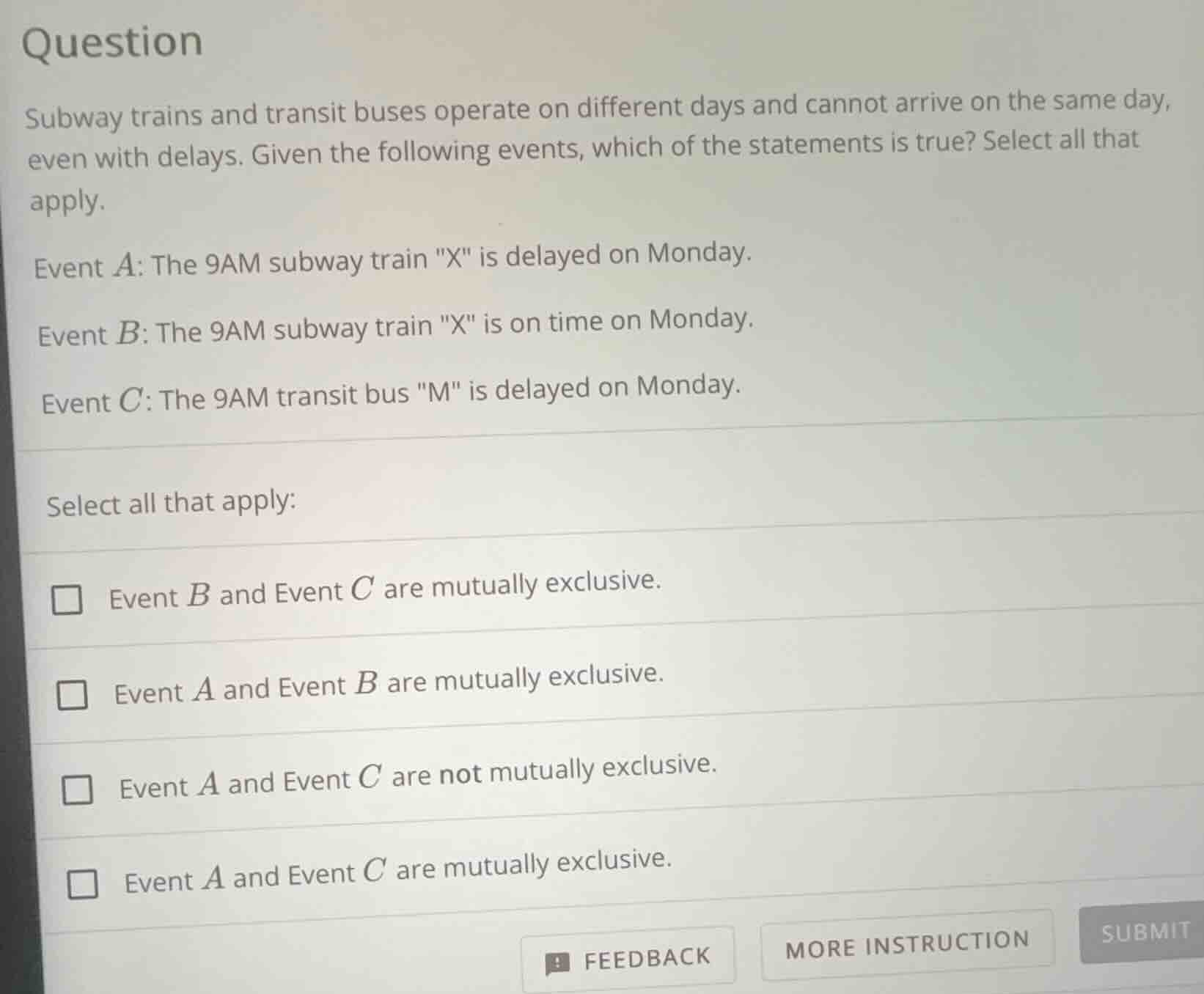
subway trains and transit buses operate on different days and cannot arrive on the same day,
even with delays. given the following events, which of the statements is true? select all that
apply.
event ( a ): the 9am subway train \x\ is delayed on monday.
event ( b ): the 9am subway train \x\ is on time on monday.
event ( c ): the 9am transit bus \m\ is delayed on monday.
select all that apply:
(square) event ( b ) and event ( c ) are mutually exclusive.
(square) event ( a ) and event ( b ) are mutually exclusive.
(square) event ( a ) and event ( c ) are not mutually exclusive.
(square) event ( a ) and event ( c ) are mutually exclusive.
To determine if events are mutually exclusive, we check if they can occur at the same time.
Step 1: Analyze Event A and Event B
Event A: Subway delayed on Monday.
Event B: Subway on time on Monday.
A subway can't be both delayed and on time at the same time. So, \( A \) and \( B \) are mutually exclusive.
Step 2: Analyze Event B and Event C
Event B: Subway on time (Monday).
Event C: Bus delayed (Monday).
The problem states subway and bus operate on different days, so they can't occur on the same day. Thus, \( B \) and \( C \) are mutually exclusive.
Step 3: Analyze Event A and Event C
Event A: Subway delayed (Monday).
Event C: Bus delayed (Monday).
But the problem says they operate on different days, so they can't happen on the same day. Wait, no—wait, the initial statement: "Subway trains and transit buses operate on different days and cannot arrive on the same day, even with delays." Wait, no, maybe misread. Wait, "operate on different days"—so subway on Monday, bus on a different day? Wait, no, the events: Event A is subway Monday, Event C is bus Monday. But the problem says they can't arrive on the same day. Wait, that must mean subway and bus are on different days, so Event A (subway Monday) and Event C (bus Monday) can't happen because they are on the same day? Wait, no, the problem says "operate on different days and cannot arrive on the same day"—so subway is on, say, Monday, bus on Tuesday? But the events have both on Monday. Wait, maybe the problem means that subway and bus are scheduled on different days, so their operations (including delays) can't be on the same day. So Event A (subway Monday) and Event C (bus Monday) would be impossible to both occur, but wait, no—maybe the key is: for mutually exclusive, can they happen at the same time?
Wait, Event A: subway delayed Monday. Event C: bus delayed Monday. But the problem says subway and bus can't arrive on the same day (even with delays). So that means subway and bus are on different days, so Event A (subway Monday) and Event C (bus Monday) can't occur together. But wait, maybe the problem's "operate on different days" means their schedules are on different days, so subway is, say, Monday, bus is Tuesday. So Event A (subway Monday) and Event C (bus Monday) would be impossible, but that can't be. Wait, maybe I misread. Let's re-express:
The problem says: "Subway trains and transit buses operate on different days and cannot arrive on the same day, even with delays." So, subway and bus are on different days (e.g., subway Monday, bus Tuesday). Therefore, any event involving subway on Monday and bus on Monday is impossible, but the events have both on Monday. Wait, maybe the problem has a typo, but assuming the events are as stated:
Wait, no—maybe the "different days" is about their operation days (subway on day X, bus on day Y, X≠Y), so Event A (subway Monday) and Event C (bus Monday) can't happen because Monday is the same day, but according to the problem, they can't be on the same day. Wait, this is confusing. Wait, no—let's re-express:
Mutually exclusive: \( P(A \cap C) = 0 \).
But the problem says "Subway trains and transit buses operate on different days and cannot arrive on the same day, even with delays." So that means subway and bus are on different days, so Event A (subway Monday) and Event C (bus Monday) can't occur together because they are on the same day, which is not allowed. Wait, but that would mean \( A \) and \( C \) are mutually exclusive? But that contradicts the option. Wait, no—maybe the problem's "different days" is that subway is on,…

Snap & solve any problem in the app
Get step-by-step solutions on Sovi AI
Photo-based solutions with guided steps
Explore more problems and detailed explanations
- Event B and Event C are mutually exclusive.
- Event A and Event B are mutually exclusive.
- Event A and Event C are not mutually exclusive.