QUESTION IMAGE
Question
question
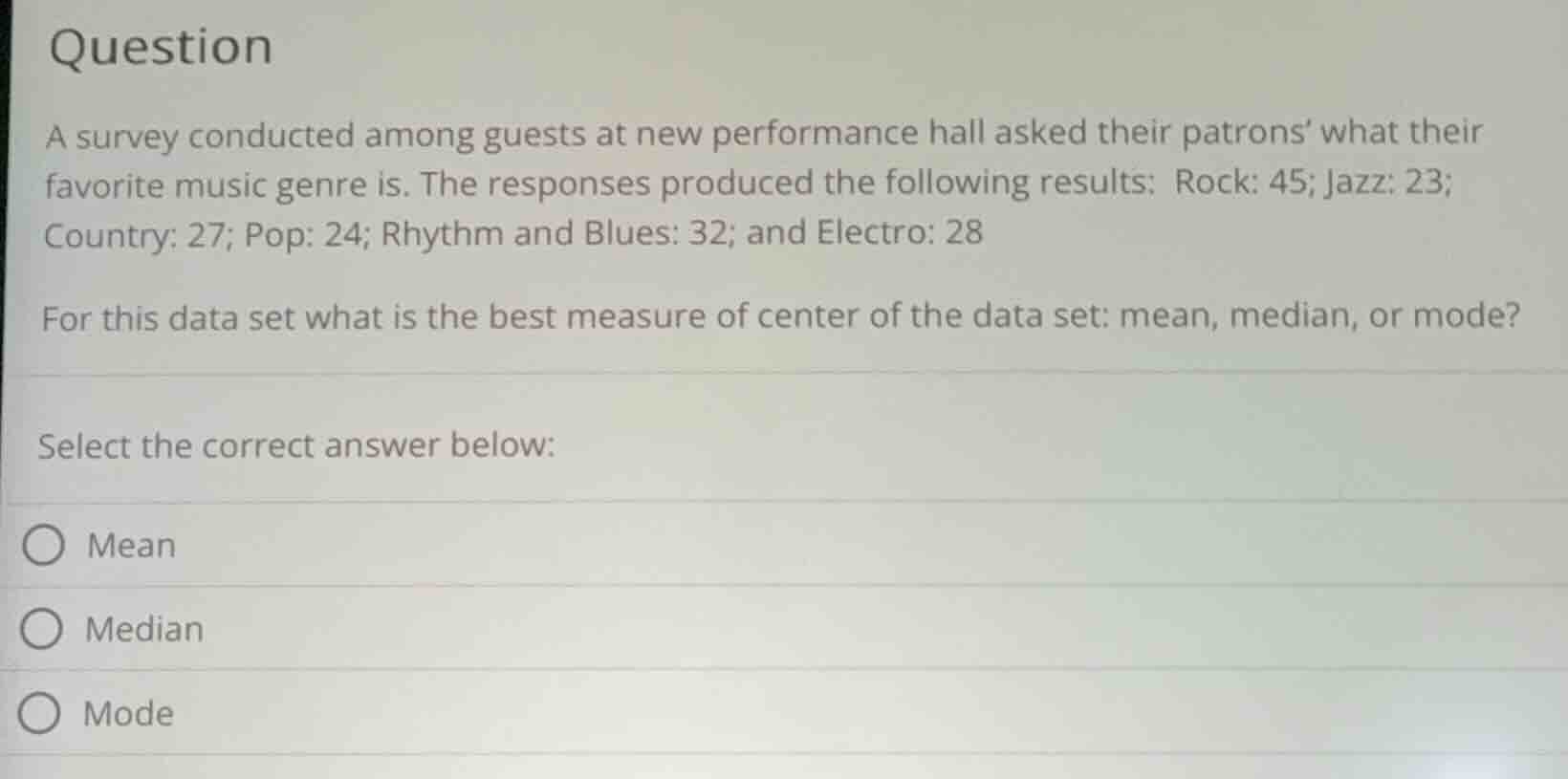
a survey conducted among guests at new performance hall asked their patrons’ what their favorite music genre is. the responses produced the following results: rock: 45; jazz: 23; country: 27; pop: 24; rhythm and blues: 32; and electro: 28
for this data set what is the best measure of center of the data set: mean, median, or mode?
select the correct answer below:
○ mean
○ median
○ mode
Step1: Analyze the data type
The data here represents the frequency of different music genres (Rock: 45, Jazz: 23, Country: 27, Pop: 24, Rhythm and Blues: 32, Electro: 28). Each value is a count of patrons favoring a genre.
Step2: Recall measures of center
- Mean: Requires numerical data with a meaningful average (e.g., continuous data like heights, weights). Here, the "values" are frequencies of categories, not numerical values with a natural average (e.g., averaging the number of people who like different genres doesn't make sense in terms of a "center" for the genre preferences).
- Median: Also for ordered numerical data. But the genres are categorical, and the frequencies are counts. However, if we order the frequencies: 23 (Jazz), 24 (Pop), 27 (Country), 28 (Electro), 32 (Rhythm and Blues), 45 (Rock). The median would be the average of the 3rd and 4th values: \(\frac{27 + 28}{2}=27.5\). But is this a good measure? Wait, no—wait, actually, the data is about counts of categorical responses. Wait, no, the question is about the "center" of the data set of frequencies. Wait, maybe I misread. The data set is the frequencies: 45, 23, 27, 24, 32, 28. These are numerical values (counts). So we can consider mean, median, mode for these numbers.
Wait, let's re-express: the data points are the frequencies: 23, 24, 27, 28, 32, 45.
- Mode: The most frequent value. But in this case, all frequencies are unique (45,23,27,24,32,28—no repeats), so mode doesn't exist (or all are modes, which isn't useful).
- Mean: Sum of frequencies divided by number of genres. Sum = 23 + 24 + 27 + 28 + 32 + 45 = 179. Number of genres = 6. Mean = \( \frac{179}{6} \approx 29.83 \).
- Median: Order the data: 23, 24, 27, 28, 32, 45. There are 6 values, so median is average of 3rd and 4th: \( \frac{27 + 28}{2} = 27.5 \).
But wait, the question is about the "best measure of center" for this data set (the frequencies of genre preferences). Wait, but actually, the data is about categorical variables (genres) with their frequencies. But when we talk about the center of the frequencies (the numerical counts), we can use mean, median, or mode. But since there's no mode (all frequencies are distinct), mode is out. Now, is mean or median better? The mean is affected by the outlier (45, which is much larger than the others). The median is less affected by outliers. Wait, but 45 is a high frequency (Rock is more popular). So the mean is pulled up by 45, while the median is in the middle of the ordered frequencies. But wait, maybe I made a mistake. Wait, the data set is the counts of people who like each genre. So the "data set" is the list of counts: 45,23,27,24,32,28. So we need to choose the best measure of center for these numbers.
Wait, let's check again:
- Mode: No mode (all unique).
- Mean: \( \frac{23+24+27+28+32+45}{6} = \frac{179}{6} \approx 29.83 \)
- Median: \( \frac{27 + 28}{2} = 27.5 \)
But wait, the question is about the "best measure of center" for this data set. Let's think about the nature of the data. The frequencies are counts of categorical responses. But when analyzing the distribution of the counts (how many people like each genre), the median is a better measure of center when there are outliers (like 45, which is higher than the others). The mean is affected by the outlier (45), so median is more robust. Wait, but earlier I thought mode was out. Wait, but maybe I misinterpret the data. Wait, the data is: Rock:45 (45 people like Rock), Jazz:23 (23 like Jazz), etc. So the "data set" is the number of people in each category…

Snap & solve any problem in the app
Get step-by-step solutions on Sovi AI
Photo-based solutions with guided steps
Explore more problems and detailed explanations
Median (the option: Median)