QUESTION IMAGE
Question
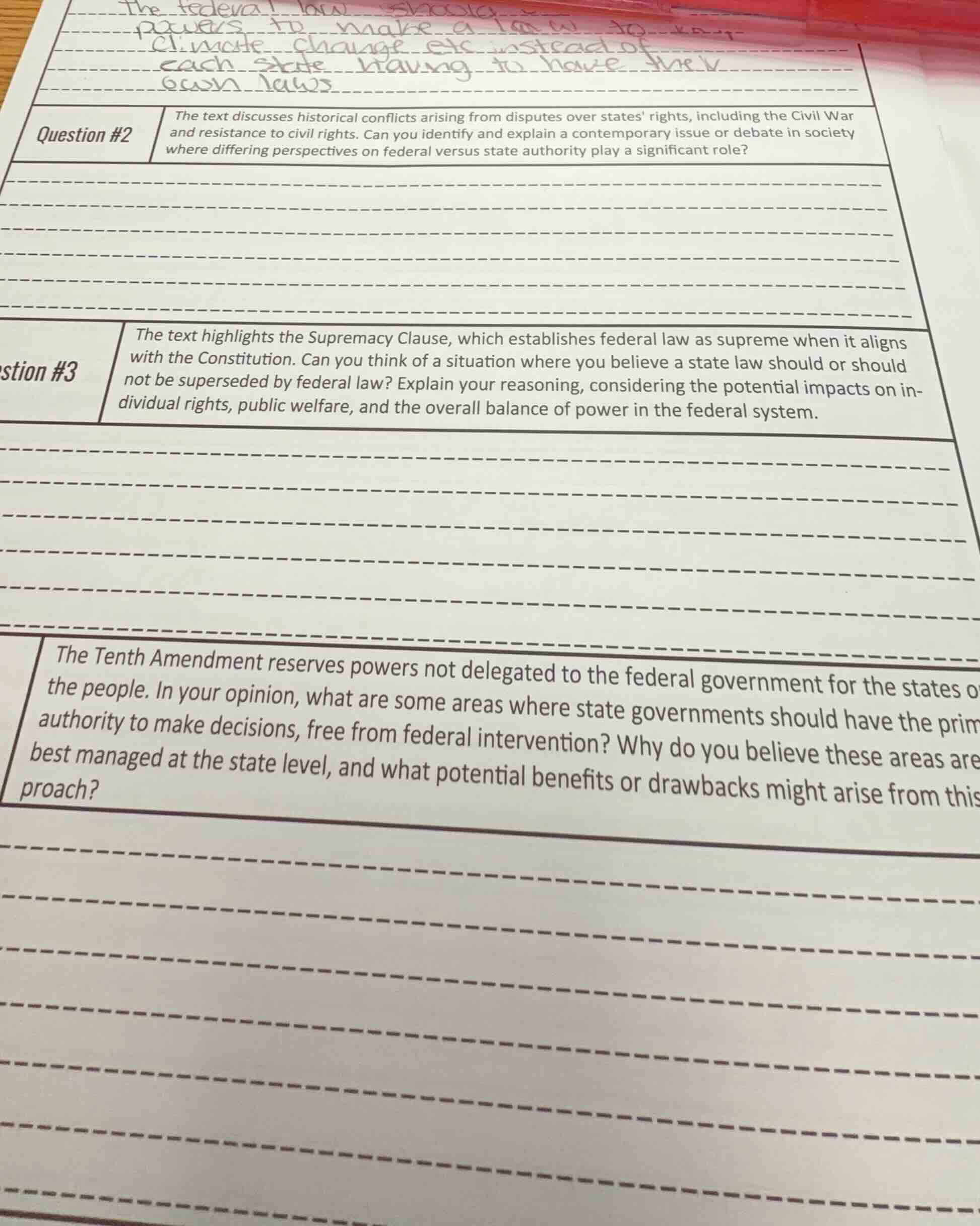
question #2
the text discusses historical conflicts arising from disputes over states rights, including the civil war and resistance to civil rights. can you identify and explain a contemporary issue or debate in society where differing perspectives on federal versus state authority play a significant role?
question #3
the text highlights the supremacy clause, which establishes federal law as supreme when it aligns with the constitution. can you think of a situation where you believe a state law should or should not be superseded by federal law? explain your reasoning, considering the potential impacts on individual rights, public welfare, and the overall balance of power in the federal system.
the tenth amendment reserves powers not delegated to the federal government for the states or the people. in your opinion, what are some areas where state governments should have the primary authority to make decisions, free from federal intervention? why do you believe these areas are best managed at the state level, and what potential benefits or drawbacks might arise from this approach?
For Question #2:
A key contemporary debate is marijuana legalization. Federal law classifies marijuana as a Schedule I controlled substance (illegal nationwide), but over 30 U.S. states have legalized it for medical use, and over 20 have legalized recreational use. Disputes stem from differing views: federal authorities argue uniform regulation is needed for public health and drug control, while states claim they have the right to set policies that reflect local voter preferences and address state-specific public health and economic goals (like tax revenue and reduced criminal justice burdens).
For Question #3:
A situation where state law should not be superseded by federal law is state-level public health policies tailored to local pandemic conditions. During the COVID-19 pandemic, some states implemented stricter mask and vaccine mandates than federal guidelines, while others had looser rules. If federal law forced a one-size-fits-all policy, it could ignore regional differences in infection rates, healthcare capacity, and local values. Allowing state control here protects individual autonomy (by aligning with local community preferences), supports public welfare (by letting states respond to their specific crises), and maintains federal system balance by honoring states' reserved public health powers under the Tenth Amendment. Conversely, a state law that undermines fundamental civil rights (like a state law restricting voting access in a way that violates federal voting rights protections) should be superseded by federal law, as the Supremacy Clause ensures federal protection of constitutional rights overrides state actions that harm individual rights and public welfare.
For the Tenth Amendment Question:
State governments should have primary authority over K-12 education policy. Local school boards and state education agencies are closer to students, parents, and community needs, so they can design curricula (like state-specific history lessons) and funding models that reflect local values and address regional educational gaps. Benefits include more responsive, community-centered education and greater public engagement in school policy. Drawbacks include inconsistent educational quality across states, which can create inequities for students moving between states, and the risk of some states implementing curricula that exclude diverse perspectives or fail to meet national academic standards. Another area is local zoning laws: states/municipalities can set rules for land use (residential vs. commercial zones) that fit local growth plans, but drawbacks can include exclusionary zoning that limits affordable housing access.

Snap & solve any problem in the app
Get step-by-step solutions on Sovi AI
Photo-based solutions with guided steps
Explore more problems and detailed explanations
Question #2:
A contemporary debate is U.S. marijuana legalization: federal law bans it nationwide, but over 30 states allow medical use and over 20 allow recreational use, driven by conflicting views on federal drug control vs. state-level policy autonomy and local preferences.
Question #3:
State public health policies tailored to local pandemic conditions should not be superseded by federal law. This respects regional differences in infection rates, healthcare capacity, and community values, protecting local autonomy, supporting targeted public welfare, and upholding federal system balance. In contrast, state laws violating federal civil rights (e.g., restrictive voting rules) should be superseded to protect individual constitutional rights.
Tenth Amendment Question:
- K-12 education policy: States are closer to local community needs, so they can design curricula and funding models aligned with local values. Benefits: community-responsive education; drawbacks: cross-state educational inequities.
- Local zoning laws: States/municipalities can set land-use rules for local growth. Benefits: tailored development plans; drawbacks: risk of exclusionary zoning limiting affordable housing.