QUESTION IMAGE
Question
question #3
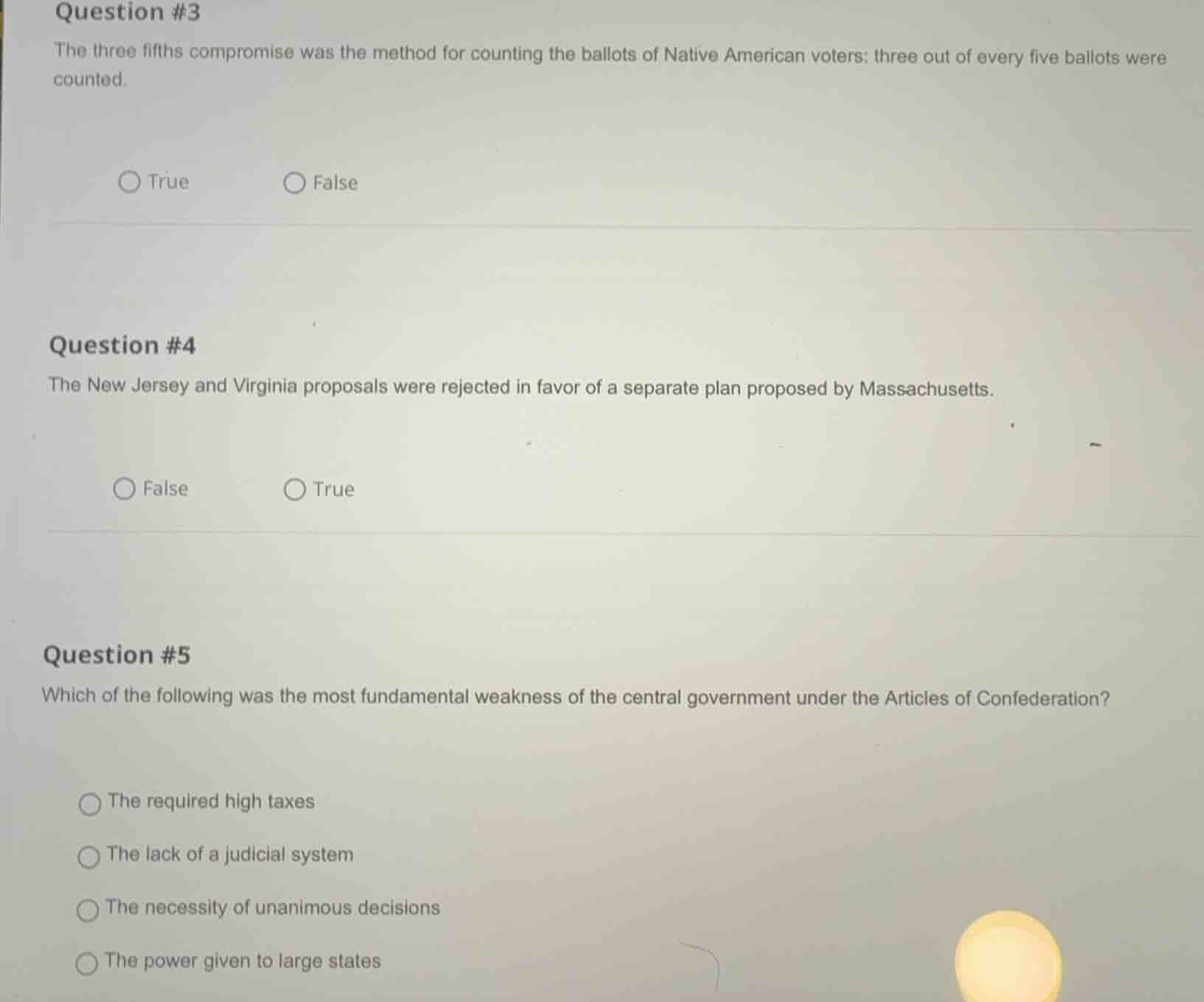
the three fifths compromise was the method for counting the ballots of native american voters: three out of every five ballots were counted.
true false
question #4
the new jersey and virginia proposals were rejected in favor of a separate plan proposed by massachusetts.
false true
question #5
which of the following was the most fundamental weakness of the central government under the articles of confederation?
the required high taxes
the lack of a judicial system
the necessity of unanimous decisions
the power given to large states
Question #3
The Three - Fifths Compromise was about counting enslaved people (not Native American voters) for purposes of representation and taxation, with three - fifths of the enslaved population being counted. So the statement is false.
The New Jersey Plan and the Virginia Plan were part of the Constitutional Convention discussions. The Great Compromise (also called the Connecticut Compromise) was reached by combining elements of both, not by adopting a separate plan from Massachusetts. So the statement is false.
- Option "The required high taxes": The central government under the Articles of Confederation had no power to tax, so this is incorrect.
- Option "The lack of a judicial system": While there were issues with the judicial system, it was not the most fundamental weakness.
- Option "The necessity of unanimous decisions": Amendments to the Articles required unanimous consent of the states, which made it very difficult to make changes or pass laws, and this was a fundamental weakness.
- Option "The power given to large states": The Articles had a unicameral legislature with each state having one vote, so small states had equal power to large ones in that regard, so this is incorrect.

Snap & solve any problem in the app
Get step-by-step solutions on Sovi AI
Photo-based solutions with guided steps
Explore more problems and detailed explanations
B. False