QUESTION IMAGE
Question
this question has two parts. first, answer part a. then, answer part b.
part a
incorrect
1 try left. try once more
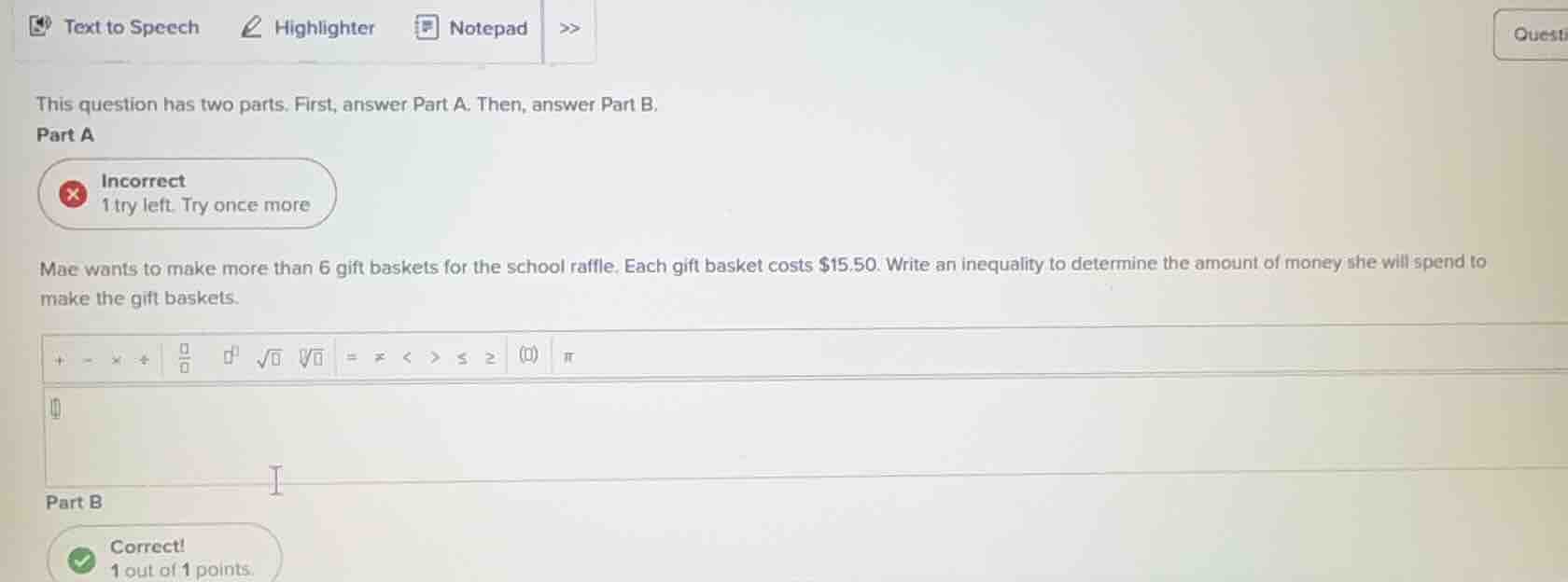
mae wants to make more than 6 gift baskets for the school raffle. each gift basket costs $15.50. write an inequality to determine the amount of money she will spend to make the gift baskets.
part b
correct!
1 out of 1 points.
Step1: Define variables
Let \( n \) be the number of gift baskets and \( m \) be the amount of money spent.
Step2: Analyze the cost per basket
Each basket costs \(\$15.50\), so the total cost for \( n \) baskets is \( 15.50n \), which is equal to \( m \).
Step3: Analyze the number of baskets
Mae wants to make more than 6 baskets, so \( n > 6 \).
Step4: Relate cost and number of baskets
Since \( m = 15.50n \) and \( n > 6 \), we can substitute \( n \) in the inequality. So \( m > 15.50\times6 \), which simplifies to \( m > 93 \). But we can also write it in terms of \( n \) first. Since \( n > 6 \) and \( m = 15.50n \), the inequality for \( m \) in terms of the number of baskets is \( m>15.50n \) with \( n > 6 \), but a more direct inequality using the relationship between cost and the number of baskets (since we know the cost per basket) is: Let \( n \) be the number of baskets, \( n>6 \), and total cost \( m = 15.50n \), so the inequality for the amount of money spent is \( m > 15.50\times6\) or in terms of \( n \), \( m=15.50n \) and \( n > 6 \), so combining them, \( m>15.50\times6\) which is \( m > 93 \), but the standard way is to let \( n \) be the number of baskets, \( n>6 \), and total cost \( m = 15.50n \), so the inequality is \( m>15.50n \) where \( n > 6 \), but if we want to write it as an inequality with \( m \) and the number of baskets (since the number of baskets is more than 6), we can also write \( m>15.50\times6 \) (because if \( n > 6 \), then \( 15.50n>15.50\times6 \)). But the most appropriate inequality is \( m > 15.50n \) with \( n>6 \), but since we can express it as \( m>15.50\times6 \) (because when \( n = 6 \), cost is \( 15.50\times6 = 93 \), and since \( n>6 \), cost \( m>93 \)). However, the inequality in terms of the number of baskets and cost is \( m > 15.50n \) where \( n > 6 \), but we can also write it as \( m>15.50\times6 \) or \( m > 93 \). But the correct inequality based on the number of baskets (letting \( n \) be the number of baskets) is: Let \( n \) be the number of gift baskets, \( n>6 \), and total cost \( m = 15.50n \), so the inequality for \( m \) is \( m>15.50n \) with \( n > 6 \), but a simpler way is to note that since each basket is \( \$15.50 \) and she makes more than 6, the total cost \( m \) must be more than \( 15.50\times6 \), so \( m > 93 \). But the inequality can also be written as \( 15.50n < m \) where \( n > 6 \), but the standard form is \( m > 15.50n \) and \( n > 6 \), so combining these, we can write \( m > 15.50\times6 \) (because \( n > 6 \) implies \( 15.50n>15.50\times6 \)). So the inequality is \( m > 15.50n \) with \( n > 6 \), but if we consider \( n \) as the number of baskets (a positive integer greater than 6), then the total cost \( m = 15.50n \), so the inequality for \( m \) is \( m > 15.50\times6 \), which is \( m > 93 \). But the problem says "write an inequality to determine the amount of money she will spend to make the gift baskets", so we can let \( n \) be the number of baskets, \( n > 6 \), and \( m = 15.50n \), so the inequality is \( m > 15.50n \) where \( n > 6 \), but we can also write it as \( m > 15.50 \times 6 \) (since \( n > 6 \), the minimum number of baskets is more than 6, so the minimum cost is more than \( 15.50\times6 \)). So the inequality is \( m > 93 \) or \( m > 15.50n \) with \( n > 6 \). But the correct inequality using the number of baskets (let \( n \) be the number of baskets) is: Let \( n \) be the number of gift baskets, \( n > 6 \), and let \( m \) be the total money spent. Then \( m = 15.50n \), so subst…

Snap & solve any problem in the app
Get step-by-step solutions on Sovi AI
Photo-based solutions with guided steps
Explore more problems and detailed explanations
\( m > 15.50n \) (where \( n > 6 \)) or \( m > 93 \) (a more simplified form where \( n \) is the number of baskets greater than 6 and \( m \) is the total money spent)