QUESTION IMAGE
Question
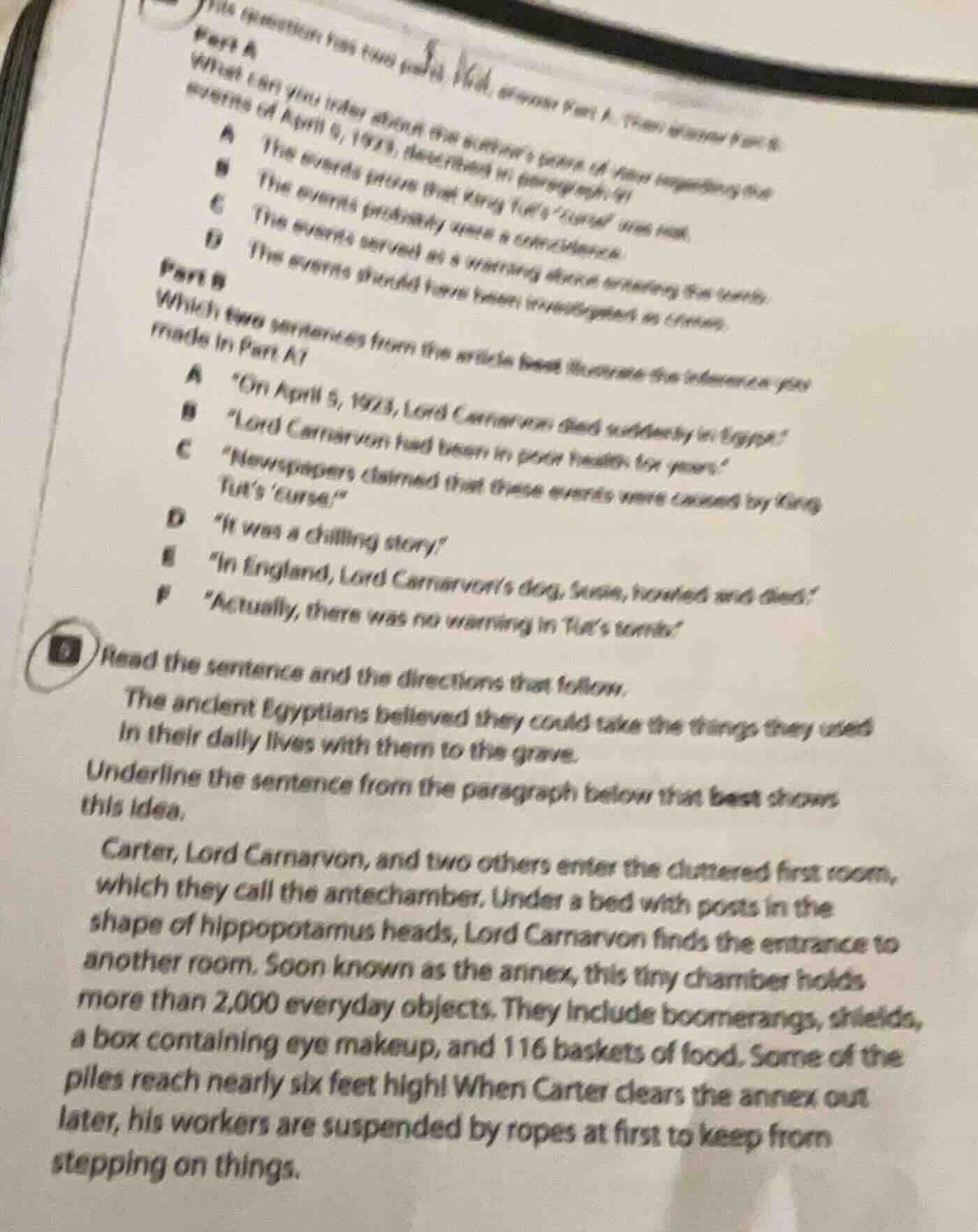
this question has two parts. first, answer part a. then answer part b. part a what can you infer about the author’s point of view regarding the events of april 5, 1923, described in paragraph 9? a the events prove that king tut’s “curse” was real. b the events probably were a coincidence. c the events served as a warning about entering the tomb. d the events should have been investigated as crimes. part b which two sentences from the article best illustrate the inference you made in part a? a “on april 5, 1923, lord carnarvon died suddenly in egypt.” b “lord carnarvon had been in poor health for years.” c “newspapers claimed that these events were caused by king tut’s ‘curse.’” d “it was a chilling story.” e “in england, lord carnarvon’s dog, susie, howled and died.” f “actually, there was no warning in tut’s tomb.” read the sentence and the directions that follow. the ancient egyptians believed they could take the things they used in their daily lives with them to the grave. underline the sentence from the paragraph below that best shows this idea. carter, lord carnarvon, and two others enter the cluttered first room, which they call the antechamber. under a bed with posts in the shape of hippopotamus heads, lord carnarvon finds the entrance to another room. soon known as the annex, this tiny chamber holds more than 2,000 everyday objects. they include boomerangs, shields, a box containing eye makeup, and 116 baskets of food. some of the piles reach nearly six feet high! when carter clears the annex out later, his workers are suspended by ropes at first to keep from stepping on things.
Part A
To solve Part A, we analyze each option:
- Option A: The events (like deaths) don't prove a curse is real, as there could be natural explanations. Eliminate A.
- Option B: The events (Lord Carnarvon's death, his dog's death) likely were coincidences, as there's no scientific proof of a curse, and Lord Carnarvon had poor health. This is a reasonable inference.
- Option C: The events (deaths) aren't a warning about entering the tomb; the idea of a "curse" is a superstition, not a real warning. Eliminate C.
- Option D: The events (deaths) aren't crimes, they were likely natural or coincidental. Eliminate D.
We need to find two sentences that support the inference from Part A (events were a coincidence).
- Option B: "Lord Carnarvon had been in poor health for years." This shows his death could be due to poor health, not a curse (supporting coincidence).
- Option F: "Actually, there was no warning in Tut’s tomb." This undermines the curse idea, supporting that events were coincidences.
- Option A just states his death, not supporting coincidence. Option C and D promote the curse idea, opposing the inference. Option E is about the dog's death, not directly supporting coincidence.
The idea is that ancient Egyptians took daily - use items to the grave. The sentence "Soon known as the annex, this tiny chamber holds more than 2,000 everyday objects. They include boomerangs, shields, a box containing eye makeup, and 116 baskets of food." shows that the tomb (grave) has many everyday objects, which supports the idea that they took daily - use things to the grave.

Snap & solve any problem in the app
Get step-by-step solutions on Sovi AI
Photo-based solutions with guided steps
Explore more problems and detailed explanations
B. The events probably were a coincidence.