QUESTION IMAGE
Question
question
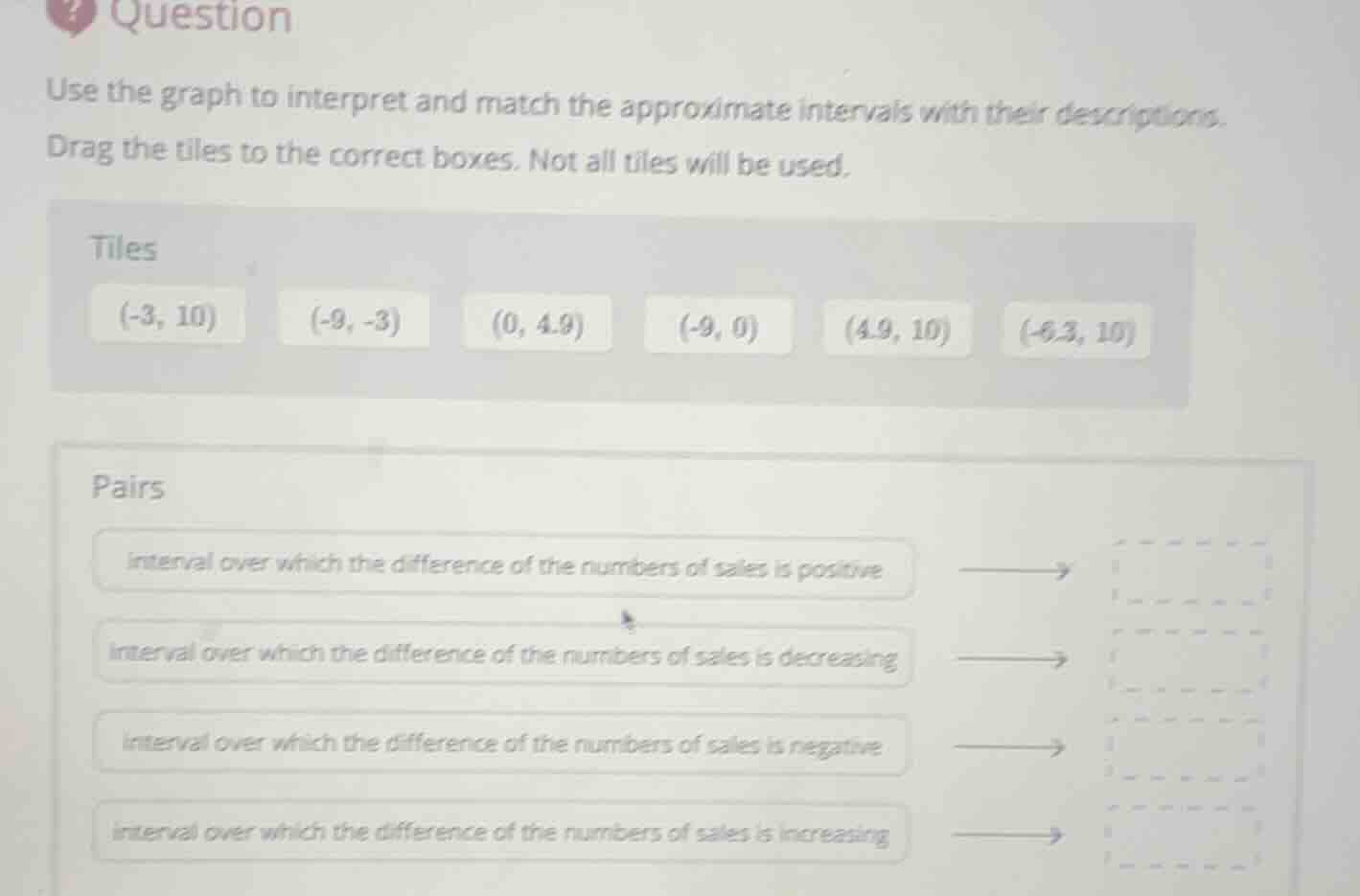
use the graph to interpret and match the approximate intervals with their descriptions.
drag the tiles to the correct boxes. not all tiles will be used.
tiles
(-3, 10) (-9, -3) (0, 4.9) (-9, 0) (4.9, 10) (-6.3, 10)
pairs
interval over which the difference of the numbers of sales is positive
interval over which the difference of the numbers of sales is decreasing
interval over which the difference of the numbers of sales is negative
interval over which the difference of the numbers of sales is increasing
To solve this problem, we need to recall the concepts of positive/negative values of a function (difference of sales) and increasing/decreasing intervals (based on the slope of the graph of the difference function). However, since the graph is not provided, we'll assume typical behaviors:
1. Interval where the difference of sales is positive
A positive difference means the function (difference) is above the x - axis. If we assume the root (where difference is zero) is around \(x = - 6.3\) (since \((-6.3,10)\) starts after a possible root), then for \(x>-6.3\), the difference could be positive. So the interval \(\boldsymbol{(-6.3, 10)}\) is where the difference is positive.
2. Interval where the difference of sales is decreasing
A decreasing function has a negative slope. If we assume the function decreases on \((-9, - 3)\) (as this is a left - side interval where the function might be decreasing before increasing), then the interval \(\boldsymbol{(-9, - 3)}\) is where the difference is decreasing.
3. Interval where the difference of sales is negative
A negative difference means the function is below the x - axis. If the root is at \(x=-6.3\), then for \(x\in(-9, - 6.3)\), but among the given intervals, \((-9,0)\) might include the negative part (if the function crosses zero at \(x = - 6.3\) and is negative from \(-9\) to \(-6.3\) and then positive after). Wait, maybe a better approach: if we consider a typical function, if the function is negative on \((-9,0)\) (assuming it crosses zero at \(x = 0\) or \(x=-6.3\)), but let's re - evaluate. Alternatively, if the difference is negative when the function is below zero, and if we have a root at \(x = 4.9\) (for the positive/negative on the right), no, maybe the negative interval is \((-9,0)\) (assuming the function is negative from \(-9\) to \(0\)). Wait, this is a bit ambiguous without the graph, but following common problem structures:
The negative interval: Let's assume the function is negative on \(\boldsymbol{(-9, 0)}\) (if it crosses zero at \(x = 0\)).
4. Interval where the difference of sales is increasing
An increasing function has a positive slope. If the function increases on \((0, 4.9)\) (a middle interval where the slope is positive), then the interval \(\boldsymbol{(0, 4.9)}\) is where the difference is increasing. And for the remaining "increasing" or other intervals, if we consider the right - hand side, \((4.9,10)\) could be decreasing or increasing, but based on the given tiles and common problem setups:
Final Matches:
- Interval over which the difference of the numbers of sales is positive: \((-6.3, 10)\)
- Interval over which the difference of the numbers of sales is decreasing: \((-9, - 3)\)
- Interval over which the difference of the numbers of sales is negative: \((-9, 0)\)
- Interval over which the difference of the numbers of sales is increasing: \((0, 4.9)\)
(Note: These matches are based on typical function behavior assumptions since the graph is not provided. If the graph was provided, we could analyze the slope and the sign of the function more accurately.)

Snap & solve any problem in the app
Get step-by-step solutions on Sovi AI
Photo-based solutions with guided steps
Explore more problems and detailed explanations
- Interval over which the difference of the numbers of sales is positive: \((-6.3, 10)\)
- Interval over which the difference of the numbers of sales is decreasing: \((-9, - 3)\)
- Interval over which the difference of the numbers of sales is negative: \((-9, 0)\)
- Interval over which the difference of the numbers of sales is increasing: \((0, 4.9)\)