QUESTION IMAGE
Question
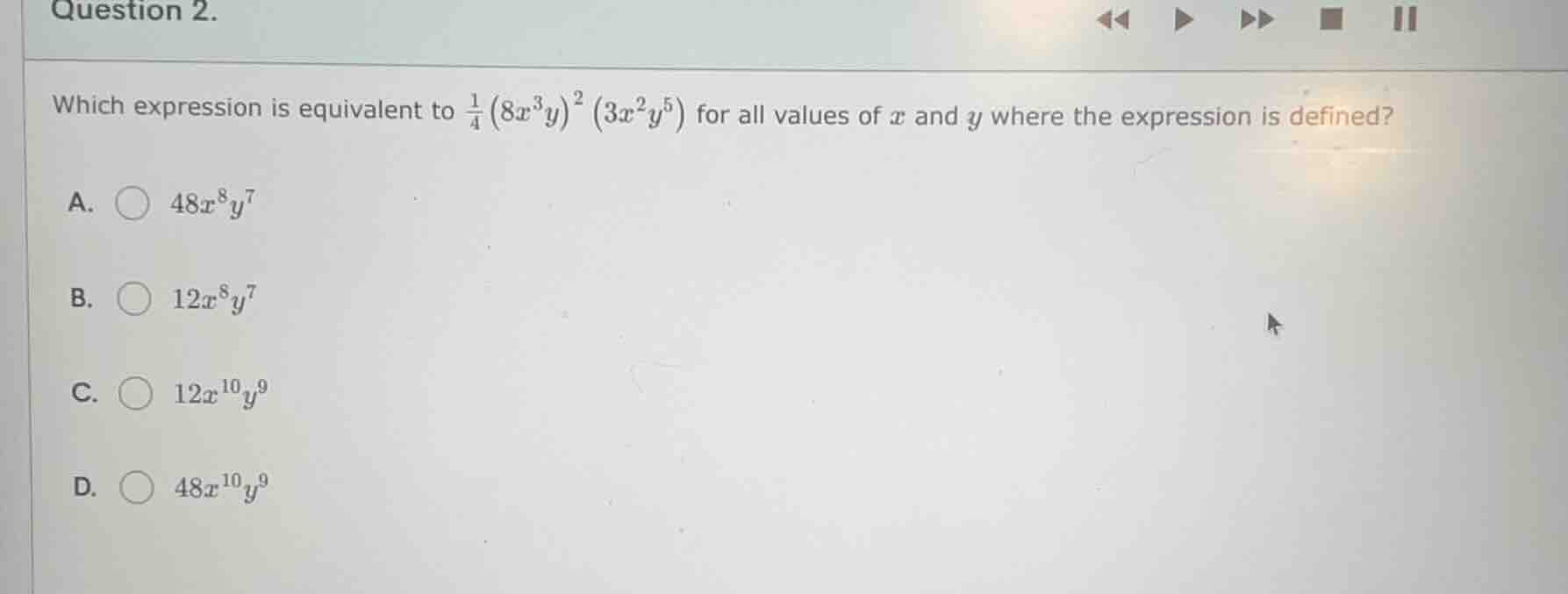
question 2. which expression is equivalent to \\(\frac{1}{4}\left(8x^{3}y\
ight)^{2}\left(3x^{2}y^{5}\
ight)\\) for all values of \\(x\\) and \\(y\\) where the expression is defined? a. \\(48x^{8}y^{7}\\) b. \\(12x^{8}y^{7}\\) c. \\(12x^{10}y^{9}\\) d. \\(48x^{10}y^{9}\\)
Step1: Simplify the squared term
First, we simplify \((8x^{3}y)^{2}\) using the power of a product rule \((ab)^n = a^n b^n\) and the power of a power rule \((a^m)^n = a^{mn}\).
So, \((8x^{3}y)^{2}=8^{2}(x^{3})^{2}y^{2}=64x^{6}y^{2}\)
Step2: Multiply by the fraction
Now, we multiply this result by \(\frac{1}{4}\):
\(\frac{1}{4}\times64x^{6}y^{2}=\frac{64}{4}x^{6}y^{2} = 16x^{6}y^{2}\)
Step3: Multiply by the remaining term
Next, we multiply \(16x^{6}y^{2}\) by \(3x^{2}y^{5}\) using the product of powers rule \(a^m \cdot a^n = a^{m + n}\) for the same base.
For the coefficients: \(16\times3 = 48\)? Wait, no, wait. Wait, in step 2 we had \(\frac{1}{4}\times64 = 16\), then we multiply by 3: \(16\times3=48\)? Wait, no, wait, let's re - check.
Wait, original expression: \(\frac{1}{4}(8x^{3}y)^{2}(3x^{2}y^{5})\)
After step 1: \((8x^{3}y)^{2}=64x^{6}y^{2}\)
Step 2: \(\frac{1}{4}\times64x^{6}y^{2}=16x^{6}y^{2}\)
Step 3: Now multiply \(16x^{6}y^{2}\) with \(3x^{2}y^{5}\)
Coefficients: \(16\times3 = 48\)? Wait, no, wait, I made a mistake. Wait, \(\frac{1}{4}\times64 = 16\), then \(16\times3=48\)? But let's check the exponents.
For \(x\): \(x^{6}\times x^{2}=x^{6 + 2}=x^{8}\)
For \(y\): \(y^{2}\times y^{5}=y^{2+5}=y^{7}\)
Wait, but that would give \(48x^{8}y^{7}\)? But that's option A. But wait, maybe I made a mistake in calculation. Wait, no, wait:
Wait, \((8x^{3}y)^{2}=64x^{6}y^{2}\)
\(\frac{1}{4}\times64x^{6}y^{2}=16x^{6}y^{2}\)
Then \(16x^{6}y^{2}\times3x^{2}y^{5}=(16\times3)x^{6 + 2}y^{2+5}=48x^{8}y^{7}\)? But that's option A. But wait, maybe I messed up. Wait, no, let's re - do the calculation.
Wait, \(\frac{1}{4}(8x^{3}y)^{2}(3x^{2}y^{5})\)
First, \((8x^{3}y)^{2}=64x^{6}y^{2}\)
Then \(\frac{1}{4}\times64x^{6}y^{2}=16x^{6}y^{2}\)
Then \(16x^{6}y^{2}\times3x^{2}y^{5}\)
\(16\times3 = 48\), \(x^{6+2}=x^{8}\), \(y^{2 + 5}=y^{7}\)
So the result is \(48x^{8}y^{7}\), which is option A. Wait, but let's check again.
Wait, maybe I made a mistake in the coefficient. Wait, \(\frac{1}{4}\times64 = 16\), \(16\times3 = 48\). Exponents: \(x^{3\times2}=x^{6}\), then \(x^{6}\times x^{2}=x^{8}\); \(y^{1\times2}=y^{2}\), then \(y^{2}\times y^{5}=y^{7}\). So the expression is \(48x^{8}y^{7}\), which is option A.
Wait, but let's check the options again. Option A is \(48x^{8}y^{7}\), option B is \(12x^{8}y^{7}\), option C is \(12x^{10}y^{9}\), option D is \(48x^{10}y^{9}\).
Wait, maybe I made a mistake in the exponent of \(x\). Wait, \((x^{3})^{2}=x^{6}\), then \(x^{6}\times x^{2}=x^{8}\), that's correct. For \(y\): \(y^{2}\times y^{5}=y^{7}\), correct. Coefficient: \(\frac{1}{4}\times64 = 16\), \(16\times3 = 48\). So the answer should be A. \(48x^{8}y^{7}\)

Snap & solve any problem in the app
Get step-by-step solutions on Sovi AI
Photo-based solutions with guided steps
Explore more problems and detailed explanations
A. \(48x^{8}y^{7}\)