QUESTION IMAGE
Question
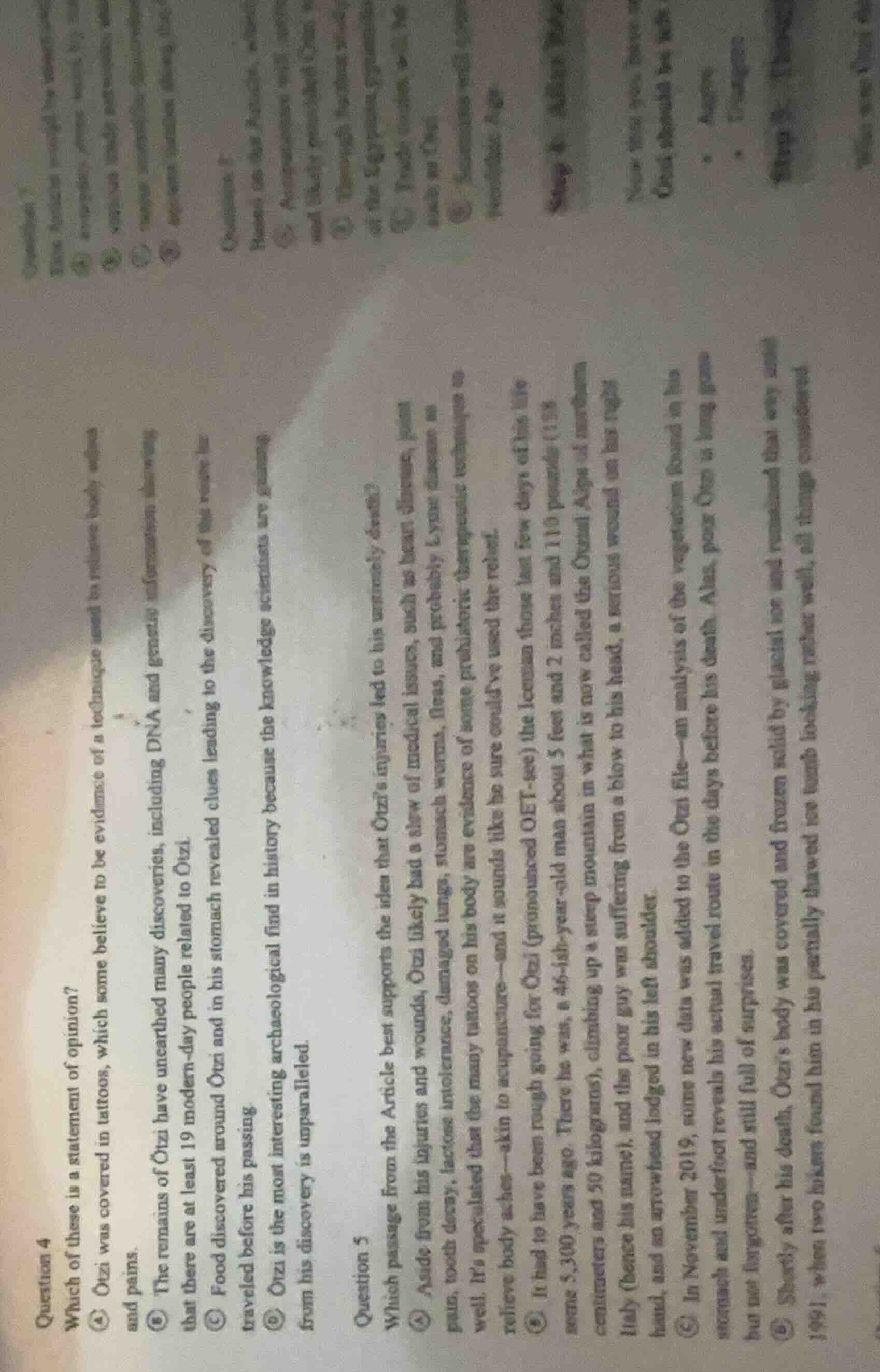
question 4
which of these is a statement of opinion?
ⓐ ötzi was covered in tattoos, which some believe to be evidence of a technique used to relieve body and pains.
ⓑ the remains of ötzi have unearthed many discoveries, including dna and genetic information that there are at least 19 modern - day people related to ötzi.
ⓒ food discovered around ötzi and in his stomach revealed clues leading to the discovery of the route he traveled before his passing.
ⓓ ötzi is the most interesting archaeological find in history because the knowledge scientists are learning from his discovery is unparalleled.
question 5
which passage from the article best supports the idea that ötzi’s injuries led to his untimely death?
ⓐ aside from his injuries and wounds, ötzi likely had a slew of medical issues, such as heart disease, pain, tooth decay, lactose intolerance, damaged lungs, stomach worms, fleas, and probably lyme disease as well. it’s speculated that the many tattoos on his body are evidence of some prehistoric therapeutic techniques to relieve body aches—and it sounds like he sure could’ve used the relief.
ⓑ it had to have been rough going for ötzi (pronounced oet - see) the iceman those last few days of his life, some 5,300 years ago. there he was, a 46 - year - old man about 5 feet and 2 inches and 110 pounds (1.58 centimeters and 50 kilograms), climbing up a steep mountain in what is now called the ötztal alps of northeastern italy (hence his name), and the poor guy was suffering from a blow to his head, a serious wound on his right hand, and an arrowhead lodged in his left shoulder.
ⓒ in november 2019, some new data was added to the ötzi file—an analysis of the vegetation found in his stomach and underfoot reveals his actual travel route in the days before his death. also, poor ötzi is a being researchers had long forgotten—and still full of surprises.
ⓓ shortly after his death, ötzi’s body was covered and frozen solid by glacial ice and remained that way until two hikers found him partially shaved ice tomb looking rather well, all things considered in 1991.
- Question 4: A statement of opinion is a subjective claim, not a verifiable fact. Option D presents a subjective judgment that Ötzi is the "most interesting archaeological find" (this cannot be objectively proven, unlike the factual statements in A, B, and C).
- Question 5: To support the idea that Ötzi's injuries caused his untimely death, we need evidence of fatal or life-ending injuries. Option B details a blow to the head, a serious wound, and an arrowhead in his shoulder—these are direct injuries that would cause death. Options A focuses on non-fatal medical issues, C discusses post-death travel, and D covers his preservation, which do not link injuries to his death.

Snap & solve any problem in the app
Get step-by-step solutions on Sovi AI
Photo-based solutions with guided steps
Explore more problems and detailed explanations
Question 4: D. Ötzi is the most interesting archaeological find in history because the knowledge scientists are gaining from his discovery is unparalleled.
Question 5: B. It had to have been rough going for Ötzi (pronounced OET-see) the Iceman those last few days of his life some 5,300 years ago. There he was, a 46-ish-year-old man about 5 feet and 2 inches and 110 pounds (158 centimeters and 50 kilograms), climbing up a steep mountain in what is now called the Ötztal Alps of northern Italy (hence his name), and this poor guy was suffering from a blow to his head, a serious wound on his right hand, and an arrowhead lodged in his left shoulder.