QUESTION IMAGE
Question
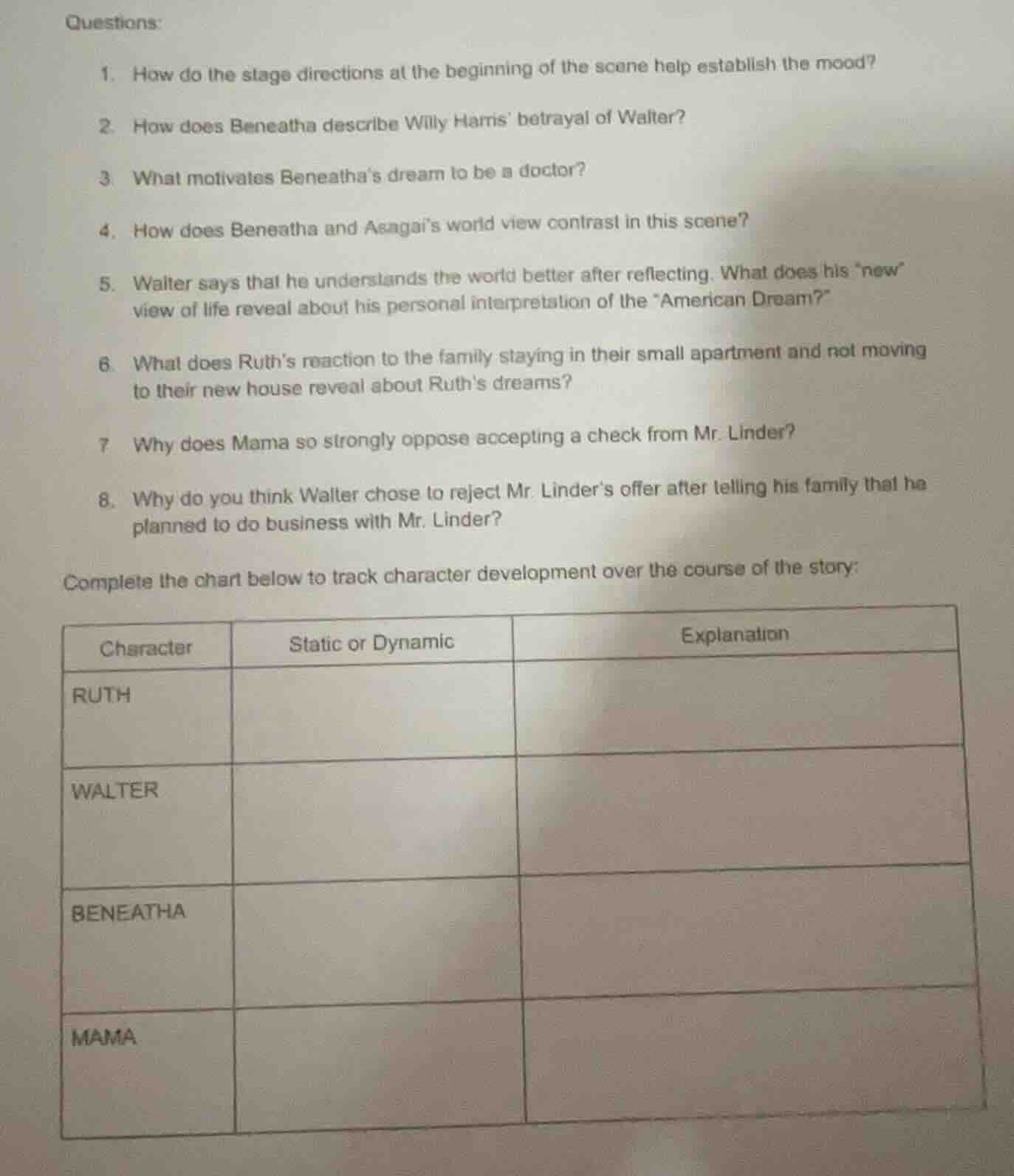
questions:
- how do the stage directions at the beginning of the scene help establish the mood?
- how does beneatha describe willy harris’ betrayal of walter?
- what motivates beneatha’s dream to be a doctor?
- how does beneatha and asagai’s world view contrast in this scene?
- walter says that he understands the world better after reflecting. what does his “new” view of life reveal about his personal interpretation of the “american dream?”
- what does ruth’s reaction to the family staying in their small apartment and not moving to their new house reveal about ruth’s dreams?
- why does mama so strongly oppose accepting a check from mr. linder?
- why do you think walter chose to reject mr. linder’s offer after telling his family that he planned to do business with mr. linder?
complete the chart below to track character development over the course of the story:
| character | static or dynamic | explanation |
|---|---|---|
| walter | ||
| beneatha | ||
| mama |
To solve the character development chart for A Raisin in the Sun, we analyze each character's growth:
RUTH
- Static or Dynamic: Dynamic
- Explanation: Ruth starts as a tired, overburdened woman focused on family survival. As the play progresses, she becomes more assertive, especially regarding the new house. She supports Walter’s growth and embraces hope for a better life, showing internal and relational change.
WALTER
- Static or Dynamic: Dynamic
- Explanation: Walter begins as a frustrated, money - obsessed man, desperate to prove himself. After losing the insurance money, he faces moral and personal crises. By the end, he rejects Mr. Linder’s racist offer, prioritizing family dignity over financial gain. This shift from self - centeredness to responsibility marks significant character growth.
BENEATHA
- Static or Dynamic: Dynamic
- Explanation: Beneatha starts as a young, idealistic student exploring her identity (through culture, religion, and career). Her interactions with Asagai and the family’s struggles make her more grounded. She refines her dreams of being a doctor, balancing idealism with a deeper understanding of her community’s needs.
MAMA
- Static or Dynamic: Static (with subtle growth)
- Explanation: Mama’s core values—family, dignity, and heritage—remain constant. She is a pillar of strength, guiding the family. While she becomes more open to Walter’s growth (e.g., trusting him with the house decision), her fundamental nature as a nurturing, principled matriarch stays unchanged.
Filling the Chart:
| Character | Static or Dynamic | Explanation |
|---|---|---|
| WALTER | Dynamic | Transforms from money - driven to morally responsible, rejecting Mr. Linder’s offer to protect family dignity. |
| BENEATHA | Dynamic | Evolves from idealistic to a more grounded understanding of identity and purpose as a doctor. |
| MAMA | Static (with minor growth) | Core values (family, dignity) persist; subtly adapts to trust Walter’s growth. |
These analyses reflect how each character (or not, in Mama’s case) changes over the play’s arc, aligning with the definitions of static (unchanged core) and dynamic (significant internal/relational growth) characters.

Snap & solve any problem in the app
Get step-by-step solutions on Sovi AI
Photo-based solutions with guided steps
Explore more problems and detailed explanations
To solve the character development chart for A Raisin in the Sun, we analyze each character's growth:
RUTH
- Static or Dynamic: Dynamic
- Explanation: Ruth starts as a tired, overburdened woman focused on family survival. As the play progresses, she becomes more assertive, especially regarding the new house. She supports Walter’s growth and embraces hope for a better life, showing internal and relational change.
WALTER
- Static or Dynamic: Dynamic
- Explanation: Walter begins as a frustrated, money - obsessed man, desperate to prove himself. After losing the insurance money, he faces moral and personal crises. By the end, he rejects Mr. Linder’s racist offer, prioritizing family dignity over financial gain. This shift from self - centeredness to responsibility marks significant character growth.
BENEATHA
- Static or Dynamic: Dynamic
- Explanation: Beneatha starts as a young, idealistic student exploring her identity (through culture, religion, and career). Her interactions with Asagai and the family’s struggles make her more grounded. She refines her dreams of being a doctor, balancing idealism with a deeper understanding of her community’s needs.
MAMA
- Static or Dynamic: Static (with subtle growth)
- Explanation: Mama’s core values—family, dignity, and heritage—remain constant. She is a pillar of strength, guiding the family. While she becomes more open to Walter’s growth (e.g., trusting him with the house decision), her fundamental nature as a nurturing, principled matriarch stays unchanged.
Filling the Chart:
| Character | Static or Dynamic | Explanation |
|---|---|---|
| WALTER | Dynamic | Transforms from money - driven to morally responsible, rejecting Mr. Linder’s offer to protect family dignity. |
| BENEATHA | Dynamic | Evolves from idealistic to a more grounded understanding of identity and purpose as a doctor. |
| MAMA | Static (with minor growth) | Core values (family, dignity) persist; subtly adapts to trust Walter’s growth. |
These analyses reflect how each character (or not, in Mama’s case) changes over the play’s arc, aligning with the definitions of static (unchanged core) and dynamic (significant internal/relational growth) characters.