QUESTION IMAGE
Question
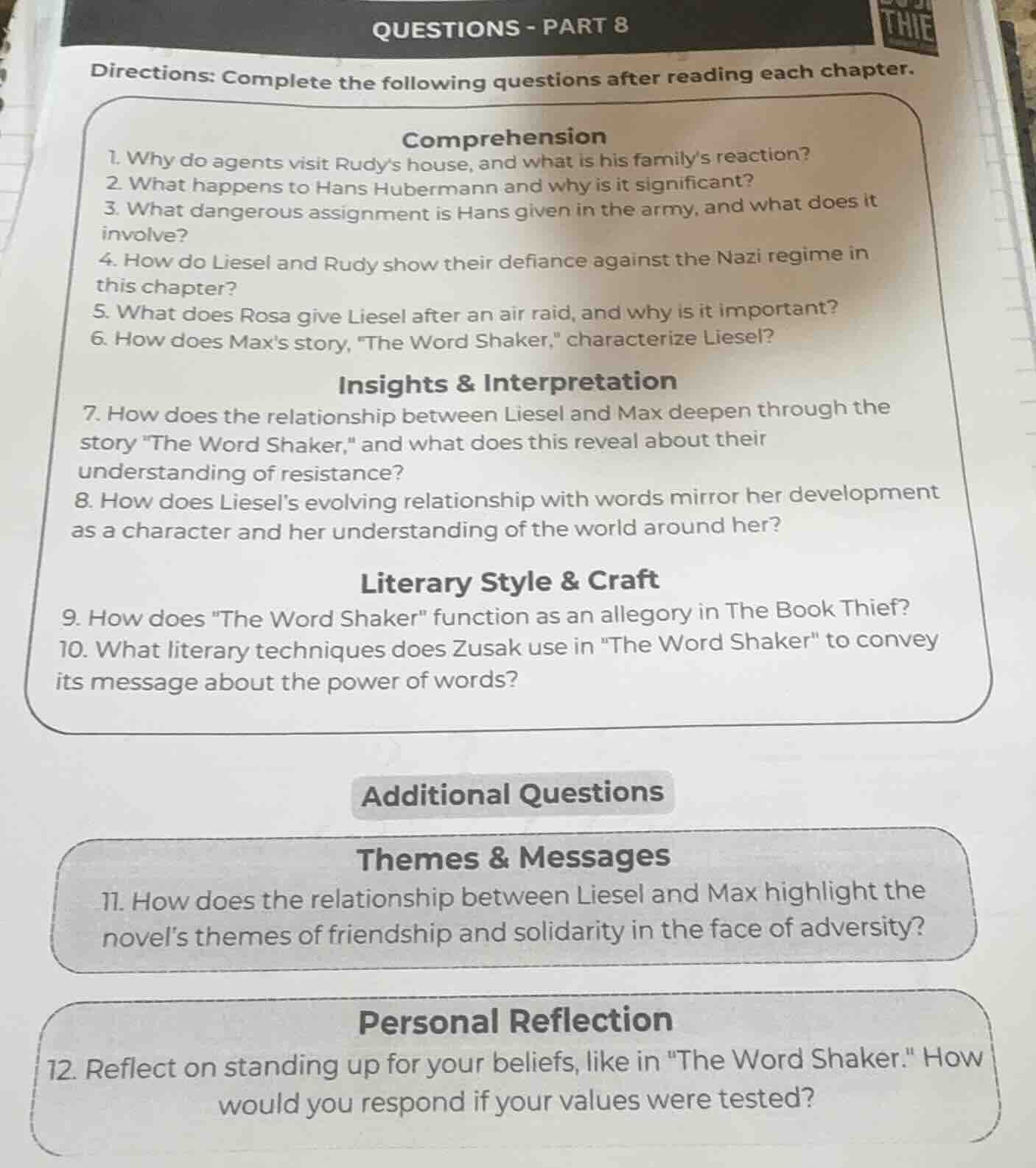
questions - part 8
directions: complete the following questions after reading each chapter.
comprehension
- why do agents visit rudy’s house, and what is his family’s reaction?
- what happens to hans hubermann and why is it significant?
- what dangerous assignment is hans given in the army, and what does it involve?
- how do liesel and rudy show their defiance against the nazi regime in this chapter?
- what does rosa give liesel after an air raid, and why is it important?
- how does max’s story, “the word shaker,” characterize liesel?
insights & interpretation
- how does the relationship between liesel and max deepen through the story “the word shaker,” and what does this reveal about their understanding of resistance?
- how does liesel’s evolving relationship with words mirror her development as a character and her understanding of the world around her?
literary style & craft
- how does “the word shaker” function as an allegory in the book thief?
- what literary techniques does zusak use in “the word shaker” to convey its message about the power of words?
additional questions
themes & messages
- how does the relationship between liesel and max highlight the novel’s themes of friendship and solidarity in the face of adversity?
personal reflection
- reflect on standing up for your beliefs, like in “the word shaker.” how would you respond if your values were tested?

Snap & solve any problem in the app
Get step-by-step solutions on Sovi AI
Photo-based solutions with guided steps
Explore more problems and detailed explanations
- Agents visit to check for hidden Jews; Rudy's family is terrified, and Rudy is forced to do physical exercises for them.
- Hans is drafted into the army; it is significant because it breaks the relative safety the Hubermanns had, and it is punishment for helping a Jewish man.
- Hans is assigned to the LSE (Luftschutz-Ersatz), which involves digging out survivors and recovering bodies from bombed buildings.
- They steal food from a wealthy neighborhood and leave a Nazi propaganda book at the scene.
- Rosa gives Liesel the book The Whistler; it is important as it is a symbol of their bond and helps Liesel cope with fear.
- It characterizes Liesel as someone who uses words to connect, resist, and find hope, and as a loyal, kind friend.
- Their bond deepens as they connect over the story's message of resistance through words; it reveals they understand resistance as rooted in empathy and using one's voice.
- Her growing mastery of words mirrors her move from vulnerability to strength, and her understanding shifts from innocence to recognizing the power of words for both harm and good.
- It is an allegory for the power of words to both manipulate (Hitler's propaganda) and resist (Liesel's acts of connection), and for the resilience of humanity.
- Zusak uses fable-like narrative, metaphor, and symbolism (the word tree, the shaker) to convey the power of words.
- Their relationship highlights these themes as they support each other through isolation, fear, and oppression, choosing solidarity over self-preservation.
- (Personal example: I would stand firm in my values by speaking up peacefully, supporting others who share them, and refusing to comply with unjust demands.)