QUESTION IMAGE
Question
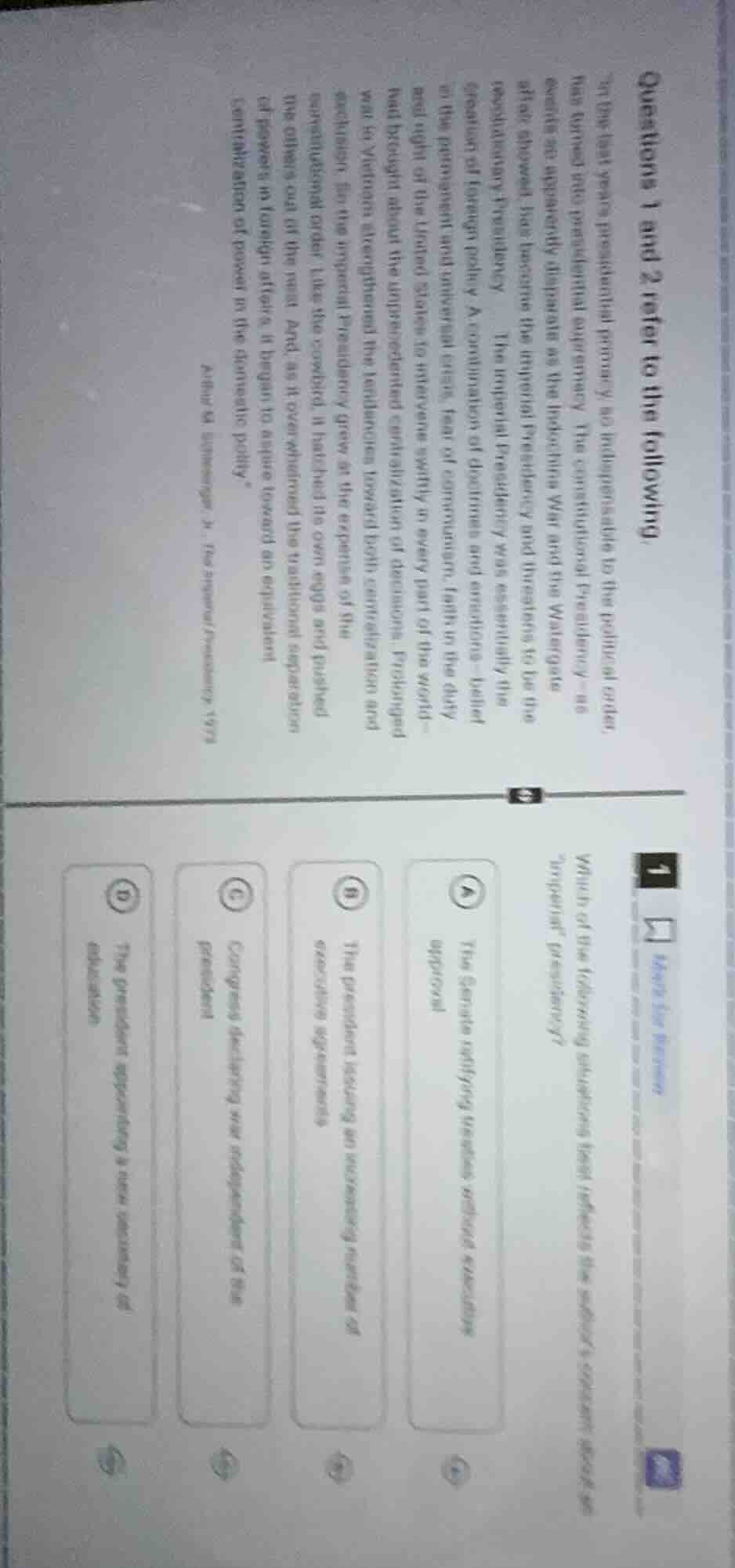
questions 1 and 2 refer to the following:\in the last years presidential primary, so indispensable to the political order, has turned into presidential supremacy. the constitutional presidency—as events so apparently disparate as the indochina war and the watergate affair showed, has become the imperial presidency and threatens to be the revolutionary presidency. the imperial presidency was essentially the creation of foreign policy. a combination of doctrines and emotions-belief in the permanent and universal crisis, fear of communism, faith in the duty and right of the united states to intervene swiftly in every part of the world-had brought about the unprecedented centralization of decisions. prolonged war in vietnam strengthened the tendencies toward both centralization and exclusion. so the imperial presidency grew at the expense of the constitutional order. like the cowbird, it hatched its own eggs and pushed the others out of the nest. and, as it overwhelmed the traditional separation of powers in foreign affairs, it began to aspire toward an equivalent centralization of power in the domestic polity.\arthur m. schlesinger, jr., the imperial presidency, 19731which of the following situations best reflects the authors concern about an \imperial\ presidency?a. the senate ratifying treaties without executive approvalb. the president issuing an increasing number of executive agreementsc. congress declaring war independent of the presidentd. the president appointing a new secretary of education
The text defines the "imperial presidency" as the centralization of power in the executive branch, bypassing traditional separation of powers, especially in foreign policy, and growing at the expense of constitutional order. Option B describes the president expanding executive agreements (a tool that avoids the Senate's treaty-ratification role), which directly reflects the centralization of power in the executive that the author critiques as the "imperial presidency." Options A, C, and D do not align: A is a traditional constitutional check, C is not an established presidential power, and D is a domestic appointment power not tied to the text's focus on executive overreach in foreign/centralized decision-making.

Snap & solve any problem in the app
Get step-by-step solutions on Sovi AI
Photo-based solutions with guided steps
Explore more problems and detailed explanations
B. The president issuing an increasing number of executive agreements