QUESTION IMAGE
Question
questions 1 through 3 refer to the following.
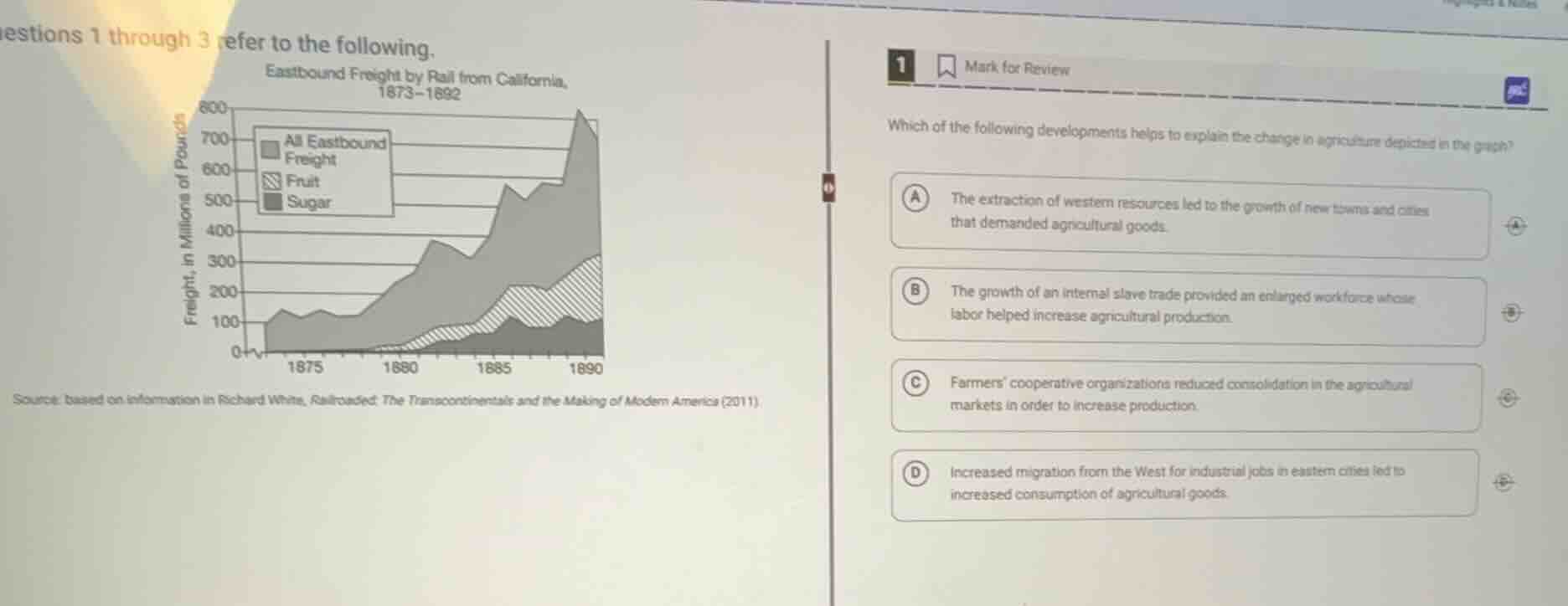
eastbound freight by rail from california,
1873–1892
freight, in millions of pounds
800
700
600
500
400
300
200
100
0
1875 1880 1885 1890
all eastbound
freight
fruit
sugar
source: based on information in richard white, railroaded: the transcontinentals and the making of modern america (2011)
1 mark for review
which of the following developments helps to explain the change in agriculture depicted in the graph?
a the extraction of western resources led to the growth of new towns and cities
that demanded agricultural goods.
b the growth of an internal slave trade provided an enlarged workforce whose
labor helped increase agricultural production.
c farmers’ cooperative organizations reduced consolidation in the agricultural
markets in order to increase production.
d increased migration from the west for industrial jobs in eastern cities led to
increased consumption of agricultural goods.
To solve this, we analyze each option:
- Option A: The graph shows increasing eastbound freight (including agricultural goods like fruit and sugar) from California (West) 1873 - 1892. Western resource extraction (mining, etc.) led to new towns/cities in the West, increasing demand for agricultural goods, driving up production and freight. This matches the graph's trend.
- Option B: The internal slave trade was prominent before the Civil War (ended 1865), but the graph is post - 1873. So this is not relevant.
- Option C: Farmers' cooperatives in this era (Grange, etc.) were more about fighting monopolies, not increasing production in a way that directly explains the freight increase shown. Also, "reduced consolidation" doesn't directly lead to production increase as stated.
- Option D: The graph is about freight from West to East. Migration from West to East for jobs would reduce West's agricultural workforce, likely decreasing production, not increasing freight. So this is incorrect.

Snap & solve any problem in the app
Get step-by-step solutions on Sovi AI
Photo-based solutions with guided steps
Explore more problems and detailed explanations
A. The extraction of western resources led to the growth of new towns and cities that demanded agricultural goods.