QUESTION IMAGE
Question
questions 4 through 6 refer to the following.
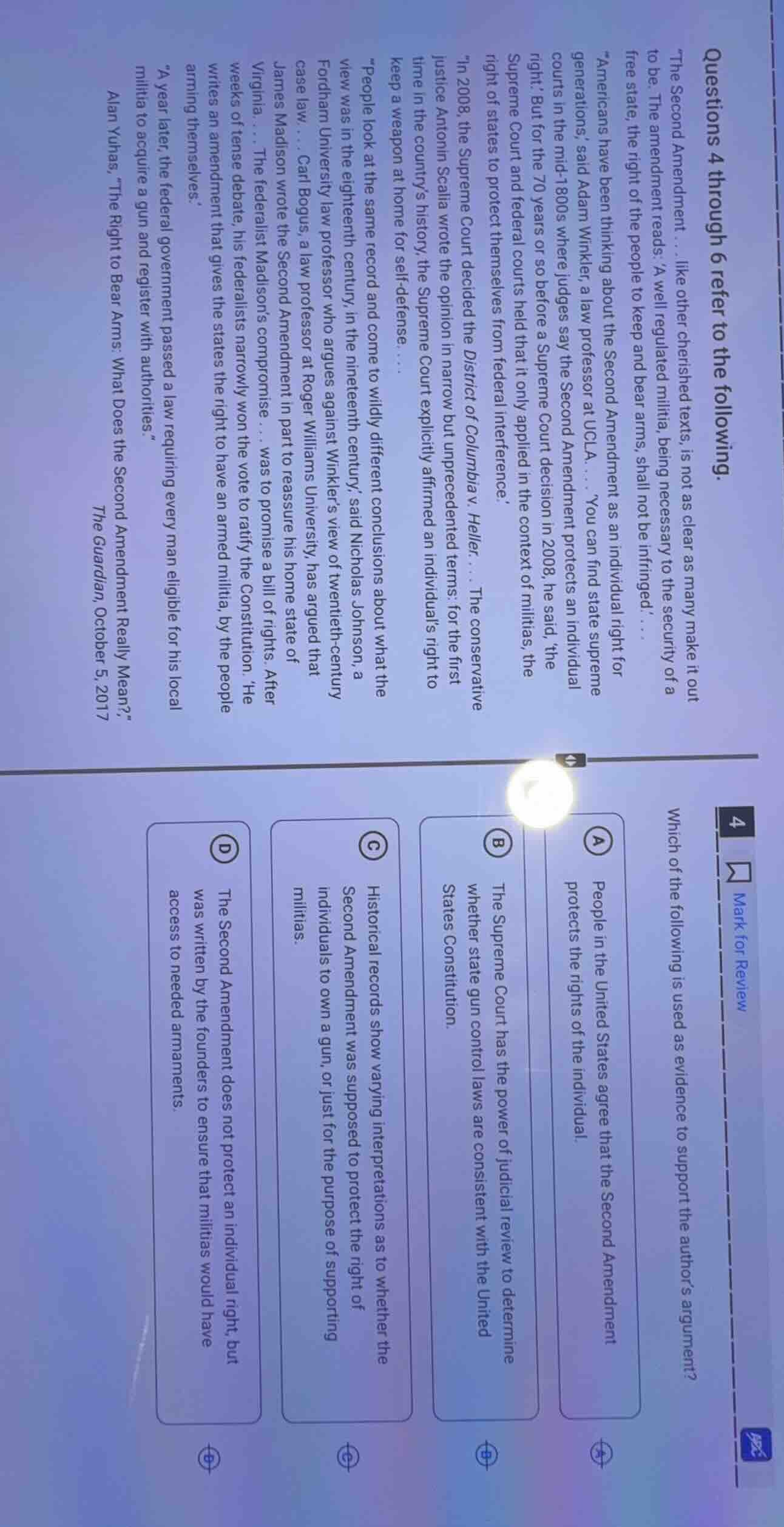
the second amendment... like other cherished texts, is not as clear as many make it out to be. the amendment reads: a well regulated militia, being necessary to the security of a free state, the right of the people to keep and bear arms, shall not be infringed....
americans have been thinking about the second amendment as an individual right for generations, said adam winkler, a law professor at ucla.... you can find state supreme courts in the mid - 1800s where judges say the second amendment protects an individual right. but for the 70 years or so before a supreme court decision in 2008, he said, the supreme court and federal courts held that it only applied in the context of militias, the right of states to protect themselves from federal interference.
in 2008, the supreme court decided the district of columbia v. heller.... the conservative justice antonin scalia wrote the opinion in narrow but unprecedented terms: for the first time in the country’s history, the supreme court explicitly affirmed an individual’s right to keep a weapon at home for self - defense....
people look at the same record and come to wildly different conclusions about what the view was in the eighteenth century, in the nineteenth century, said nicholas johnson, a fordham university law professor who argues against winkler’s view of twentieth - century case law.... carl bogus, a law professor at roger williams university, has argued that james madison wrote the second amendment in part to reassure his home state of virginia.... the federalist madison’s compromise... was to promise a bill of rights. after weeks of tense debate, his federalists narrowly won the vote to ratify the constitution. he writes an amendment that gives the states the right to have an armed militia, by the people arming themselves.
a year later, the federal government passed a law requiring every man eligible for his local militia to acquire a gun and register with authorities.
alan yuhas, the right to bear arms: what does the second amendment really mean?, the guardian, october 5, 2017
4 mark for review
which of the following is used as evidence to support the author’s argument?
a people in the united states agree that the second amendment protects the rights of the individual.
b the supreme court has the power of judicial review to determine whether state gun control laws are consistent with the united states constitution.
c historical records show varying interpretations as to whether the second amendment was supposed to protect the right of individuals to own a gun, or just for the purpose of supporting militias.
d the second amendment does not protect an individual right, but was written by the founders to ensure that militias would have access to needed armaments.
The author's core argument is that the Second Amendment is not a clear, settled text, with wildly different conclusions from different eras and experts. Option C directly reflects this, citing the varying historical interpretations (individual right vs. militia-only) that support the claim of the amendment's ambiguity. The other options either state a single interpretation (A, D) or focus on court power rather than the amendment's unclear meaning (B).

Snap & solve any problem in the app
Get step-by-step solutions on Sovi AI
Photo-based solutions with guided steps
Explore more problems and detailed explanations
C. Historical records show varying interpretations as to whether the Second Amendment was supposed to protect the right of individuals to own a gun, or just for the purpose of supporting militias.