QUESTION IMAGE
Question
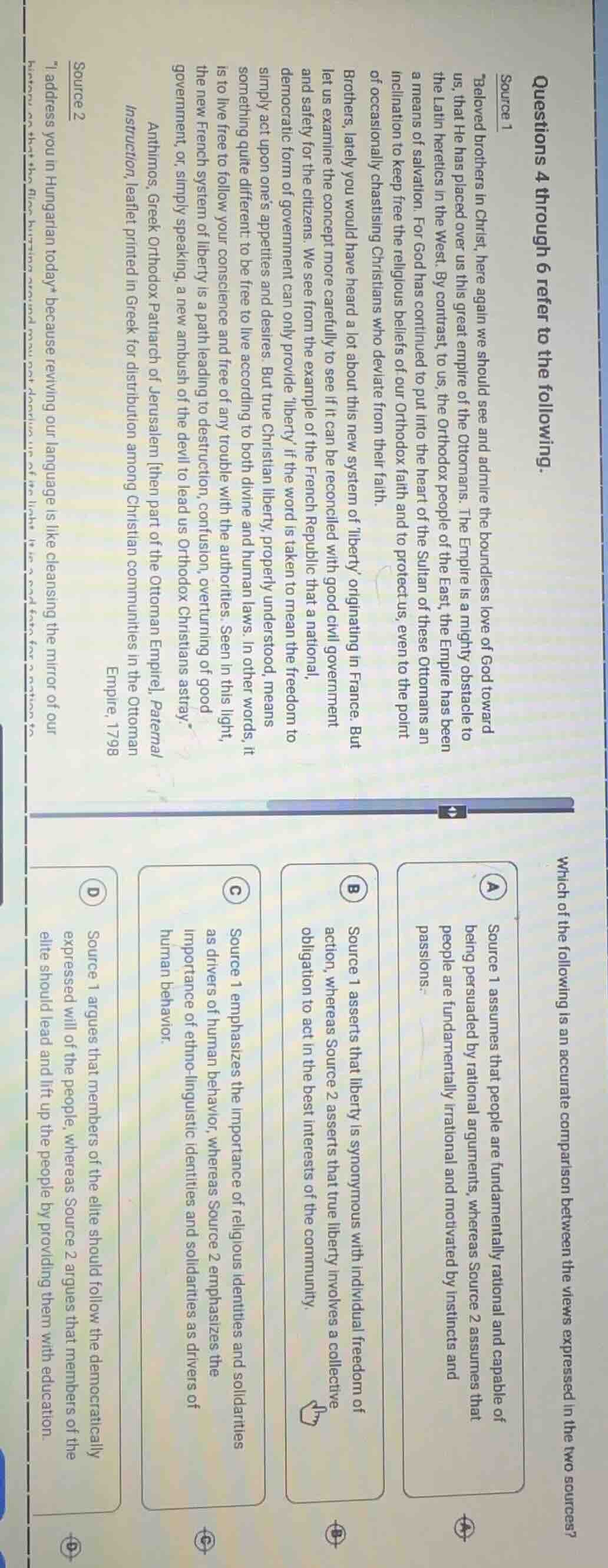
questions 4 through 6 refer to the following.source 1\beloved brothers in christ, here again we should see and admire the boundless love of god toward us, that he has placed over us this great empire of the ottomans. the empire is a mighty obstacle to the latin heretics in the west. by contrast, to us, the orthodox people of the east, the empire has been a means of salvation. for god has continued to put into the heart of the sultan of these ottomans an inclination to keep free the religious beliefs of our orthodox faith and to protect us, even to the point of occasionally chastising christians who deviate from their faith.brothers, lately you would have heard a lot about this new system of liberty originating in france. but let us examine the concept more carefully to see if it can be reconciled with good civil government and safety for the citizens. we see from the example of the french republic that a national, democratic form of government can only provide liberty if the word is taken to mean the freedom to simply act upon ones appetites and desires. but true christian liberty, properly understood, means something quite different: to be free to live according to both divine and human laws. in other words, it is to live free to follow your conscience and free of any trouble with the authorities. seen in this light, the new french system of liberty is a path leading to destruction, confusion, overturning of good government, or, simply speaking, a new ambush of the devil to lead us orthodox christians astray.\anthimos, greek orthodox patriarch of jerusalem then part of the ottoman empire, paternal instruction, leaflet printed in greek for distribution among christian communities in the ottoman empire, 1798source 2\i address you in hungarian today* because reviving our language is like cleansing the mirror of ourwhich of the following is an accurate comparison between the views expressed in the two sources?a. source 1 assumes that people are fundamentally rational and capable of being persuaded by rational arguments, whereas source 2 assumes that people are fundamentally irrational and motivated by instincts and passions.b. source 1 asserts that liberty is synonymous with individual freedom of action, whereas source 2 asserts that true liberty involves a collective obligation to act in the best interests of the community.c. source 1 emphasizes the importance of religious identities and solidarities as drivers of human behavior, whereas source 2 emphasizes the importance of ethno-linguistic identities and solidarities as drivers of human behavior.d. source 1 argues that members of the elite should follow the democratically expressed will of the people, whereas source 2 argues that members of the elite should lead and lift up the people by providing them with education.
- Source 1 frames French "liberty" as individual freedom to act on appetites, which it rejects, while defining true Christian liberty as following divine/human laws (collective, community-focused obligation to uphold faith and order).
- Source 2 explicitly rejects the French understanding of liberty as individual freedom, stating true Christian liberty is living by divine/human laws (collective obligation to the community and correct faith), and warns the French system is a "devil's ambush" that leads people astray from this collective good.
- Option A is incorrect: neither source frames people as fundamentally rational/irrational.
- Option C is incorrect: Source 2 focuses on rejecting French liberty, not ethno-linguistic identity as a driver of behavior.
- Option D is incorrect: neither source discusses elite leadership in this context.

Snap & solve any problem in the app
Get step-by-step solutions on Sovi AI
Photo-based solutions with guided steps
Explore more problems and detailed explanations
B. Source 1 asserts that liberty is synonymous with individual freedom of action, whereas Source 2 asserts that true liberty involves a collective obligation to act in the best interests of the community.