QUESTION IMAGE
Question
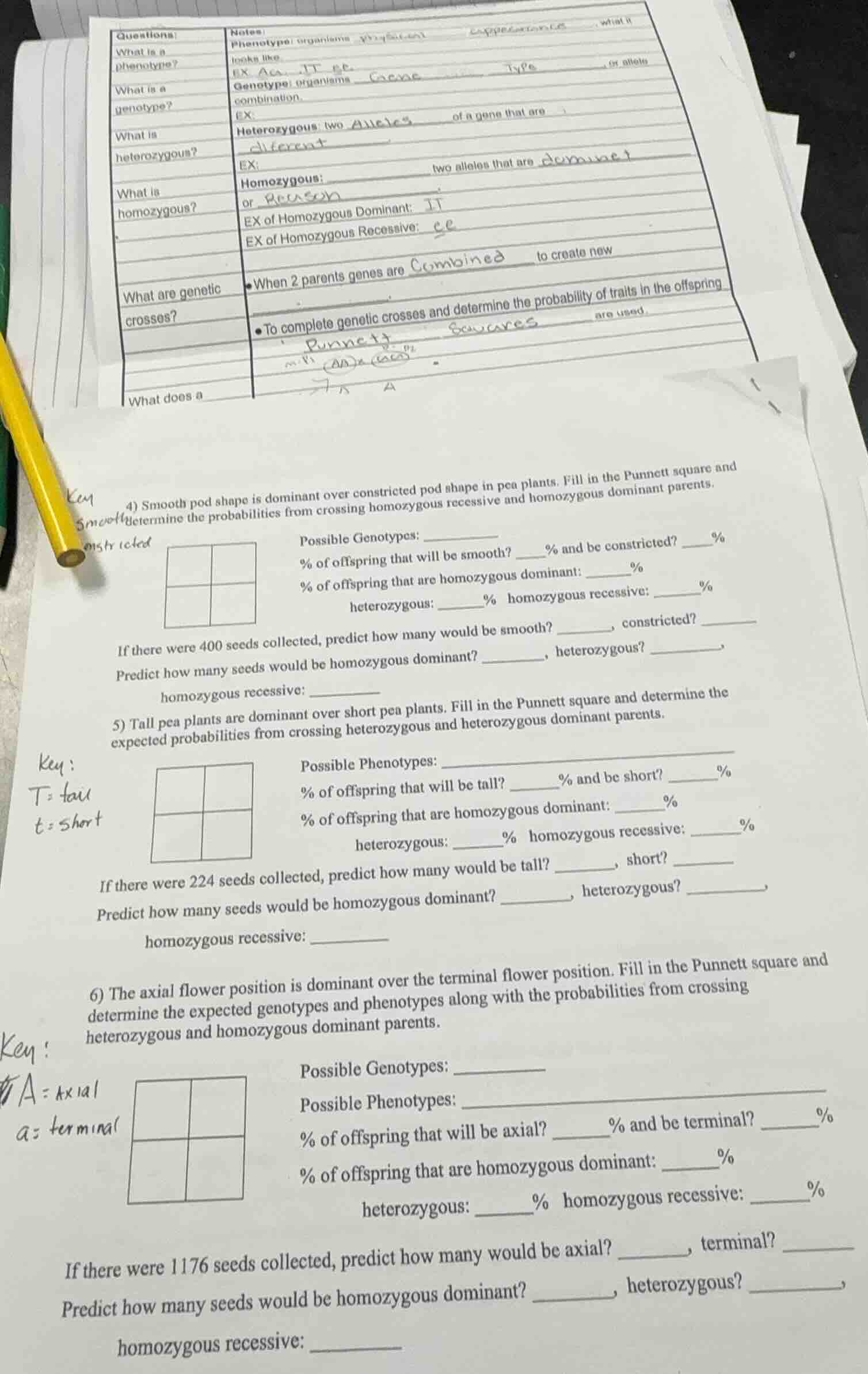
questions:
what is a phenotype?
what is a genotype?
what is heterozygous?
what is homozygous?
what are genetic crosses?
what does a
- smooth pod shape is dominant over constricted pod shape in pea plants. fill in the punnett square and determine the probabilities from crossing homozygous recessive and homozygous dominant parents.
possible genotypes:
% of offspring that will be smooth? __% and be constricted? __%
% of offspring that are homozygous dominant: ____%
heterozygous: __% homozygous recessive: __%
if there were 400 seeds collected, predict how many would be smooth? __, constricted? __
predict how many seeds would be homozygous dominant? __, heterozygous? __,
homozygous recessive: ____
- tall pea plants are dominant over short pea plants. fill in the punnett square and determine the expected probabilities from crossing heterozygous and heterozygous dominant parents.
possible phenotypes:
% of offspring that will be tall? __% and be short? __%
% of offspring that are homozygous dominant: ____%
heterozygous: __% homozygous recessive: __%
if there were 224 seeds collected, predict how many would be tall? __, short? __
predict how many seeds would be homozygous dominant? __, heterozygous? __,
homozygous recessive: ____
- the axial flower position is dominant over the terminal flower position. fill in the punnett square and determine the expected genotypes and phenotypes along with the probabilities from crossing heterozygous and homozygous dominant parents.
possible genotypes:
possible phenotypes:
% of offspring that will be axial? __% and be terminal? __%
% of offspring that are homozygous dominant: ____%
heterozygous: __% homozygous recessive: __%
if there were 1176 seeds collected, predict how many would be axial? __, terminal? __
predict how many seeds would be homozygous dominant? __, heterozygous? __,
homozygous recessive: ____
Question 4 Solution:
Step 1: Define Alleles
Let \( S \) represent the dominant allele (smooth pod) and \( s \) represent the recessive allele (constricted pod). The homozygous recessive parent has genotype \( ss \), and the homozygous dominant parent has genotype \( SS \).
Step 2: Create Punnett Square
| \( S \) | \( S \) | |
|---|---|---|
| \( s \) | \( Ss \) | \( Ss \) |
Step 3: Determine Genotypes and Phenotypes
- Possible Genotypes: All offspring are \( Ss \) (heterozygous).
- Phenotypes: Since \( S \) is dominant, all offspring will have smooth pods.
Step 4: Calculate Percentages
- % smooth: \( 100\% \) (all \( Ss \) show smooth phenotype)
- % constricted: \( 0\% \) (no \( ss \) genotypes)
- % homozygous dominant (\( SS \)): \( 0\% \) (no \( SS \) offspring)
- % heterozygous (\( Ss \)): \( 100\% \) (all offspring are \( Ss \))
- % homozygous recessive (\( ss \)): \( 0\% \) (no \( ss \) offspring)
Step 5: Predict Seed Counts (400 seeds)
- Smooth seeds: \( 100\% \times 400 = 400 \)
- Constricted seeds: \( 0\% \times 400 = 0 \)
- Homozygous dominant: \( 0\% \times 400 = 0 \)
- Heterozygous: \( 100\% \times 400 = 400 \)
- Homozygous recessive: \( 0\% \times 400 = 0 \)
Question 5 Solution:
Step 1: Define Alleles
Let \( T \) represent the dominant allele (tall) and \( t \) represent the recessive allele (short). Both parents are heterozygous, so their genotype is \( Tt \).
Step 2: Create Punnett Square
| \( T \) | \( t \) | |
|---|---|---|
| \( t \) | \( Tt \) | \( tt \) |
Step 3: Determine Genotypes and Phenotypes
- Genotypes: \( TT \) (25%), \( Tt \) (50%), \( tt \) (25%)
- Phenotypes: \( TT \) and \( Tt \) show tall (75%), \( tt \) shows short (25%)
Step 4: Calculate Percentages
- % tall: \( 75\% \)
- % short: \( 25\% \)
- % homozygous dominant (\( TT \)): \( 25\% \)
- % heterozygous (\( Tt \)): \( 50\% \)
- % homozygous recessive (\( tt \)): \( 25\% \)
Step 5: Predict Seed Counts (224 seeds)
- Tall seeds: \( 75\% \times 224 = 168 \)
- Short seeds: \( 25\% \times 224 = 56 \)
- Homozygous dominant (\( TT \)): \( 25\% \times 224 = 56 \)
- Heterozygous (\( Tt \)): \( 50\% \times 224 = 112 \)
- Homozygous recessive (\( tt \)): \( 25\% \times 224 = 56 \)
Question 6 Solution:
Step 1: Define Alleles
Let \( A \) represent the dominant allele (axial flower) and \( a \) represent the recessive allele (terminal flower). The heterozygous parent has genotype \( Aa \), and the homozygous dominant parent has genotype \( AA \).
Step 2: Create Punnett Square
| \( A \) | \( A \) | |
|---|---|---|
| \( a \) | \( Aa \) | \( Aa \) |
Step 3: Determine Genotypes and Phenotypes
- Genotypes: \( AA \) (50%), \( Aa \) (50%)
- Phenotypes: All offspring show axial flower (since \( A \) is dominant)
Step 4: Calculate Percentages
- % axial: \( 100\% \) (all \( AA \) and \( Aa \) show axial phenotype)
- % terminal: \( 0\% \) (no \( aa \) genotypes)
- % homozygous dominant (\( AA \)): \( 50\% \) (half of offspring are \( AA \))
- % heterozygous (\( Aa \)): \( 50\% \) (half of offspring are \( Aa \))
- % homozygous recessive (\( aa \)): \( 0\% \) (no \( aa \) offspring)
Step 5: Predict Seed Counts (1176 seeds)
- Axial seeds: \( 100\% \times 1176 = 1176 \)
- Terminal seeds: \( 0\% \times 1176 = 0 \)
- Homozygous dominant (\( AA \)): \( 50\% \times 1176 = 588 \)
- Heterozygous (\( Aa \)): \( 50\% \times 1176 = 588 \)
- Homozygous reces…

Snap & solve any problem in the app
Get step-by-step solutions on Sovi AI
Photo-based solutions with guided steps
Explore more problems and detailed explanations
Question 4 Solution:
Step 1: Define Alleles
Let \( S \) represent the dominant allele (smooth pod) and \( s \) represent the recessive allele (constricted pod). The homozygous recessive parent has genotype \( ss \), and the homozygous dominant parent has genotype \( SS \).
Step 2: Create Punnett Square
| \( S \) | \( S \) | |
|---|---|---|
| \( s \) | \( Ss \) | \( Ss \) |
Step 3: Determine Genotypes and Phenotypes
- Possible Genotypes: All offspring are \( Ss \) (heterozygous).
- Phenotypes: Since \( S \) is dominant, all offspring will have smooth pods.
Step 4: Calculate Percentages
- % smooth: \( 100\% \) (all \( Ss \) show smooth phenotype)
- % constricted: \( 0\% \) (no \( ss \) genotypes)
- % homozygous dominant (\( SS \)): \( 0\% \) (no \( SS \) offspring)
- % heterozygous (\( Ss \)): \( 100\% \) (all offspring are \( Ss \))
- % homozygous recessive (\( ss \)): \( 0\% \) (no \( ss \) offspring)
Step 5: Predict Seed Counts (400 seeds)
- Smooth seeds: \( 100\% \times 400 = 400 \)
- Constricted seeds: \( 0\% \times 400 = 0 \)
- Homozygous dominant: \( 0\% \times 400 = 0 \)
- Heterozygous: \( 100\% \times 400 = 400 \)
- Homozygous recessive: \( 0\% \times 400 = 0 \)
Question 5 Solution:
Step 1: Define Alleles
Let \( T \) represent the dominant allele (tall) and \( t \) represent the recessive allele (short). Both parents are heterozygous, so their genotype is \( Tt \).
Step 2: Create Punnett Square
| \( T \) | \( t \) | |
|---|---|---|
| \( t \) | \( Tt \) | \( tt \) |
Step 3: Determine Genotypes and Phenotypes
- Genotypes: \( TT \) (25%), \( Tt \) (50%), \( tt \) (25%)
- Phenotypes: \( TT \) and \( Tt \) show tall (75%), \( tt \) shows short (25%)
Step 4: Calculate Percentages
- % tall: \( 75\% \)
- % short: \( 25\% \)
- % homozygous dominant (\( TT \)): \( 25\% \)
- % heterozygous (\( Tt \)): \( 50\% \)
- % homozygous recessive (\( tt \)): \( 25\% \)
Step 5: Predict Seed Counts (224 seeds)
- Tall seeds: \( 75\% \times 224 = 168 \)
- Short seeds: \( 25\% \times 224 = 56 \)
- Homozygous dominant (\( TT \)): \( 25\% \times 224 = 56 \)
- Heterozygous (\( Tt \)): \( 50\% \times 224 = 112 \)
- Homozygous recessive (\( tt \)): \( 25\% \times 224 = 56 \)
Question 6 Solution:
Step 1: Define Alleles
Let \( A \) represent the dominant allele (axial flower) and \( a \) represent the recessive allele (terminal flower). The heterozygous parent has genotype \( Aa \), and the homozygous dominant parent has genotype \( AA \).
Step 2: Create Punnett Square
| \( A \) | \( A \) | |
|---|---|---|
| \( a \) | \( Aa \) | \( Aa \) |
Step 3: Determine Genotypes and Phenotypes
- Genotypes: \( AA \) (50%), \( Aa \) (50%)
- Phenotypes: All offspring show axial flower (since \( A \) is dominant)
Step 4: Calculate Percentages
- % axial: \( 100\% \) (all \( AA \) and \( Aa \) show axial phenotype)
- % terminal: \( 0\% \) (no \( aa \) genotypes)
- % homozygous dominant (\( AA \)): \( 50\% \) (half of offspring are \( AA \))
- % heterozygous (\( Aa \)): \( 50\% \) (half of offspring are \( Aa \))
- % homozygous recessive (\( aa \)): \( 0\% \) (no \( aa \) offspring)
Step 5: Predict Seed Counts (1176 seeds)
- Axial seeds: \( 100\% \times 1176 = 1176 \)
- Terminal seeds: \( 0\% \times 1176 = 0 \)
- Homozygous dominant (\( AA \)): \( 50\% \times 1176 = 588 \)
- Heterozygous (\( Aa \)): \( 50\% \times 1176 = 588 \)
- Homozygous recessive (\( aa \)): \( 0\% \times 1176 = 0 \)
Final Answers:
Question 4:
- Possible Genotypes: \( Ss \)
- % smooth: \( 100\% \), % constricted: \( 0\% \)
- % homozygous dominant: \( 0\% \), % heterozygous: \( 100\% \), % homozygous recessive: \( 0\% \)
- Smooth seeds: \( 400 \), Constricted seeds: \( 0 \)
- Homozygous dominant: \( 0 \), Heterozygous: \( 400 \), Homozygous recessive: \( 0 \)
Question 5:
- Possible Phenotypes: Tall, Short
- % tall: \( 75\% \), % short: \( 25\% \)
- % homozygous dominant: \( 25\% \), % heterozygous: \( 50\% \), % homozygous recessive: \( 25\% \)
- Tall seeds: \( 168 \), Short seeds: \( 56 \)
- Homozygous dominant: \( 56 \), Heterozygous: \( 112 \), Homozygous recessive: \( 56 \)
Question 6:
- Possible Genotypes: \( AA, Aa \)
- Possible Phenotypes: Axial
- % axial: \( 100\% \), % terminal: \( 0\% \)
- % homozygous dominant: \( 50\% \), % heterozygous: \( 50\% \), % homozygous recessive: \( 0\% \)
- Axial seeds: \( 1176 \), Terminal seeds: \( 0 \)
- Homozygous dominant: \( 588 \), Heterozygous: \( 588 \), Homozygous recessive: \( 0 \)