QUESTION IMAGE
Question
quiz: the theory of plate tectonics
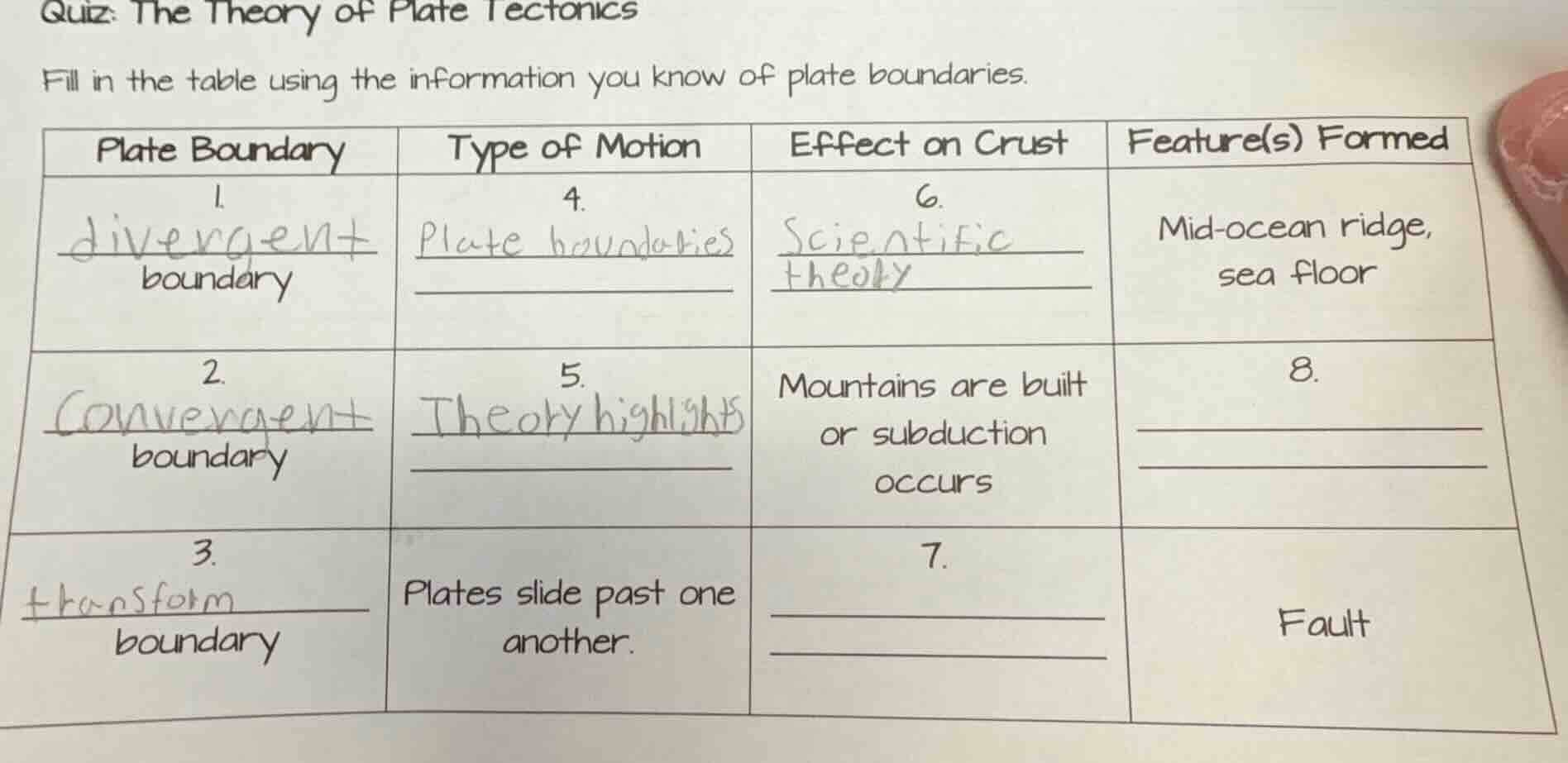
fill in the table using the information you know of plate boundaries.
| plate boundary | type of motion | effect on crust | feature(s) formed |
|---|
| 1.
divergent boundary | 4.
plate boundaries
_ | 6.
scientific
theory
_ | mid - ocean ridge,
sea floor |
| 2.
convergent boundary | 5.
theory highlights
_ | mountains are built
or subduction
occurs | 8.
_ |
| 3.
transform
boundary | plates slide past one
another. | 7.
_ | fault |
Brief Explanations
- For divergent boundaries: Plates move apart, creating new crust as magma rises.
- For convergent boundaries: Plates collide, leading to crust building up or being pushed under another plate, forming large landforms or trenches.
- For transform boundaries: Plates sliding past each other grind and fracture the crust.

Snap & solve any problem in the app
Get step-by-step solutions on Sovi AI
Photo-based solutions with guided steps
Explore more problems and detailed explanations
| Plate Boundary | Type of Motion | Effect on Crust | Feature(s) Formed |
|---|---|---|---|
| 2. convergent boundary | 5. Plates move toward each other. | Mountains are built or subduction occurs | 8. Mountains, volcanoes, ocean trenches |
| 3. transform boundary | Plates slide past one another. | 7. Crust is fractured/ground up. | Fault (e.g., San Andreas Fault) |