QUESTION IMAGE
Question
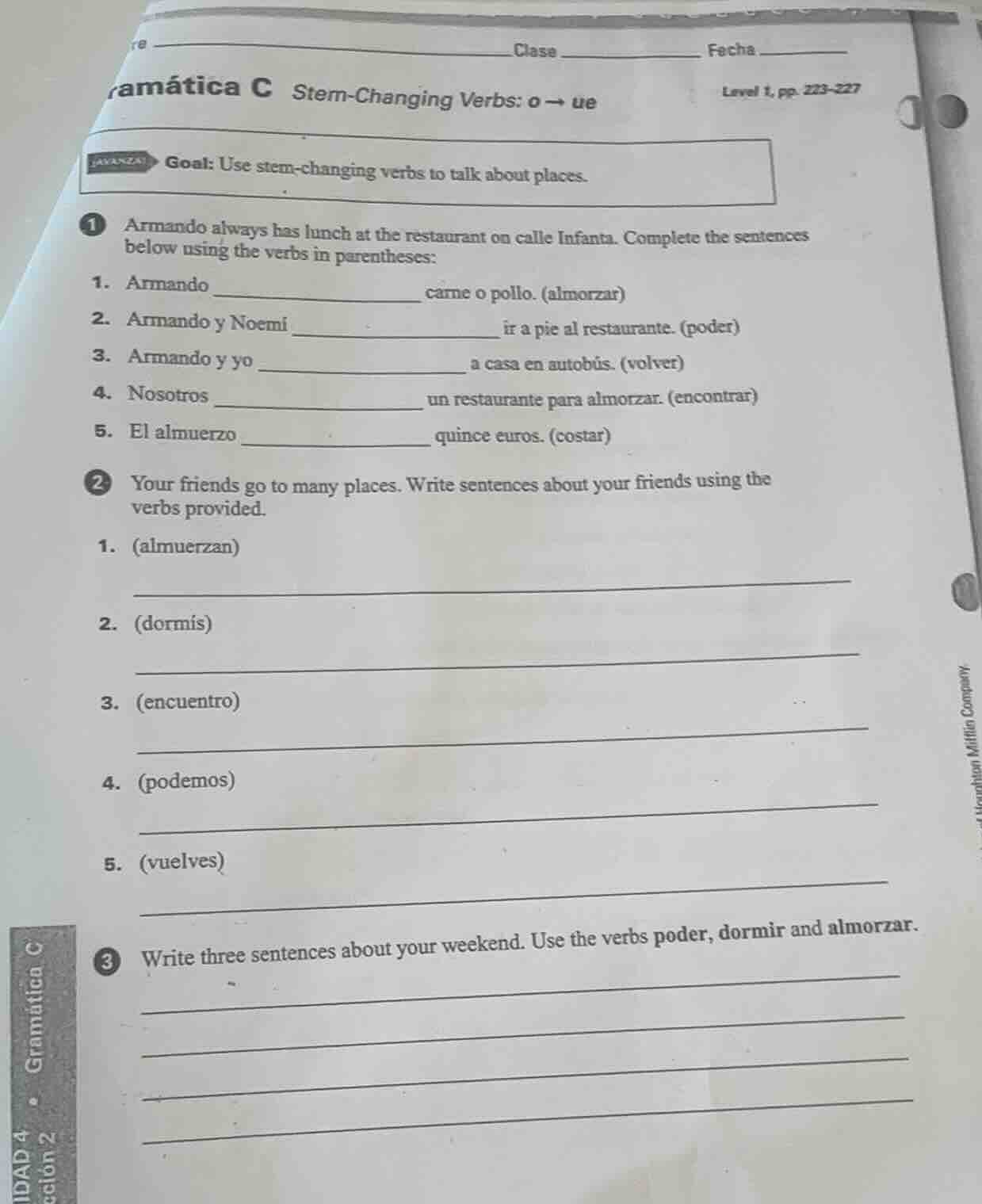
ramática c stem - changing verbs: o → ue level 1, pp. 223 - 227 goal: use stem - changing verbs to talk about places. 1 armando always has lunch at the restaurant on calle infanta. complete the sentences below using the verbs in parentheses: 1. armando ________ carne o pollo. (almorzar) 2. armando y noemi ______ ir a pie al restaurante. (poder) 3. armando y yo ______ a casa en autobús. (volver) 4. nosotros ______ un restaurante para almorzar. (encontrar) 5. el almuerzo ______ quince euros. (costar) 2 your friends go to many places. write sentences about your friends using the verbs provided. 1. (almuerzan) ______ 2. (dormis) ______ 3. (encuentro) ______ 4. (podemos) ______ 5. (vuelves) ______ 3 write three sentences about your weekend. use the verbs poder, dormir and almorzar. ______ ______ ______ ________
Part 1: Completing Sentences with Stem - Changing Verbs
1. For “Armando ______ carne o pollo. (almorzar)”
- Step 1: Identify the subject and verb type. The subject “Armando” is third - person singular. The verb “almorzar” is a stem - changing verb with “o→ue” in the present tense.
- Step 2: Conjugate the verb. For third - person singular (él/ella/usted) of “almorzar”, we have “almuerza”.
So the answer is “almuerza”.
2. For “Armando y Noemí ______ ir a pie al restaurante. (poder)”
- Step 1: Identify the subject. “Armando y Noemí” is a third - person plural subject (ellos/ellas/ustedes).
- Step 2: Conjugate “poder” (stem - changing “o→ue” in present tense). For third - person plural, “poder” becomes “pueden”.
So the answer is “pueden”.
3. For “Armando y yo ______ a casa en autobús. (volver)”
- Step 1: Identify the subject. “Armando y yo” is a first - person plural subject (nosotros/nosotras).
- Step 2: Conjugate “volver” (stem - changing “o→ue” in present tense). For first - person plural, “volver” becomes “volvemos”.
So the answer is “volvemos”.
4. For “Nosotros ______ un restaurante para almorzar. (encontrar)”
- Step 1: Identify the subject. “Nosotros” is first - person plural.
- Step 2: Conjugate “encontrar” (stem - changing “o→ue” in present tense). For first - person plural, “encontrar” becomes “encontramos”.
So the answer is “encontramos”.
5. For “El almuerzo ______ quince euros. (costar)”
- Step 1: Identify the subject. “El almuerzo” is third - person singular.
- Step 2: Conjugate “costar” (stem - changing “o→ue” in present tense). For third - person singular, “costar” becomes “cuesta”.
So the answer is “cuesta”.
Part 2: Writing Sentences about Friends
1. (almuerzan)
- Step 1: Use the verb “almuerzan” (third - person plural of “almorzar”) to write a sentence about friends having lunch.
- Step 2: Construct a sentence like “Mis amigos almuerzan en un restaurante italiano.” (My friends have lunch in an Italian restaurant.)
2. (dormis)
- Step 1: “Dormis” is the second - person singular (tú) form of “dormir”. But since we are writing about friends, we can adjust. Wait, maybe a typo? If it's “dormen” (third - person plural of “dormir”), a sentence could be “Mis amigos dormen en un hotel cuando viajan.” (My friends sleep in a hotel when they travel.) If we consider “dormis” as a mistake and use the correct form for friends (third - person plural), this is a possible sentence.
3. (encuentro)
- Step 1: “Encuentro” is first - person singular (yo) of “encontrar”. To write about friends, we can change it to “encuentran” (third - person plural). A sentence: “Mis amigos encuentran muchas tiendas interesantes en el centro.” (My friends find many interesting shops in the center.)
4. (podemos)
- Step 1: “Podemos” is first - person plural (nosotros) of “poder”. A sentence: “Mis amigos y yo podemos ir al cine después del almuerzo.” (My friends and I can go to the movies after lunch.)
5. (vuelves)
- Step 1: “Vuelves” is second - person singular (tú) of “volver”. For friends (third - person plural), use “vuelven”. A sentence: “Mis amigos vuelven a su casa temprano los domingos.” (My friends return to their home early on Sundays.)
Part 3: Writing about the Weekend
Sentence 1 (using “poder”):
- Step 1: Decide on an activity. Let's say going to the park.
- Step 2: Construct the sentence. “El fin de semana, yo puedo ir al parque con mis amigos.” (On the weekend, I can go to the park with my friends.)
Sentence 2 (using “dormir”):
- Step 1: Think about sleeping. Maybe sleep…

Snap & solve any problem in the app
Get step-by-step solutions on Sovi AI
Photo-based solutions with guided steps
Explore more problems and detailed explanations
Part 1: Completing Sentences with Stem - Changing Verbs
1. For “Armando ______ carne o pollo. (almorzar)”
- Step 1: Identify the subject and verb type. The subject “Armando” is third - person singular. The verb “almorzar” is a stem - changing verb with “o→ue” in the present tense.
- Step 2: Conjugate the verb. For third - person singular (él/ella/usted) of “almorzar”, we have “almuerza”.
So the answer is “almuerza”.
2. For “Armando y Noemí ______ ir a pie al restaurante. (poder)”
- Step 1: Identify the subject. “Armando y Noemí” is a third - person plural subject (ellos/ellas/ustedes).
- Step 2: Conjugate “poder” (stem - changing “o→ue” in present tense). For third - person plural, “poder” becomes “pueden”.
So the answer is “pueden”.
3. For “Armando y yo ______ a casa en autobús. (volver)”
- Step 1: Identify the subject. “Armando y yo” is a first - person plural subject (nosotros/nosotras).
- Step 2: Conjugate “volver” (stem - changing “o→ue” in present tense). For first - person plural, “volver” becomes “volvemos”.
So the answer is “volvemos”.
4. For “Nosotros ______ un restaurante para almorzar. (encontrar)”
- Step 1: Identify the subject. “Nosotros” is first - person plural.
- Step 2: Conjugate “encontrar” (stem - changing “o→ue” in present tense). For first - person plural, “encontrar” becomes “encontramos”.
So the answer is “encontramos”.
5. For “El almuerzo ______ quince euros. (costar)”
- Step 1: Identify the subject. “El almuerzo” is third - person singular.
- Step 2: Conjugate “costar” (stem - changing “o→ue” in present tense). For third - person singular, “costar” becomes “cuesta”.
So the answer is “cuesta”.
Part 2: Writing Sentences about Friends
1. (almuerzan)
- Step 1: Use the verb “almuerzan” (third - person plural of “almorzar”) to write a sentence about friends having lunch.
- Step 2: Construct a sentence like “Mis amigos almuerzan en un restaurante italiano.” (My friends have lunch in an Italian restaurant.)
2. (dormis)
- Step 1: “Dormis” is the second - person singular (tú) form of “dormir”. But since we are writing about friends, we can adjust. Wait, maybe a typo? If it's “dormen” (third - person plural of “dormir”), a sentence could be “Mis amigos dormen en un hotel cuando viajan.” (My friends sleep in a hotel when they travel.) If we consider “dormis” as a mistake and use the correct form for friends (third - person plural), this is a possible sentence.
3. (encuentro)
- Step 1: “Encuentro” is first - person singular (yo) of “encontrar”. To write about friends, we can change it to “encuentran” (third - person plural). A sentence: “Mis amigos encuentran muchas tiendas interesantes en el centro.” (My friends find many interesting shops in the center.)
4. (podemos)
- Step 1: “Podemos” is first - person plural (nosotros) of “poder”. A sentence: “Mis amigos y yo podemos ir al cine después del almuerzo.” (My friends and I can go to the movies after lunch.)
5. (vuelves)
- Step 1: “Vuelves” is second - person singular (tú) of “volver”. For friends (third - person plural), use “vuelven”. A sentence: “Mis amigos vuelven a su casa temprano los domingos.” (My friends return to their home early on Sundays.)
Part 3: Writing about the Weekend
Sentence 1 (using “poder”):
- Step 1: Decide on an activity. Let's say going to the park.
- Step 2: Construct the sentence. “El fin de semana, yo puedo ir al parque con mis amigos.” (On the weekend, I can go to the park with my friends.)
Sentence 2 (using “dormir”):
- Step 1: Think about sleeping. Maybe sleeping late.
- Step 2: Construct the sentence. “El sábado por la mañana, yo duermo hasta las once.” (On Saturday morning, I sleep until eleven.)
Sentence 3 (using “almorzar”):
- Step 1: Think about having lunch. Maybe having lunch at a new restaurant.
- Step 2: Construct the sentence. “El domingo, yo almuerzo en un nuevo restaurante de sushi.” (On Sunday, I have lunch at a new sushi restaurant.)
Final Answers (for Part 1)
- almuérza
- pueden
- volvemos
- encontramos
- cuesta
(For Part 2 and 3, the sentences are examples and can be adjusted based on correct verb forms and context.)