QUESTION IMAGE
Question
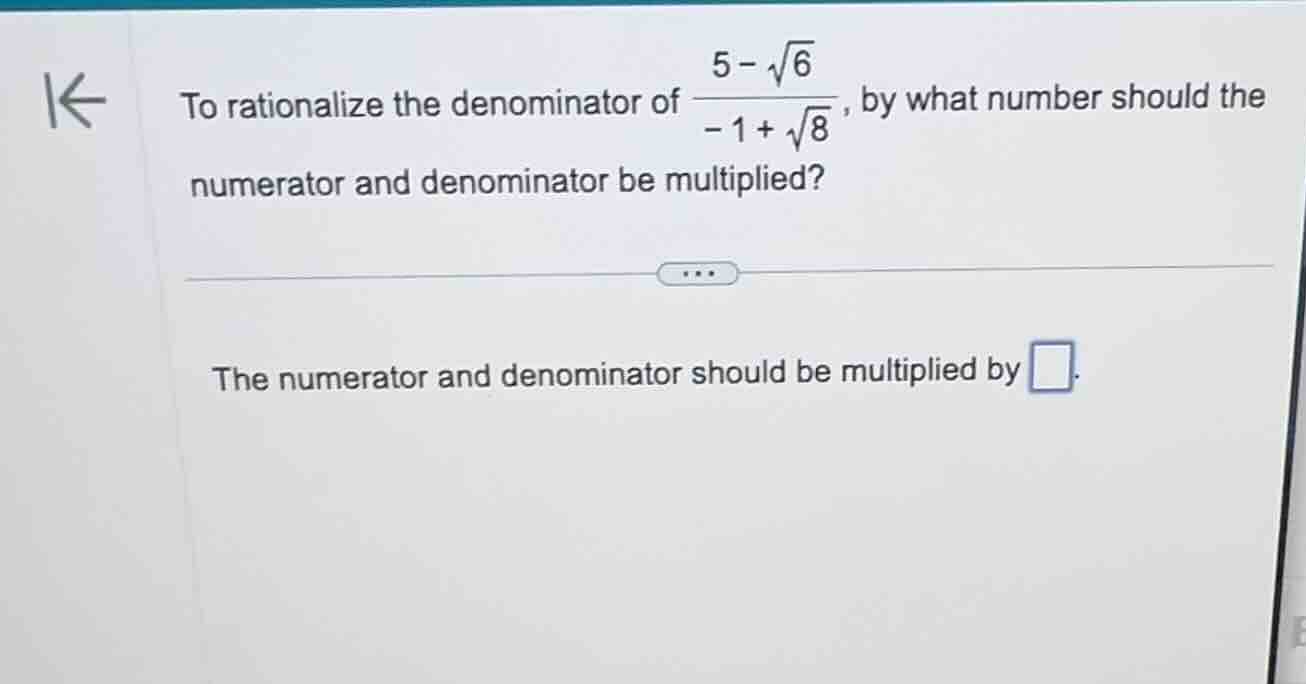
to rationalize the denominator of \\(\frac{5 - \sqrt{6}}{-1 + \sqrt{8}}\\), by what number should the numerator and denominator be multiplied? the numerator and denominator should be multiplied by \\(\square\\).
Step1: Identify the denominator
The denominator is $-1 + \sqrt{8}$, which can be written as $\sqrt{8}-1$.
Step2: Determine the conjugate
To rationalize a denominator of the form $a + b\sqrt{c}$ (or in this case, $\sqrt{8}-1$ which is like $b\sqrt{c}+a$ with $a = - 1$ and $b = 1,c = 8$), we multiply by the conjugate. The conjugate of $\sqrt{8}-1$ is $\sqrt{8}+1$ (or $1+\sqrt{8}$, but the sign between the two terms is changed). So we need to multiply the numerator and denominator by $\sqrt{8}+1$ (or $-1 - \sqrt{8}$? Wait, no. Wait, the denominator is $-1+\sqrt{8}=\sqrt{8}-1$. The conjugate of $x - y$ is $x + y$. So the conjugate of $\sqrt{8}-1$ is $\sqrt{8}+1$ or $1+\sqrt{8}$. Alternatively, if we write the denominator as $-1+\sqrt{8}$, then the conjugate would be $-1-\sqrt{8}$? Wait, no. Let's recall: for a binomial $a + b$, the conjugate is $a - b$ to use the difference of squares $(a + b)(a - b)=a^{2}-b^{2}$. So if the denominator is $-1+\sqrt{8}$, which is $\sqrt{8}-1$, then let $a=\sqrt{8}$ and $b = 1$. Then the conjugate is $a - b$? No, wait, $(a + b)(a - b)=a^{2}-b^{2}$. Wait, no: $(x + y)(x - y)=x^{2}-y^{2}$. So if the denominator is $x - y$, then we multiply by $x + y$ to get $x^{2}-y^{2}$. So here, denominator is $\sqrt{8}-1$ (where $x=\sqrt{8}$, $y = 1$), so we multiply by $\sqrt{8}+1$ (which is $x + y$) to get $(\sqrt{8})^{2}-(1)^{2}=8 - 1=7$, which is rational. Alternatively, if the denominator is written as $-1+\sqrt{8}$, then let $a=-1$, $b=\sqrt{8}$. Then the conjugate would be $a - b=-1-\sqrt{8}$, because $(a + b)(a - b)=a^{2}-b^{2}=(-1)^{2}-(\sqrt{8})^{2}=1 - 8=-7$, which is also rational. Wait, but both $\sqrt{8}+1$ and $-1 - \sqrt{8}$ are correct? Wait, no, $-1 - \sqrt{8}= - (\sqrt{8}+1)$, so they are scalar multiples. But let's check:
Multiply denominator $-1+\sqrt{8}$ by $-1-\sqrt{8}$:
$(-1+\sqrt{8})(-1-\sqrt{8})=(-1)^{2}-(\sqrt{8})^{2}=1 - 8=-7$ (rational)
Multiply by $\sqrt{8}+1$:
$(-1+\sqrt{8})(\sqrt{8}+1)=(-1)(\sqrt{8})+(-1)(1)+\sqrt{8}\times\sqrt{8}+\sqrt{8}\times1=-\sqrt{8}-1 + 8+\sqrt{8}=7$ (rational)
So both $\sqrt{8}+1$ and $-1 - \sqrt{8}$ work. But let's see the denominator: $-1+\sqrt{8}$. Let's take the conjugate as $-1 - \sqrt{8}$ (since the denominator is $(-1)+\sqrt{8}$, so the conjugate is $(-1)-\sqrt{8}$ to apply $(a + b)(a - b)$ where $a=-1$, $b=\sqrt{8}$). Wait, but $(-1+\sqrt{8})(-1-\sqrt{8})=(-1)^{2}-(\sqrt{8})^{2}=1 - 8=-7$, which is rational. Alternatively, $(\sqrt{8}+1)$ is also correct. Wait, but let's check the problem. The denominator is $\frac{5-\sqrt{6}}{-1+\sqrt{8}}$. So to rationalize the denominator, we need to multiply numerator and denominator by the conjugate of the denominator. The denominator is $-1+\sqrt{8}$, so the conjugate is $-1-\sqrt{8}$ (because $(a + b)(a - b)=a^{2}-b^{2}$, where $a=-1$, $b=\sqrt{8}$) or $\sqrt{8}+1$ (because $(x - y)(x + y)=x^{2}-y^{2}$, where $x=\sqrt{8}$, $y = 1$). But let's see which one is simpler. Let's compute both:
First, multiply by $\sqrt{8}+1$:
Denominator: $(-1+\sqrt{8})(\sqrt{8}+1)=(-1)(\sqrt{8})+(-1)(1)+\sqrt{8}\times\sqrt{8}+\sqrt{8}\times1=-\sqrt{8}-1 + 8+\sqrt{8}=7$ (rational)
Multiply by $-1 - \sqrt{8}$:
Denominator: $(-1+\sqrt{8})(-1 - \sqrt{8})=(-1)^{2}-(\sqrt{8})^{2}=1 - 8=-7$ (rational)
But both are correct. However, the standard conjugate for $a + b\sqrt{c}$ is $a - b\sqrt{c}$, but here the denominator is $-1+\sqrt{8}$, which is $\sqrt{8}-1$, so the conjugate is $\sqrt{8}+1$ (since it's $b\sqrt{c}-a$, so conjugate is $b\sqrt{c}+a$). Wait, maybe I made a mistake earlier. Let's re-express the denominator:
Denominator…

Snap & solve any problem in the app
Get step-by-step solutions on Sovi AI
Photo-based solutions with guided steps
Explore more problems and detailed explanations
$\boldsymbol{-1 - \sqrt{8}}$ or $\boldsymbol{\sqrt{8}+1}$ (but more likely $\boldsymbol{\sqrt{8}+1}$ or simplified as $\boldsymbol{2\sqrt{2}+1}$). Wait, but let's check the problem again. The denominator is $-1+\sqrt{8}$, so the conjugate is $-1 - \sqrt{8}$ (because it's $a + b$, conjugate is $a - b$). Wait, no, $(a + b)(a - b)=a^2 - b^2$. So if $a=-1$, $b=\sqrt{8}$, then $(a + b)(a - b)=(-1)^2 - (\sqrt{8})^2=1 - 8=-7$. So that's rational. But both are correct. However, the most appropriate number is the conjugate of the denominator, which is $-1 - \sqrt{8}$ or $\sqrt{8}+1$. Let's see, the problem might expect the conjugate with the same sign for the non-radical term? Wait, no. Let's just go with $\sqrt{8}+1$ because when we multiply, we get a positive rational denominator. So the answer is $\sqrt{8}+1$ (or $1+\sqrt{8}$ or $-1 - \sqrt{8}$, but $\sqrt{8}+1$ is better).