QUESTION IMAGE
Question
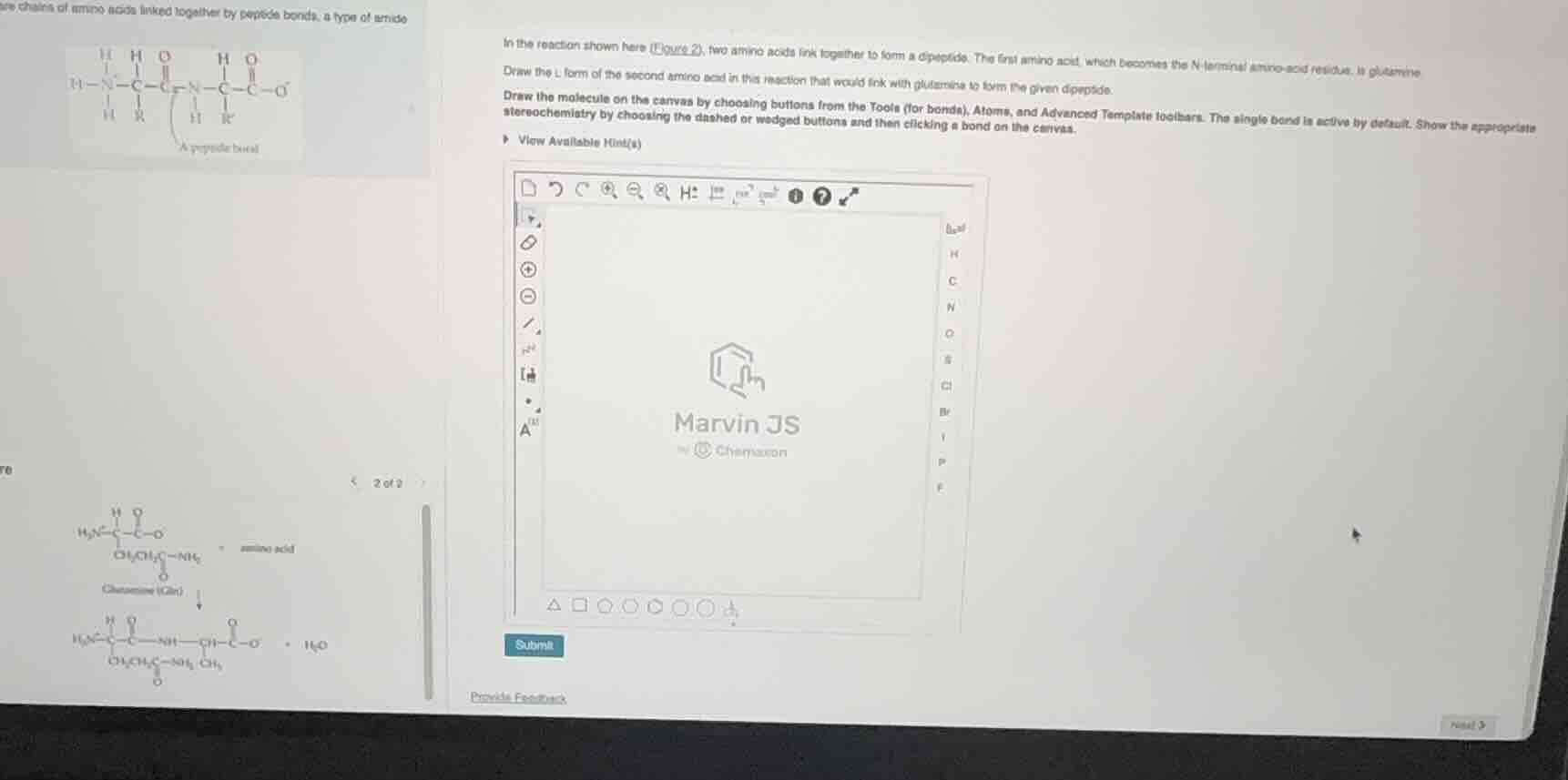
in the reaction shown here (figure 2), two amino acids link together to form a dipeptide. the first amino acid, which becomes the n - terminal amino - acid residue, is glutamine. draw the l - form of the second amino acid in this reaction that would link with glutamine to form the given dipeptide. draw the molecule on the canvas by choosing buttons from the tools (for bonds), atoms, and advanced template toolbars. the single bond is active by default. show the appropriate stereochemistry by choosing the dashed or wedged buttons and then clicking a bond on the canvas. view available hint(s)
Step1: Identify the peptide bond formation
Peptide bond forms between the carboxyl group of one amino acid (glutamine) and the amino group of the second amino acid, with water elimination. Glutamine (Gln) has structure \( \text{H}_2\text{N}-\text{C}(\text{=O})-\text{CH}(\text{CH}_2\text{CH}_2\text{C}(\text{=O})\text{NH}_2)-\text{C}(\text{=O})\text{O}^- \) (L - form, chiral center has H, \( \text{NH}_2 \) on left in Fischer projection for L - amino acid). The dipeptide shows the second amino acid's residue as \( -\text{NH}-\text{CH}(\text{CH}_3)-\text{C}(\text{=O})\text{O}^- \), so the second amino acid (L - form) should have structure: amino group (\( -\text{NH}_2 \)), chiral carbon with H (dashed or wedged? For L - amino acid, in Fischer projection, \( \text{NH}_2 \) is on left, so in 3D, the chiral C (alpha - C) has bonds: \( -\text{NH}_2 \) (amino), \( -\text{CH}_3 \) (R - group), \( -\text{H} \) (dashed or wedged), and \( -\text{C}(\text{=O})\text{OH} \) (carboxyl, but in the reaction, carboxyl reacts, so the free amino acid has \( -\text{C}(\text{=O})\text{O}^- \) or \( -\text{C}(\text{=O})\text{OH} \), but in L - form, the alpha - C configuration: \( \text{NH}_2 \) on left (Fischer), so 3D: alpha - C bonded to \( \text{NH}_2 \) (amino), \( \text{CH}_3 \) (R), \( \text{H} \) (dashed), and \( \text{C}(\text{=O})\text{O}^- \) (carboxyl).
Step2: Draw the L - amino acid
- Start with the alpha - carbon (C).
- Attach \( -\text{NH}_2 \) (amino group, use N from Atoms toolbar).
- Attach \( -\text{CH}_3 \) (R - group, use C and H: \( \text{CH}_3 \)).
- Attach \( -\text{H} \) (dashed bond: use dashed button, then bond to C).
- Attach \( -\text{C}(\text{=O})\text{O}^- \) (carboxyl group: C double - bonded to O, single - bonded to O^-; use C, O, and charge tool for O^-).
For L - amino acid, the chiral center (alpha - C) has the \( \text{NH}_2 \) group on the left side of the Fischer projection, so in 3D, the \( \text{H} \) is on the dashed bond (going into the plane) and \( \text{NH}_2 \), \( \text{CH}_3 \), \( \text{C}(\text{=O})\text{O}^- \) are on the plane or wedged? Wait, the second amino acid's R - group is \( \text{CH}_3 \) (alanine? Wait, the dipeptide residue is \( -\text{NH}-\text{CH}(\text{CH}_3)-\text{C}(\text{=O})\text{O}^- \), so the second amino acid is alanine (Ala), L - alanine. L - alanine structure: \( \text{H}_2\text{N}-\text{CH}(\text{CH}_3)-\text{COOH} \) (in free form, carboxyl is \( -\text{COOH} \) or \( -\text{COO}^- \)). In L - form, the alpha - C configuration: \( \text{NH}_2 \) on left (Fischer), so the 3D structure: alpha - C bonded to \( \text{NH}_2 \) (amino), \( \text{CH}_3 \) (R), \( \text{H} \) (dashed, into the plane), and \( \text{COOH} \) (carboxyl, out of plane? No, for L - amino acid, the standard configuration: when looking at the alpha - C with \( \text{H} \) in the back (dashed), \( \text{NH}_2 \) is on the left, \( \text{COOH} \) on the right, and \( \text{R} \) on the top? Wait, no, Fischer projection for L - amino acid: horizontal bonds are out of plane (wedged), vertical bonds are into plane (dashed). So alpha - C: top = R (\( \text{CH}_3 \)), bottom = \( \text{H} \) (dashed, into plane), left = \( \text{NH}_2 \) (wedged, out of plane), right = \( \text{COOH} \) (wedged, out of plane? No, vertical bonds (top and bottom) are dashed (into plane), horizontal (left and right) are wedged (out of plane). So for L - alanine:
- Alpha - C:
- Left: \( \text{NH}_2 \) (wedged, out of plane)
- Right: \( \text{COOH} \) (wedged, out of plane)
- Top: \( \text{CH}_3 \) (dashed, into plane? No,…

Snap & solve any problem in the app
Get step-by-step solutions on Sovi AI
Photo-based solutions with guided steps
Explore more problems and detailed explanations
The second amino acid (L - form) is L - alanine, with structure: \( \text{NH}_2-\text{CH}(\text{CH}_3)-\text{COOH} \) (L - configuration, \( \text{H} \) on dashed bond, \( \text{NH}_2 \), \( \text{CH}_3 \), and \( \text{COOH} \) on other bonds). When drawn on the canvas, use the tools to add N (with \( \text{NH}_2 \)), C (alpha), \( \text{CH}_3 \) (R), \( \text{H} \) (dashed), and \( \text{COOH} \) (or \( \text{COO}^- \)).