QUESTION IMAGE
Question
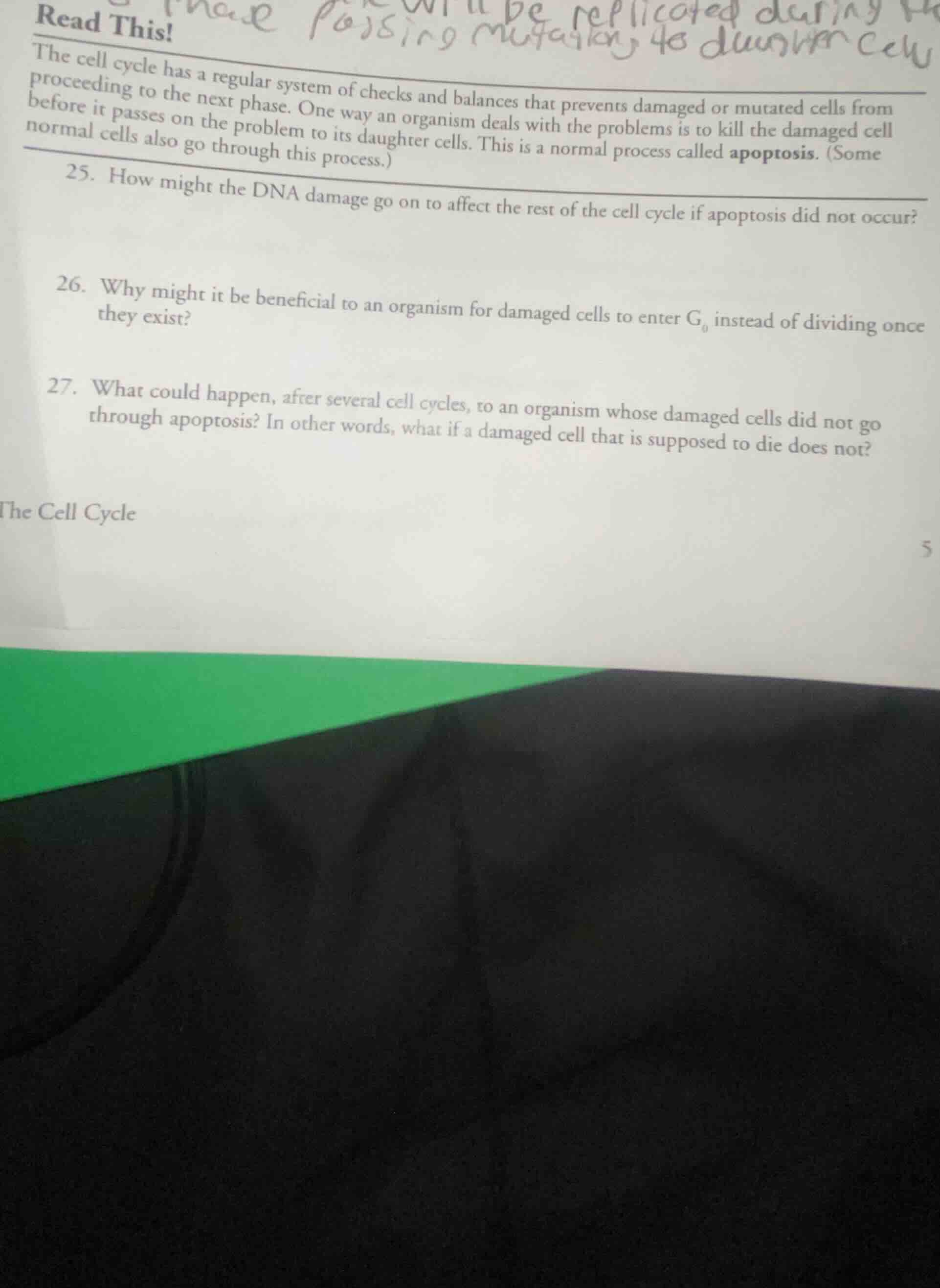
read this!
the cell cycle has a regular system of checks and balances that prevents damaged or mutated cells from proceeding to the next phase. one way an organism deals with the problems is to kill the damaged cell before it passes on the problem to its daughter cells. this is a normal process called apoptosis. (some normal cells also go through this process.)
- how might the dna damage go on to affect the rest of the cell cycle if apoptosis did not occur?
- why might it be beneficial to an organism for damaged cells to enter ( g_0 ) instead of dividing once they exist?
- what could happen, after several cell cycles, to an organism whose damaged cells did not go through apoptosis? in other words, what if a damaged cell that is supposed to die does not?
the cell cycle
For question 25:
Without apoptosis, damaged cells bypass checkpoints, passing mutated DNA to daughter cells. This disrupts cycle regulation, as mutated cells may ignore growth signals and divide uncontrollably.
For question 26:
G₀ is a non-dividing resting phase. Damaged cells entering G₀ stop dividing, preventing mutated DNA from being passed to daughter cells, avoiding spread of damage while the cell can either repair itself or be removed later.
For question 27:
Over multiple cycles, unremoved damaged cells accumulate mutations, lose cycle regulation, and divide uncontrollably. This leads to a cluster of abnormal cells (a tumor), which can invade surrounding tissues and develop into cancer, harming the organism's health.

Snap & solve any problem in the app
Get step-by-step solutions on Sovi AI
Photo-based solutions with guided steps
Explore more problems and detailed explanations
- For question 25: The damaged, mutated cell will proceed through the cell cycle, passing on its damaged DNA to daughter cells. These daughter cells will also carry the mutation, and over time, the unregulated division of these faulty cells will disrupt normal cell cycle checkpoints, leading to uncontrolled cell growth and potential breakdown of normal tissue function.
- For question 26: Entering the G₀ phase stops the damaged cell from dividing, which prevents the damaged or mutated DNA from being passed on to new daughter cells. This limits the spread of cellular damage within the organism and gives the cell time to repair its DNA, or allows the body to safely remove the non-dividing damaged cell without risking propagation of mutations.
- For question 27: After several cell cycles, the accumulated population of damaged, dividing cells will form an abnormal mass of cells (a tumor). These cells may continue to accumulate more mutations, leading to loss of normal cell function, invasion of nearby tissues, and potentially the development of cancer, which can severely impair the organism's health and lead to disease or death.