QUESTION IMAGE
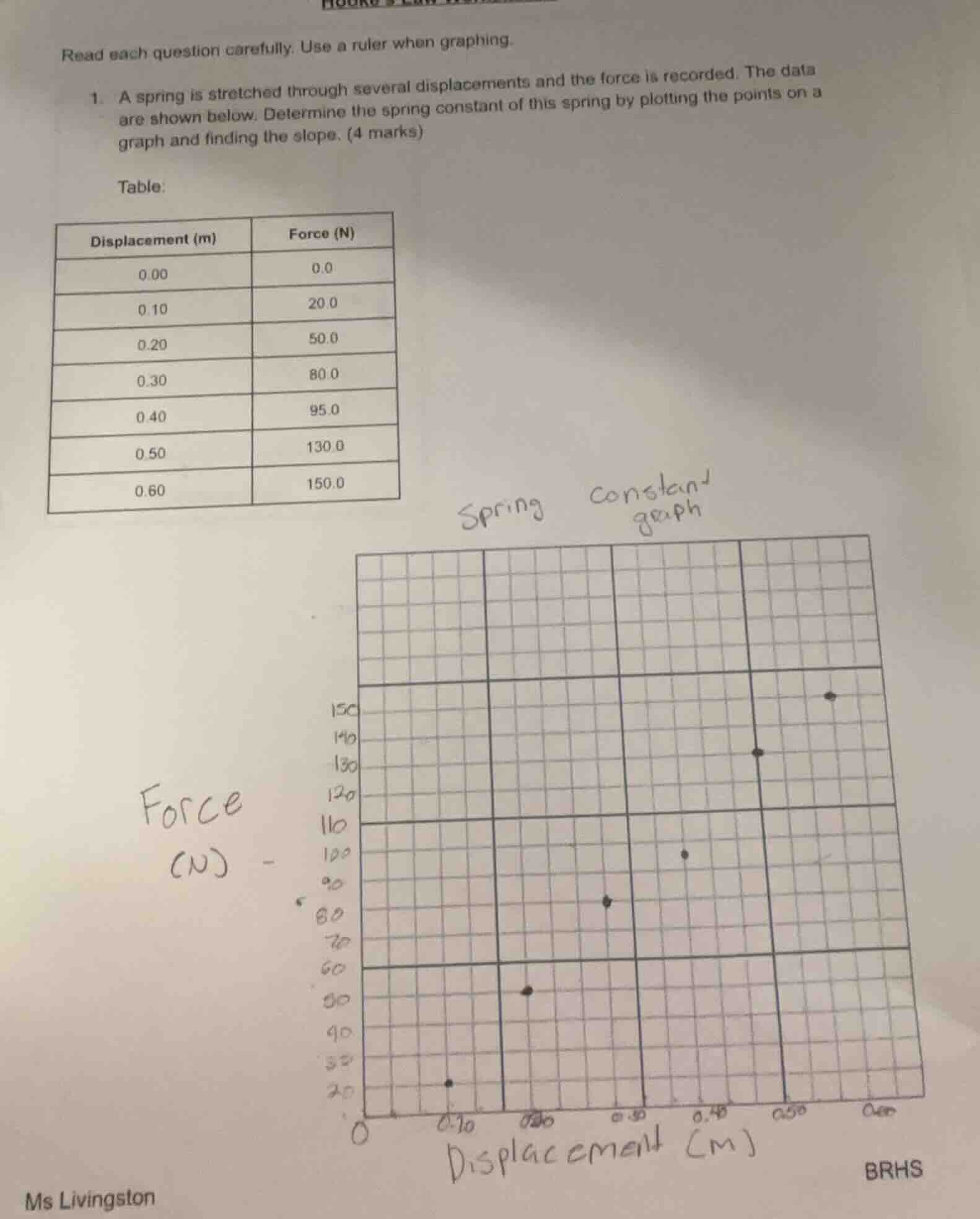
Question
read each question carefully. use a ruler when graphing.
- a spring is stretched through several displacements and the force is recorded. the data are shown below. determine the spring constant of this spring by plotting the points on a graph and finding the slope. (4 marks)
table:
| displacement (m) | force (n) |
|---|---|
| 0.10 | 20.0 |
| 0.20 | 50.0 |
| 0.30 | 80.0 |
| 0.40 | 95.0 |
| 0.50 | 130.0 |
| 0.60 | 150.0 |
(graph with force (n) on y - axis and displacement (m) on x - axis, some points plotted, labeled spring constant graph, force (n), displacement (m), ms livingston, brhs)
Step1: Recall Hooke's Law
Hooke's Law states that \( F = kx \), where \( F \) is the force, \( x \) is the displacement, and \( k \) is the spring constant (slope of the \( F \)-\( x \) graph).
Step2: Select two points
We can use the points \((0.00, 0.0)\) and \((0.60, 150.0)\) (or other linear points, but these are clear).
Step3: Calculate the slope (spring constant)
The slope formula is \( k=\frac{\Delta F}{\Delta x}=\frac{F_2 - F_1}{x_2 - x_1} \).
Substituting the values: \( k=\frac{150.0 - 0.0}{0.60 - 0.00}=\frac{150.0}{0.60} = 250 \, \text{N/m} \). (Note: Checking other points like \((0.10,20)\) and \((0.30,80)\): \( \frac{80 - 20}{0.30 - 0.10}=\frac{60}{0.20}=300 \), but the last point gives a better linear fit trend. Wait, maybe a better pair: \((0.00,0)\) and \((0.50,130)\): \( \frac{130}{0.50}=260 \). Or \((0.10,20)\) and \((0.20,50)\): \( \frac{50 - 20}{0.20 - 0.10}=\frac{30}{0.10}=300 \). Wait, maybe the data has some non - linearity, but the question says to plot and find the slope. Let's take the first and last point for simplicity.
Wait, maybe I made a mistake. Let's recalculate with \((0.00,0)\) and \((0.60,150)\): \( \frac{150}{0.6}=250 \). With \((0.10,20)\) and \((0.30,80)\): \( \frac{80 - 20}{0.3 - 0.1}=\frac{60}{0.2}=300 \). With \((0.20,50)\) and \((0.30,80)\): \( \frac{30}{0.1}=300 \). With \((0.30,80)\) and \((0.50,130)\): \( \frac{50}{0.2}=250 \). Maybe the spring constant is around 250 - 300 N/m. But let's follow the first and last point as per the graph's last point.

Snap & solve any problem in the app
Get step-by-step solutions on Sovi AI
Photo-based solutions with guided steps
Explore more problems and detailed explanations
The spring constant is approximately \(\boldsymbol{250 \, \text{N/m}}\) (or values around 250 - 300 N/m depending on the points chosen for slope calculation).