QUESTION IMAGE
Question
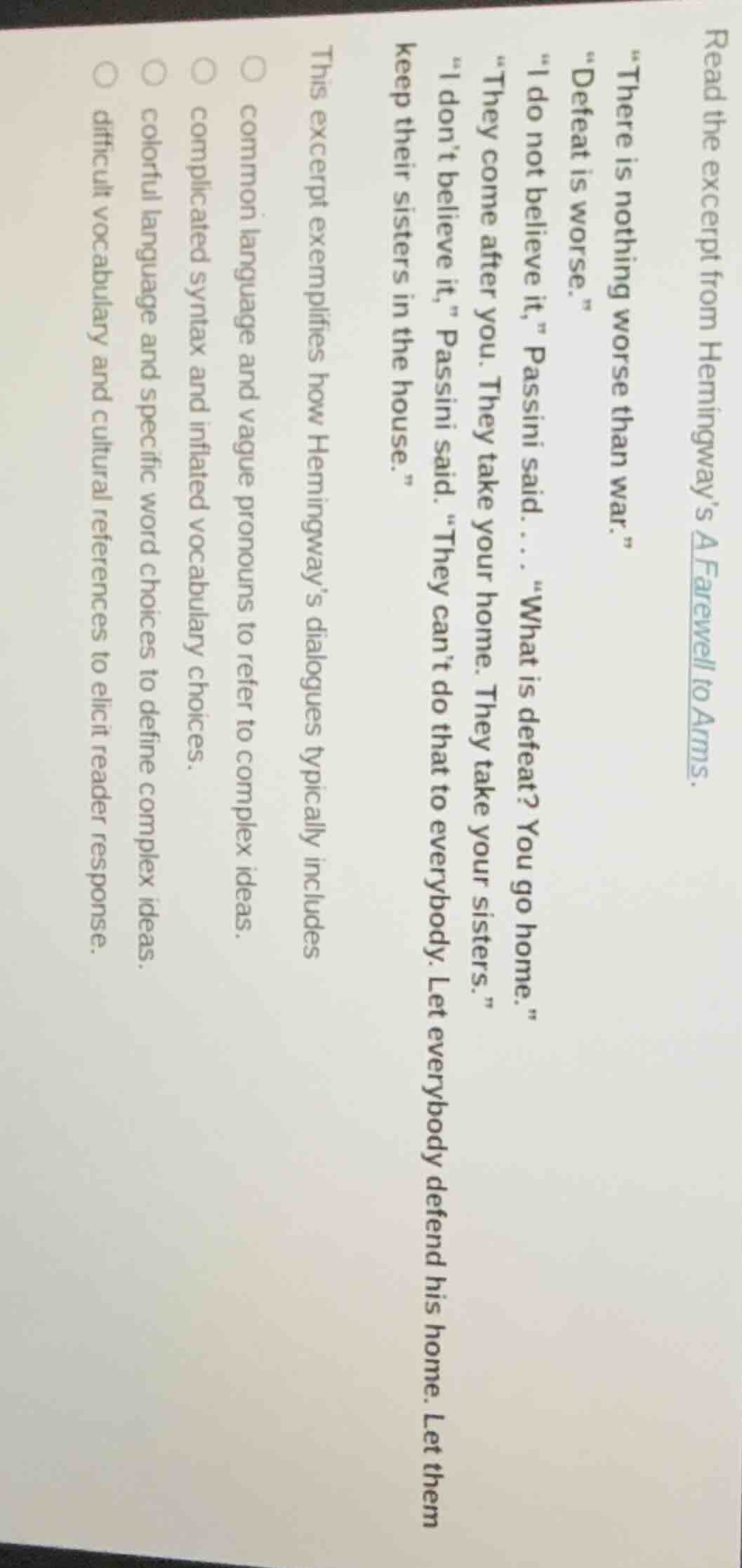
read the excerpt from hemingway’s a farewell to arms. \there is nothing worse than war.\ \defeat is worse.\ \i do not believe it,\ passini said. . . . \what is defeat? you go home.\ \they come after you. they take your home. they take your sisters.\ \i don’t believe it,\ passini said. \they can’t do that to everybody. let everybody defend his home. let them keep their sisters in the house.\ this excerpt exemplifies how hemingway’s dialogues typically includes ○ common language and vague pronouns to refer to complex ideas. ○ complicated syntax and inflated vocabulary choices. ○ colorful language and specific word choices to define complex ideas. ○ difficult vocabulary and cultural references to elicit reader response.
Hemingway's dialogue uses simple, everyday language (e.g., "war," "home," "sisters") and vague pronouns like "They" to discuss the complex, heavy ideas of war, loss, and defeat, matching this option. The other options are incorrect: the syntax is simple, language is plain not colorful, and vocabulary is not difficult.

Snap & solve any problem in the app
Get step-by-step solutions on Sovi AI
Photo-based solutions with guided steps
Explore more problems and detailed explanations
common language and vague pronouns to refer to complex ideas.