QUESTION IMAGE
Question
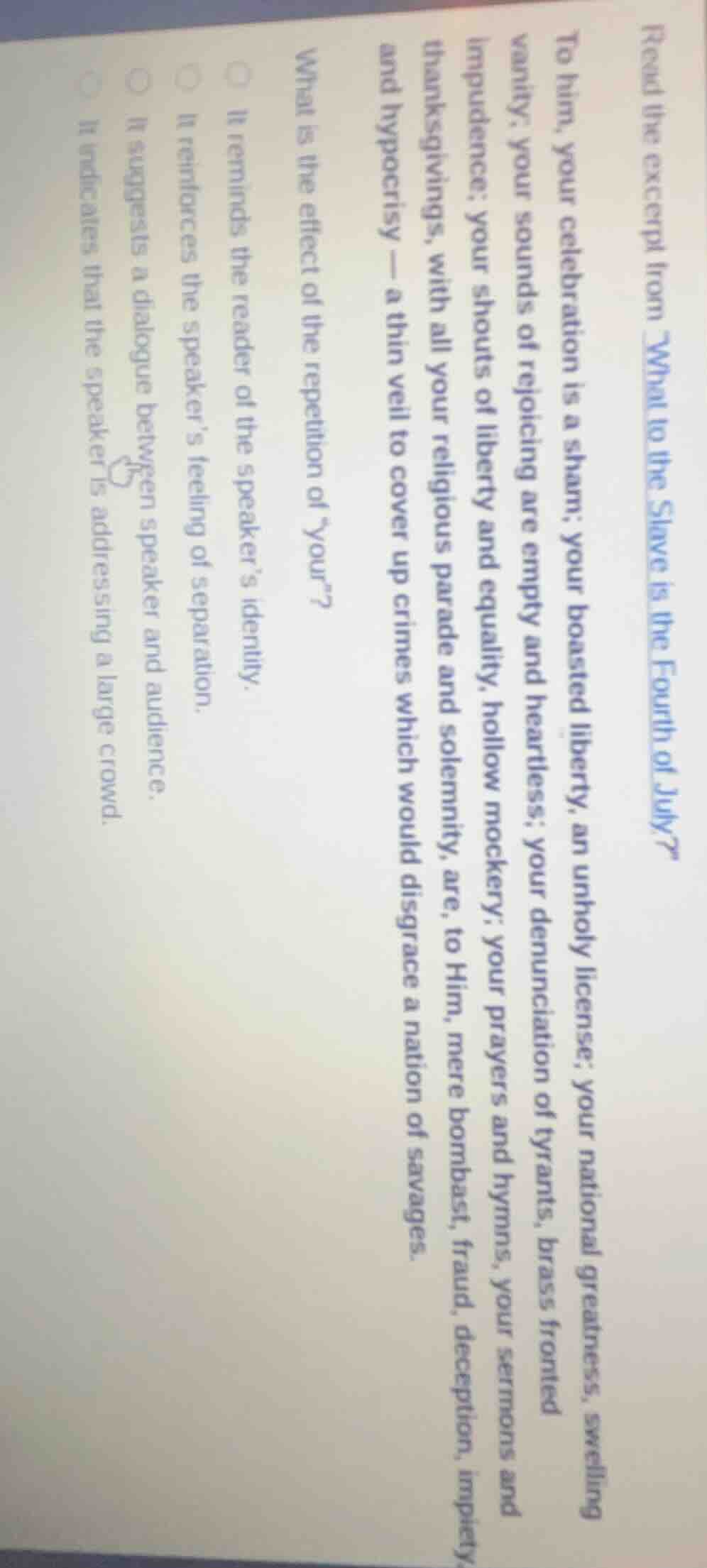
read the excerpt from what to the slave is the fourth of july? to him, your celebration is a sham; your boasted liberty, an unholy license; your national greatness, swelling vanity; your sounds of rejoicing are empty and heartless; your denunciation of tyrants, brass fronted impudence; your shouts of liberty and equality, hollow mockery; your prayers and hymns, your sermons and thanksgivings, with all your religious parade and solemnity, are, to him, mere bombast, fraud, deception, impiety, and hypocrisy — a thin veil to cover up crimes which would disgrace a nation of savages. what is the effect of the repetition of your? it reminds the reader of the speaker’s identity. it reinforces the speaker’s feeling of separation. it suggests a dialogue between speaker and audience. it indicates that the speaker is addressing a large crowd.
The repetition of "your" in the excerpt from "What to the Slave is the Fourth of July?" creates a direct address to the audience (those celebrating), emphasizing the separation between the speaker's perspective and the audience's actions. By repeatedly using "your" to describe the audience's celebration, liberty, sounds, etc., it reinforces the speaker's feeling of being distinct from this group and their hypocritical actions, highlighting the contrast between the audience's supposed values and the reality of slavery. The other options: "reminds the reader of the speaker’s identity" is incorrect as the focus is on the audience, not the speaker's identity; "suggests a dialogue between speaker and audience" is wrong as it's a critical address, not a dialogue; "indicates that the speaker is addressing a large crowd" is not the main effect of the repetition of "your"—the key is the separation in perspective, not just the size of the audience.

Snap & solve any problem in the app
Get step-by-step solutions on Sovi AI
Photo-based solutions with guided steps
Explore more problems and detailed explanations
It reinforces the speaker’s feeling of separation.