QUESTION IMAGE
Question
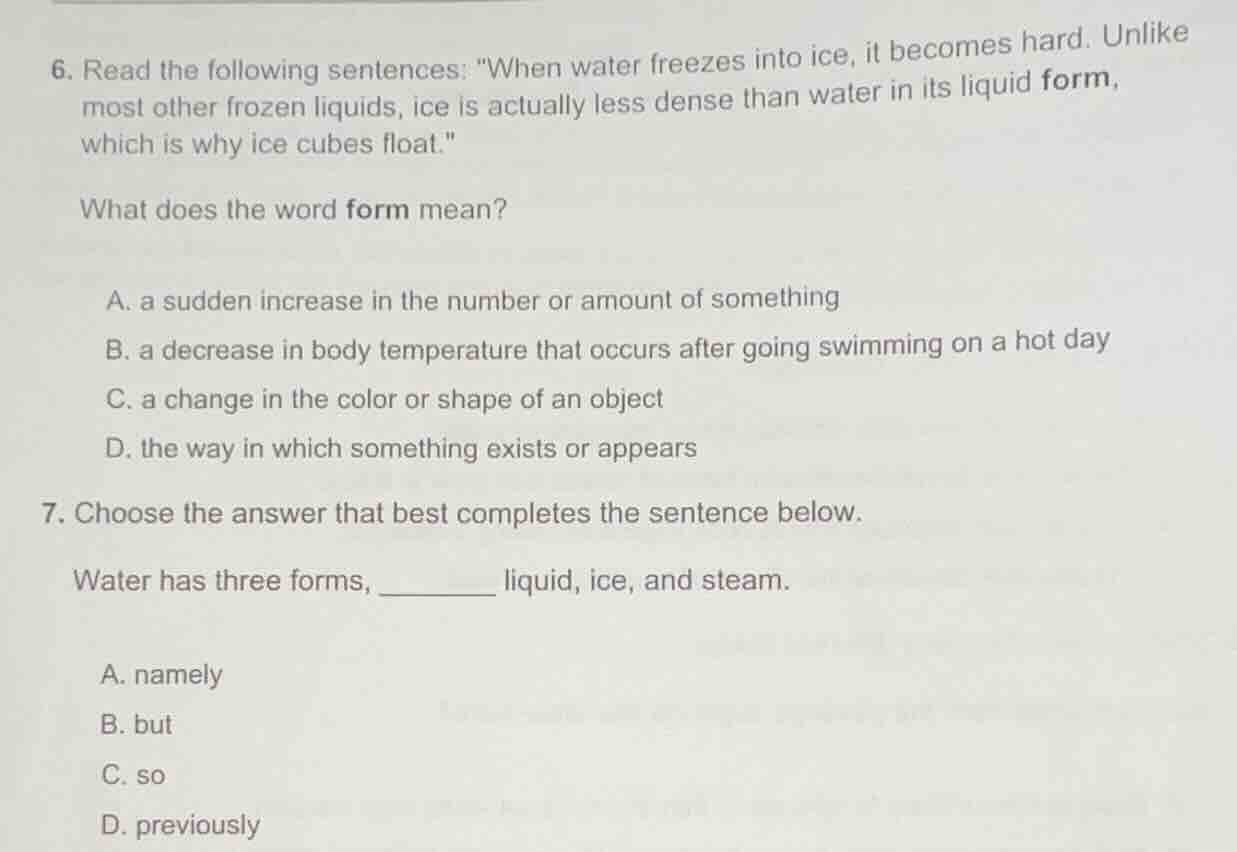
- read the following sentences: \when water freezes into ice, it becomes hard. unlike most other frozen liquids, ice is actually less dense than water in its liquid form, which is why ice cubes float.\ what does the word form mean? a. a sudden increase in the number or amount of something b. a decrease in body temperature that occurs after going swimming on a hot day c. a change in the color or shape of an object d. the way in which something exists or appears 7. choose the answer that best completes the sentence below. water has three forms, ______ liquid, ice, and steam. a. namely b. but c. so d. previously
Response
Question 6
Brief Explanations
To determine the meaning of "form" in the given sentence, we analyze each option:
- Option A: "A sudden increase..." does not relate to the context of water's state, so it's incorrect.
- Option B: "A decrease in body temperature..." is irrelevant to the meaning of "form" in this context, so it's incorrect.
- Option C: The sentence is about the state (liquid, solid) of water, not color or shape change, so this is incorrect.
- Option D: "The way in which something exists or appears" fits the context as water exists as liquid or solid (ice) with different densities, explaining why ice floats. So "form" here refers to the state (way of existing) of water.
Brief Explanations
We need to find a word that introduces the examples (liquid, ice, steam) of water's three forms:
- Option A: "namely" is used to introduce specific examples or details, which fits here as it introduces the three forms of water.
- Option B: "but" is a conjunction for contrast, which is not needed here as we are not contrasting.
- Option C: "so" is a conjunction for cause - effect, which is not relevant here.
- Option D: "previously" refers to time before, which does not fit the context of introducing examples.

Snap & solve any problem in the app
Get step-by-step solutions on Sovi AI
Photo-based solutions with guided steps
Explore more problems and detailed explanations
D. the way in which something exists or appears