QUESTION IMAGE
Question
read the information in the chart.
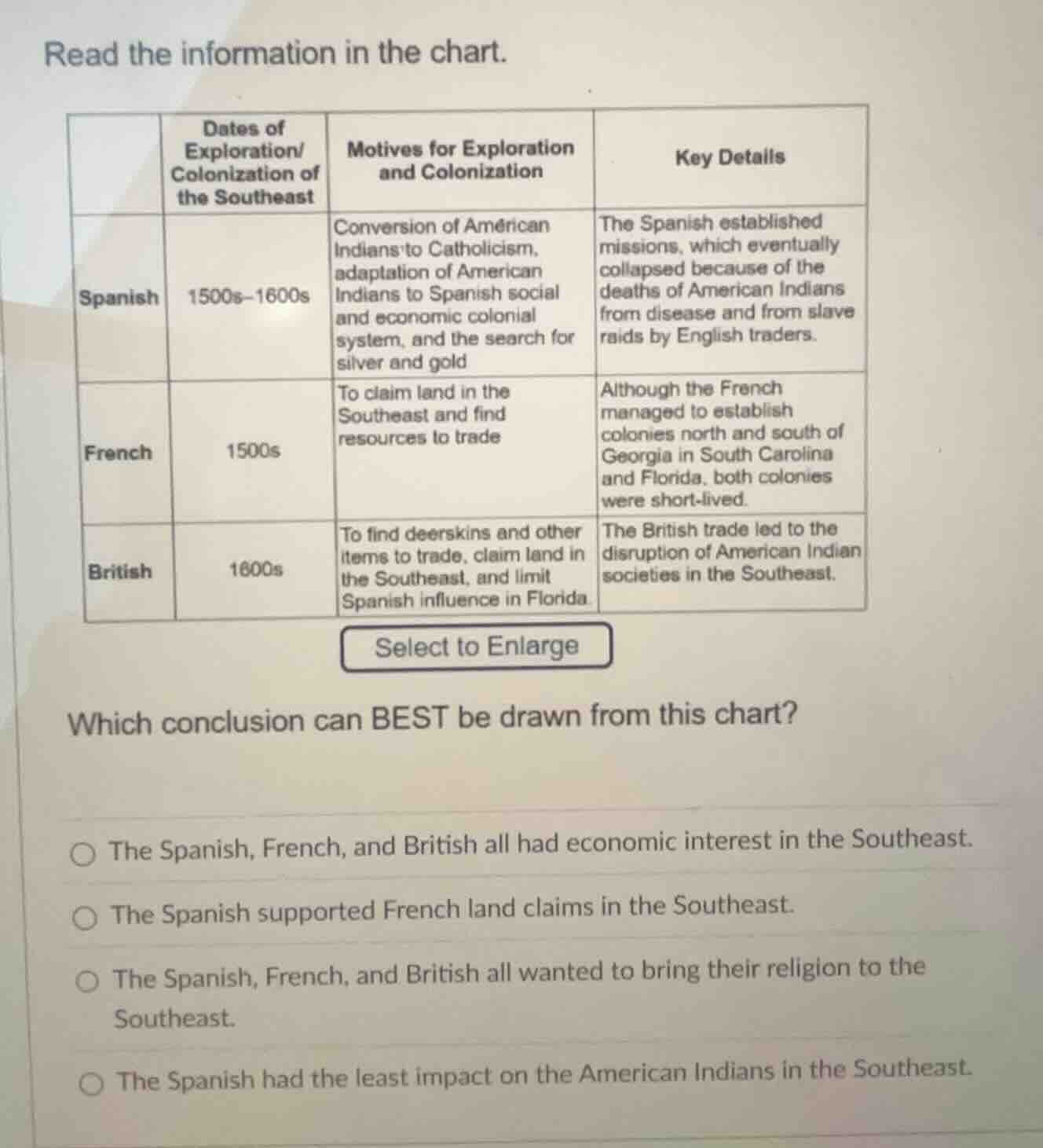
| dates of exploration/ colonization of the southeast | motives for exploration and colonization | key details | |
|---|---|---|---|
| french | 1500s | to claim land in the southeast and find resources to trade | although the french managed to establish colonies north and south of georgia in south carolina and florida, both colonies were short - lived. |
| british | 1600s | to find deerskins and other items to trade, claim land in the southeast, and limit spanish influence in florida | the british trade led to the disruption of american indian societies in the southeast. |
select to enlarge
which conclusion can best be drawn from this chart?
- the spanish, french, and british all had economic interest in the southeast.
- the spanish supported french land claims in the southeast.
- the spanish, french, and british all wanted to bring their religion to the southeast.
- the spanish had the least impact on the american indians in the southeast.
Brief Explanations
- Analyze each option against the chart data:
- Option 1: Spanish sought silver/gold (economic), French sought trade resources (economic), British sought trade items (economic) and land (economic/strategic). All had economic interests.
- Option 2: The chart shows British limited Spanish influence; there is no evidence of Spanish supporting French claims.
- Option 3: Only the Spanish had religious conversion as a motive; French and British motives did not include religion.
- Option 4: The Spanish caused massive American Indian deaths from disease and slave raids, which is a severe impact, not the least.
- The only conclusion fully supported by the chart is that all three groups had economic interests in the Southeast.

Snap & solve any problem in the app
Get step-by-step solutions on Sovi AI
Photo-based solutions with guided steps
Explore more problems and detailed explanations
The Spanish, French, and British all had economic interest in the Southeast.