QUESTION IMAGE
Question
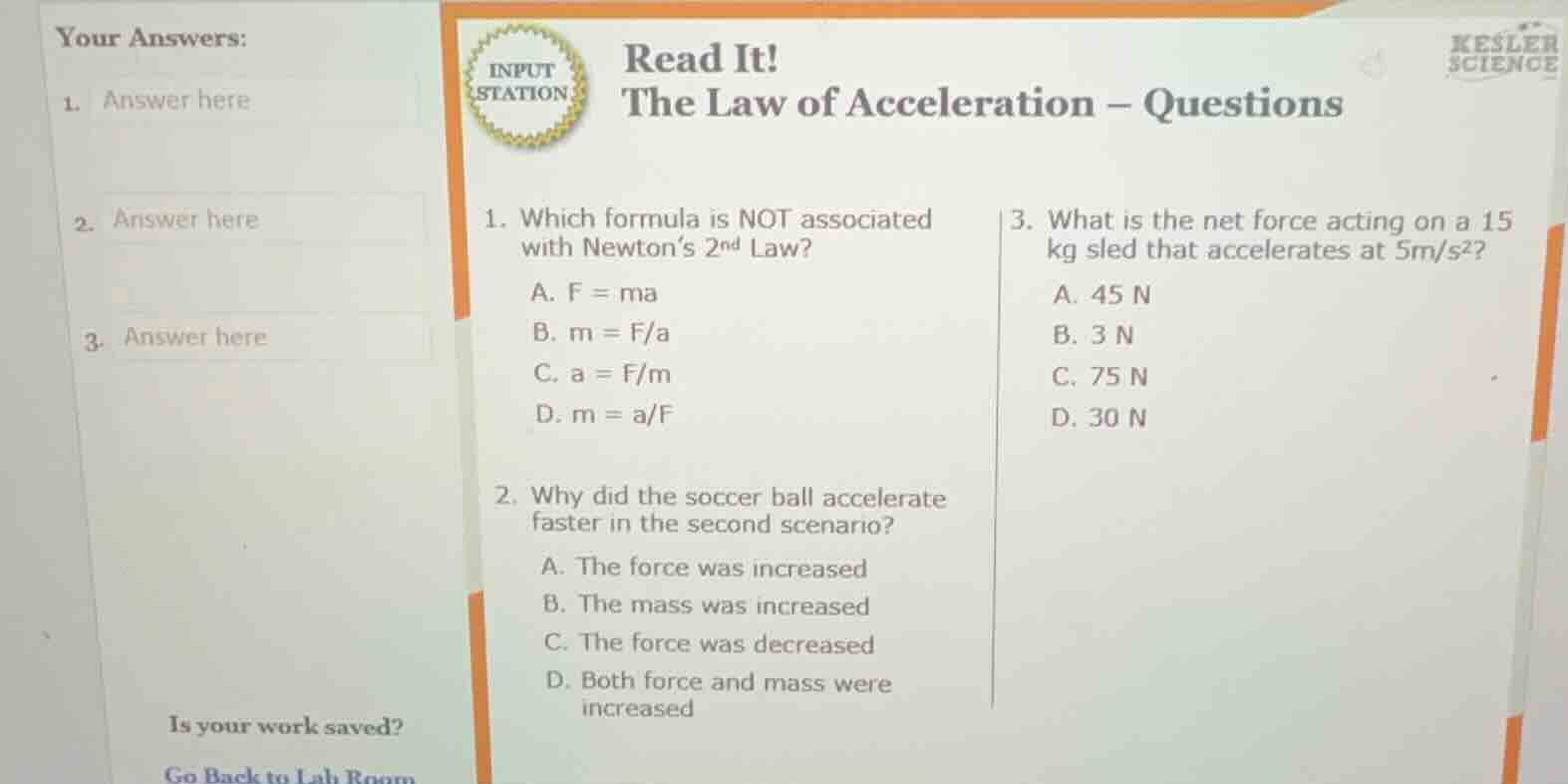
read it!
the law of acceleration – questions
- which formula is not associated with newton’s 2nd law?
a. f = ma
b. m = f/a
c. a = f/m
d. m = a/f
- why did the soccer ball accelerate faster in the second scenario?
a. the force was increased
b. the mass was increased
c. the force was decreased
d. both force and mass were increased
- what is the net force acting on a 15 kg sled that accelerates at 5m/s²?
a. 45 n
b. 3 n
c. 75 n
d. 30 n
Question 1
Step1: Recall Newton's 2nd Law
Newton's 2nd Law is \( F = ma \) (force equals mass times acceleration).
Step2: Derive related formulas
From \( F = ma \), we can rearrange to get \( m=\frac{F}{a} \) (dividing both sides by \( a \)) and \( a=\frac{F}{m} \) (dividing both sides by \( m \)). The formula \( m = \frac{a}{F} \) does not come from rearranging \( F = ma \).
Newton's 2nd Law (\( F = ma \)) shows that acceleration (\( a \)) is directly proportional to force (\( F \)) and inversely proportional to mass (\( m \)). For a soccer ball (constant mass, assuming), increasing force increases acceleration. So if it accelerated faster, the force was increased.
Step1: Identify the formula
Use Newton's 2nd Law \( F = ma \), where \( m = 15\space kg \) and \( a = 5\space m/s^2 \).
Step2: Substitute values
Substitute into the formula: \( F=(15\space kg)\times(5\space m/s^2) \).
Step3: Calculate the force
\( 15\times5 = 75 \), so \( F = 75\space N \).

Snap & solve any problem in the app
Get step-by-step solutions on Sovi AI
Photo-based solutions with guided steps
Explore more problems and detailed explanations
D. \( m = a/F \)