QUESTION IMAGE
Question
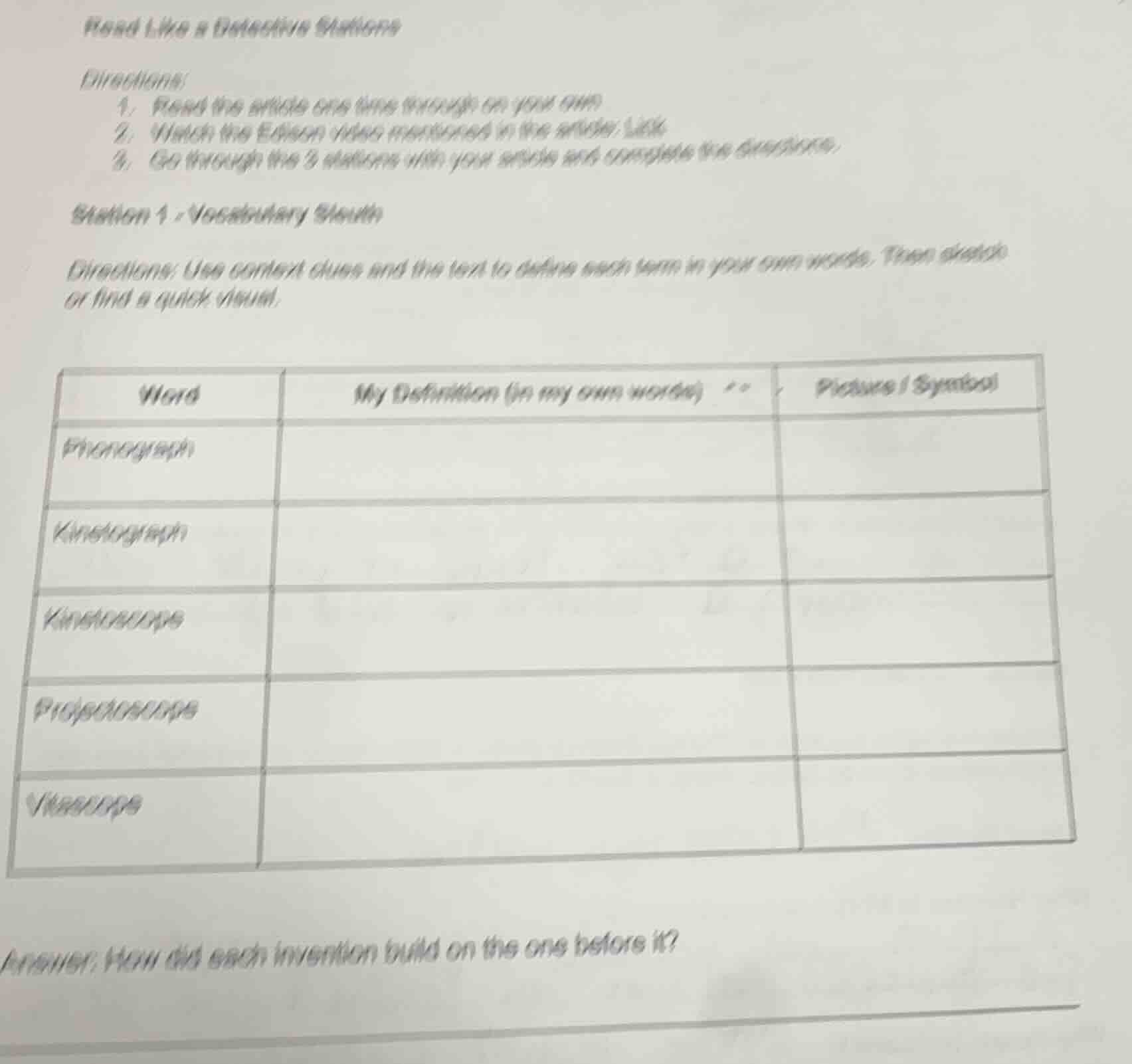
read like a detective stations
directions:
- read the article one time through on your own
- watch the edison video mentioned in the article: link
- go through the 3 stations with your article and complete the directions.
station 1 - vocabulary sleuth
directions: use context clues and the text to define each term in your own words. then sketch or find a quick visual.
| word | my definition (in my own words) | picture / symbol | ---- | ---- | ---- | phonograph | kinetograph | kinetoscope | projectoscope | vitascope | answer: how did each invention build on the one before it? |
Brief Explanations
First, define each term based on their historical function, then explain how each invention expanded on the prior one by adding new media capabilities.

Snap & solve any problem in the app
Get step-by-step solutions on Sovi AI
Photo-based solutions with guided steps
Explore more problems and detailed explanations
Vocabulary Definitions & Visuals:
| Word | My Definition (in my own words) | Picture / Symbol |
|---|---|---|
| Kinetograph | A camera that records moving images | A box-style camera with a film spool |
| Kinetoscope | A viewer for individual moving images | A coin-operated box with an eyepiece |
| Projectoscope | A device that projects small images | A box with a lens projecting onto a surface |
| Vitascope | A projector for public moving images | A large projector with a bright lamp and lens |
How each invention built on the prior one:
- The phonograph first enabled sound recording/playback; the kinetograph built on this by adding the ability to record moving visual footage, expanding media from audio-only to visual motion capture.
- The kinetoscope took the kinetograph's recorded film and created a personal viewing device, making moving images accessible to individuals.
- The projectoscope built on the kinetoscope's viewing function by allowing images to be projected onto a surface, moving beyond individual viewing to small-group displays.
- The vitascope advanced the projectoscope by creating a brighter, more powerful projector that could display moving images to large public audiences, combining the sound potential of the phonograph with large-scale visual projection.