QUESTION IMAGE
Question
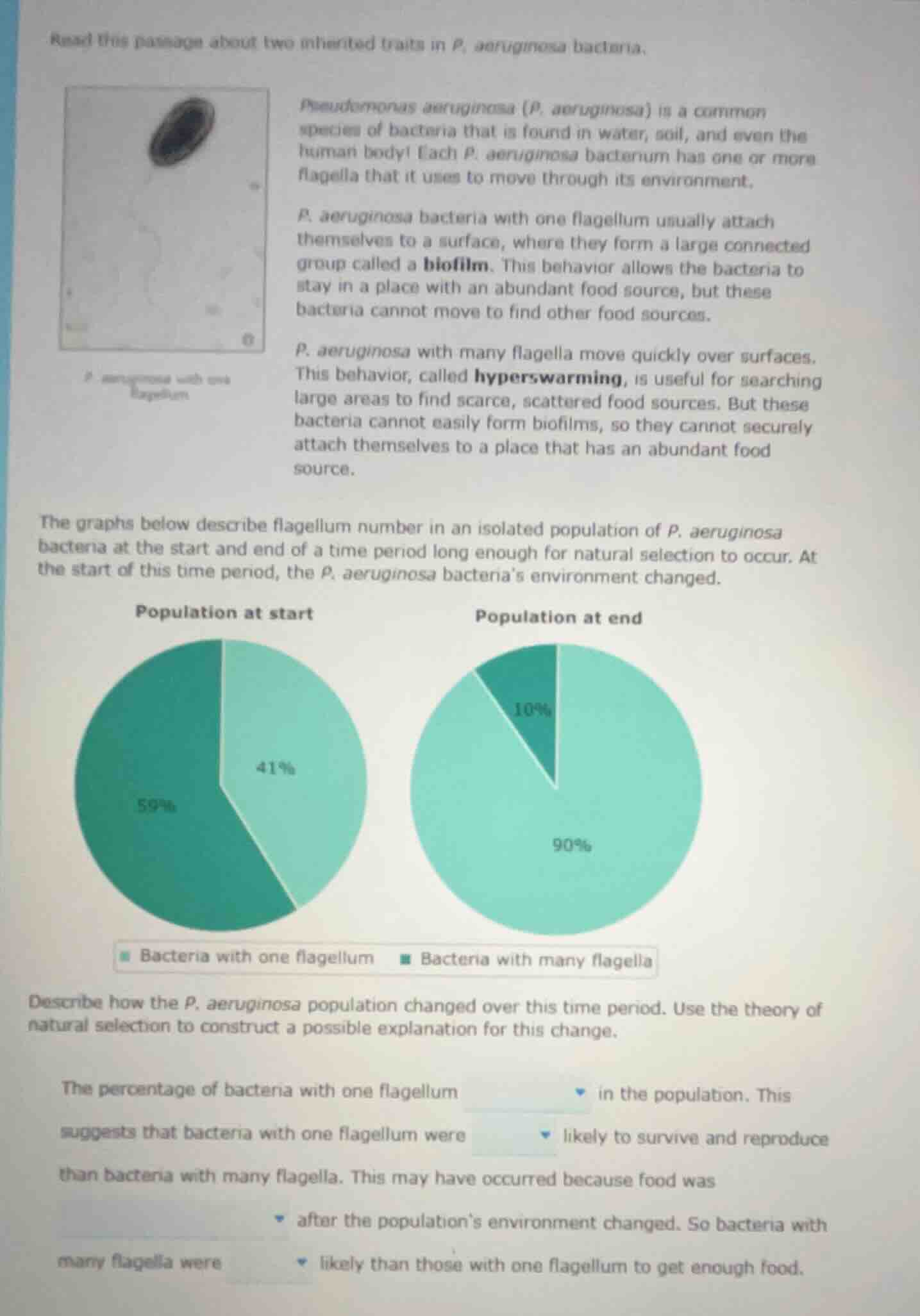
read this passage about two inherited traits in p. aeruginosa bacteria.pseudomonas aeruginosa (p. aeruginosa) is a common species of bacteria that is found in water, soil, and even the human body! each p. aeruginosa bacterium has one or more flagella that it uses to move through its environment.p. aeruginosa bacteria with one flagellum usually attach themselves to a surface, where they form a large connected group called a biofilm. this behavior allows the bacteria to stay in a place with an abundant food source, but these bacteria cannot move to find other food sources.p. aeruginosa with many flagella move quickly over surfaces. this behavior, called hyperswarming, is useful for searching large areas to find scarce, scattered food sources. but these bacteria cannot easily form biofilms, so they cannot securely attach themselves to a place that has an abundant food source.the graphs below describe flagellum number in an isolated population of p. aeruginosa bacteria at the start and end of a time period long enough for natural selection to occur. at the start of this time period, the p. aeruginosa bacterias environment changed.population at startpopulation at endbacteria with one flagellum ■ bacteria with many flagelladescribe how the p. aeruginosa population changed over this time period. use the theory of natural selection to construct a possible explanation for this change.the percentage of bacteria with one flagellum in the population. this suggests that bacteria with one flagellum were likely to survive and reproduce than bacteria with many flagella. this may have occurred because food was after the populations environment changed. so bacteria with many flagella were likely than those with one flagellum to get enough food.
- First, compare the start and end population percentages: bacteria with one flagellum went from 41% to 90%, so their percentage increased.
- A higher final percentage means these bacteria had greater survival/reproductive success, so they were more likely to survive and reproduce.
- Bacteria with many flagellum are adapted for scarce, scattered food (hyperswarming to search large areas). Since their population dropped, the new environment must have had scarce, scattered food.
- Bacteria with one flagellum are less suited for this environment, so bacteria with many flagella were more likely to get enough food.

Snap & solve any problem in the app
Get step-by-step solutions on Sovi AI
Photo-based solutions with guided steps
Explore more problems and detailed explanations
The percentage of bacteria with one flagellum increased in the population. This suggests that bacteria with one flagellum were less likely to survive and reproduce than bacteria with many flagella. This may have occurred because food was scarce and scattered after the population's environment changed. So bacteria with many flagella were more likely than those with one flagellum to get enough food.