QUESTION IMAGE
Question
read this passage about a variable inherited trait in brown trout.
a brown trout with its body length shown
brown trout are fish that may migrate, or repeatedly travel between habitats. brown trout that live in oceans often migrate to lakes or rivers to reproduce. to reach the place where they reproduce, the trout may need to pass through many different areas.
some areas are harder for trout with certain body lengths to pass through. a longer trout may struggle to swim through a shallow stream. a shorter trout may struggle to jump over a large dam or waterfall. if the trout cannot pass through these areas, they may be unable to finish migrating. trout that do not finish migrating are less likely to reproduce.
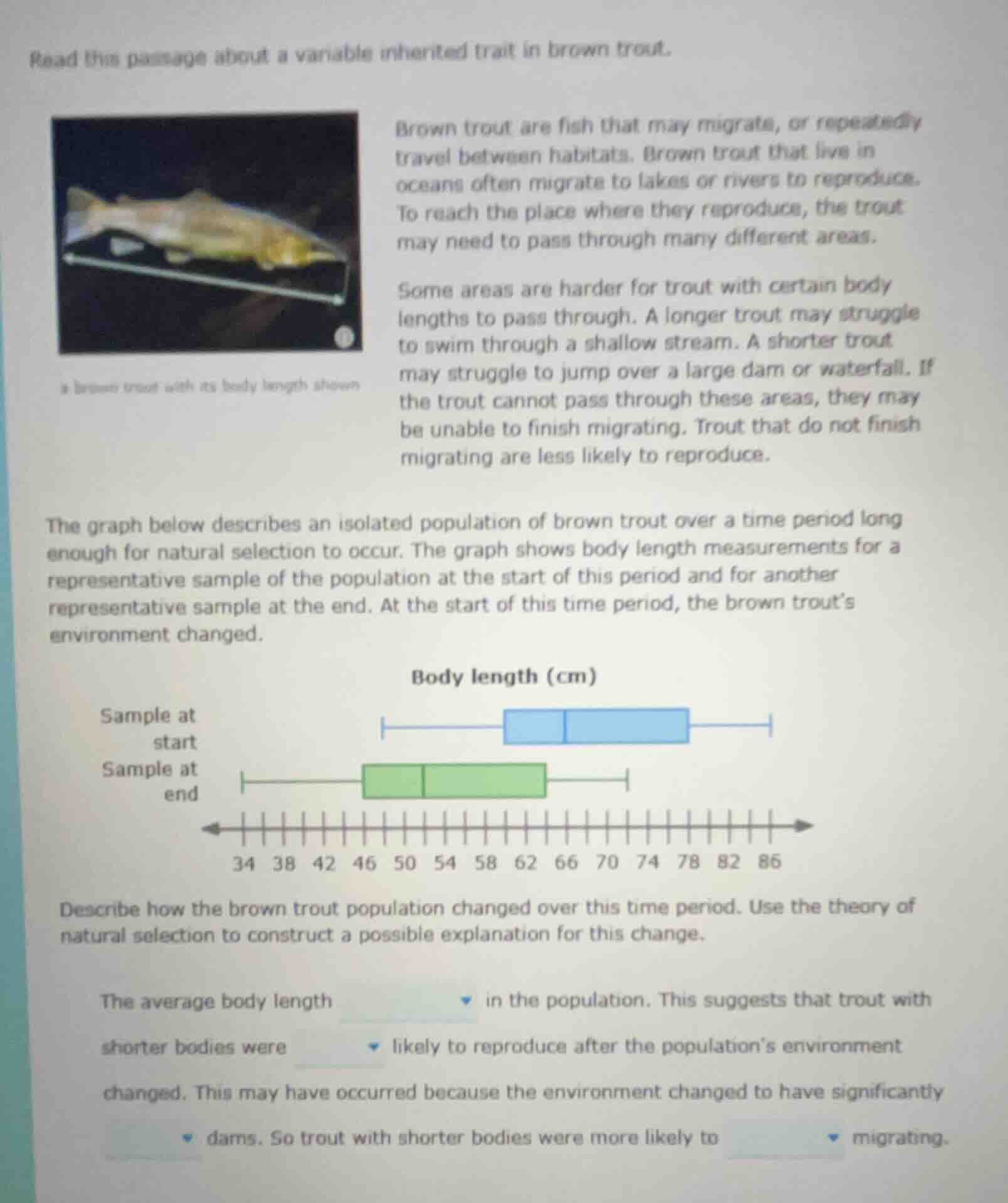
the graph below describes an isolated population of brown trout over a time period long enough for natural selection to occur. the graph shows body length measurements for a representative sample of the population at the start of this period and for another representative sample at the end. at the start of this time period, the brown trouts environment changed.
body length (cm)
sample at start
sample at end
34 38 42 46 50 54 58 62 66 70 74 78 82 86
describe how the brown trout population changed over this time period. use the theory of natural selection to construct a possible explanation for this change.
the average body length in the population. this suggests that trout with shorter bodies were likely to reproduce after the populations environment changed. this may have occurred because the environment changed to have significantly dams. so trout with shorter bodies were more likely to migrating.
- Analyze the box plot: The start sample has a higher average body length (centered around ~66 cm) while the end sample has a lower average (centered around ~54 cm), so average length decreased.
- Link to reproduction success: Since shorter trout became more common, they must have had higher reproductive success.
- Connect to environmental change: The passage states shorter trout struggle less with large dams/waterfalls. For shorter trout to be favored, the environment must have more dams.
- Conclude migration outcome: More dams mean shorter trout can complete migration (and thus reproduce) more easily.

Snap & solve any problem in the app
Get step-by-step solutions on Sovi AI
Photo-based solutions with guided steps
Explore more problems and detailed explanations
The average body length decreased in the population. This suggests that trout with shorter bodies were more likely to reproduce after the population's environment changed. This may have occurred because the environment changed to have significantly more dams. So trout with shorter bodies were more likely to complete migrating.