QUESTION IMAGE
Question
read the passage, then answer the question below.
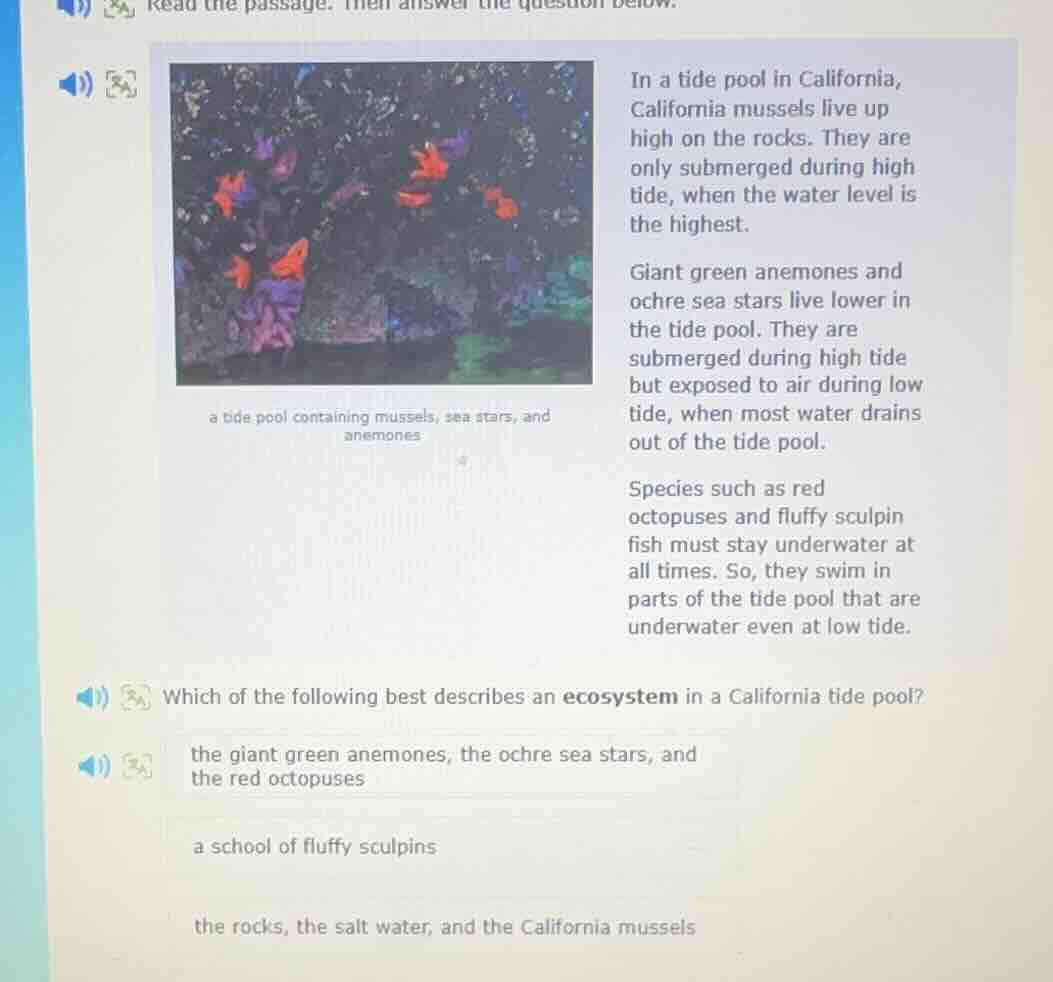
in a tide pool in california, california mussels live up high on the rocks. they are only submerged during high tide, when the water level is the highest.
giant green anemones and ochre sea stars live lower in the tide pool. they are submerged during high tide but exposed to air during low tide, when most water drains out of the tide pool.
species such as red octopuses and fluffy sculpin fish must stay underwater at all times. so, they swim in parts of the tide pool that are underwater even at low tide.
which of the following best describes an ecosystem in a california tide pool?
the giant green anemones, the ochre sea stars, and the red octopuses
a school of fluffy sculpins
the rocks, the salt water, and the california mussels
An ecosystem consists of all the living organisms (biotic factors) and the non - living environment (abiotic factors) in a particular area. Let's analyze each option:
- Option 1: "the giant green anemones, the ochre sea stars, and the red octopuses" only includes some of the living organisms. It does not include the non - living components like rocks, water, etc., and also misses other organisms like California mussels and fluffy sculpin fish.
- Option 2: "a school of fluffy sculpins" is just a group of one type of living organism. It does not include other living organisms or the non - living environment, so it cannot represent an ecosystem.
- Option 3: "the rocks, the salt water, and the California mussels" includes non - living components (rocks, salt water) and a living organism (California mussels). An ecosystem needs both biotic (living) and abiotic (non - living) components, and this option includes elements of both. Also, the other living organisms in the tide pool interact with these components and each other within this environment.

Snap & solve any problem in the app
Get step-by-step solutions on Sovi AI
Photo-based solutions with guided steps
Explore more problems and detailed explanations
the rocks, the salt water, and the California mussels