QUESTION IMAGE
Question
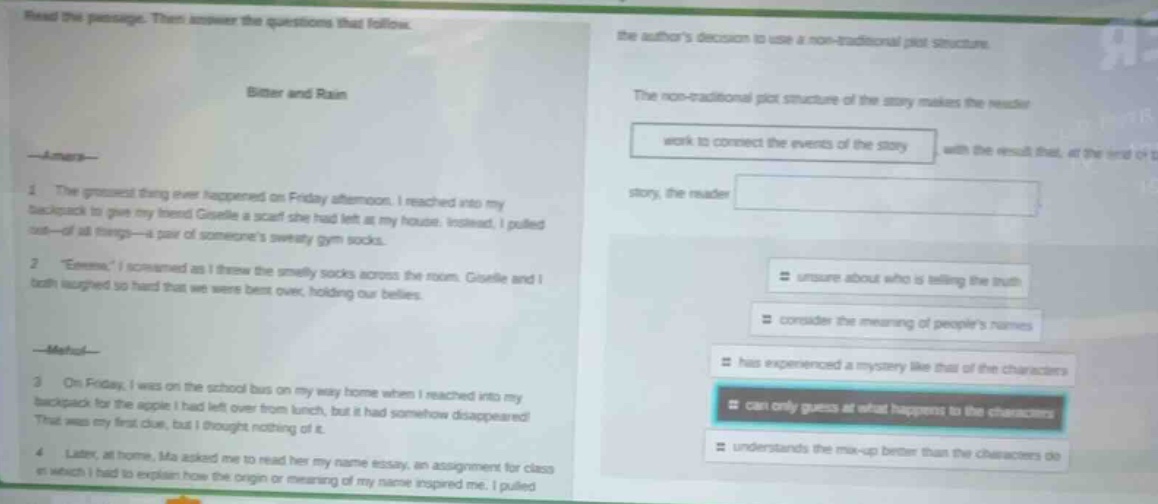
read the passage. then answer the questions that follow.
bitter and rain
—amara—
1 the grossest thing ever happened on friday afternoon. i reached into my backpack to give my friend gisselle a scarf she had left at my house. instead, i pulled out—of all things—a pair of someone’s sweaty gym socks.
2 “ewww,” i screamed as i threw the smelly socks across the room. gisselle and i both laughed so hard that we were bent over, holding our bellies.
—mekhi—
3 on friday, i was on the school bus on my way home when i reached into my backpack for the apple i had left over from lunch, but it had somehow disappeared! that was my first clue, but i thought nothing of it.
4 later, at home, ma asked me to read her my name essay, an assignment for class in which i had to explain how the origin or meaning of my name inspired me. i pulled
the author’s decision to use a non - traditional plot structure.
the non - traditional plot structure of the story makes the reader
( \boldsymbol{\text{work to connect the events of the story}} ) with the result that, at the end of the story, the reader (\boldsymbol{\text{ }}).
- unsure about who is telling the truth
- consider the meaning of people’s names
- has experienced a mystery like that of the characters
- can only guess at what happens to the characters
- understands the mix - up better than the characters do
To solve this, we analyze the effect of a non - traditional plot structure. A non - traditional plot structure often scatters events, so readers have to piece them together. At the end, because they've worked to connect events, they'll understand the mix - up (like the sock and other mix - ups in the story) better than the characters who are in the middle of the confusion.
- "unsure about who is telling the truth": There's no indication of a truth - telling conflict in the story, so this is incorrect.
- "consider the meaning of people’s names": The story's non - traditional structure isn't about name meanings, so this is wrong.
- "has experienced a mystery like that of the characters": The question is about the reader's understanding at the end of the story due to the plot structure, not about the reader's personal experience, so this is incorrect.
- "can only guess at what happens to the characters": The non - traditional structure makes readers work to connect events, not just guess. So this is wrong.
- "understands the mix - up better than the characters do": Since the reader has to piece together the events (like the sock mix - up and the apple disappearance), by the end, they'll have a clearer picture of the mix - up than the characters who are involved in the confusion.

Snap & solve any problem in the app
Get step-by-step solutions on Sovi AI
Photo-based solutions with guided steps
Explore more problems and detailed explanations
understands the mix - up better than the characters do