QUESTION IMAGE
Question
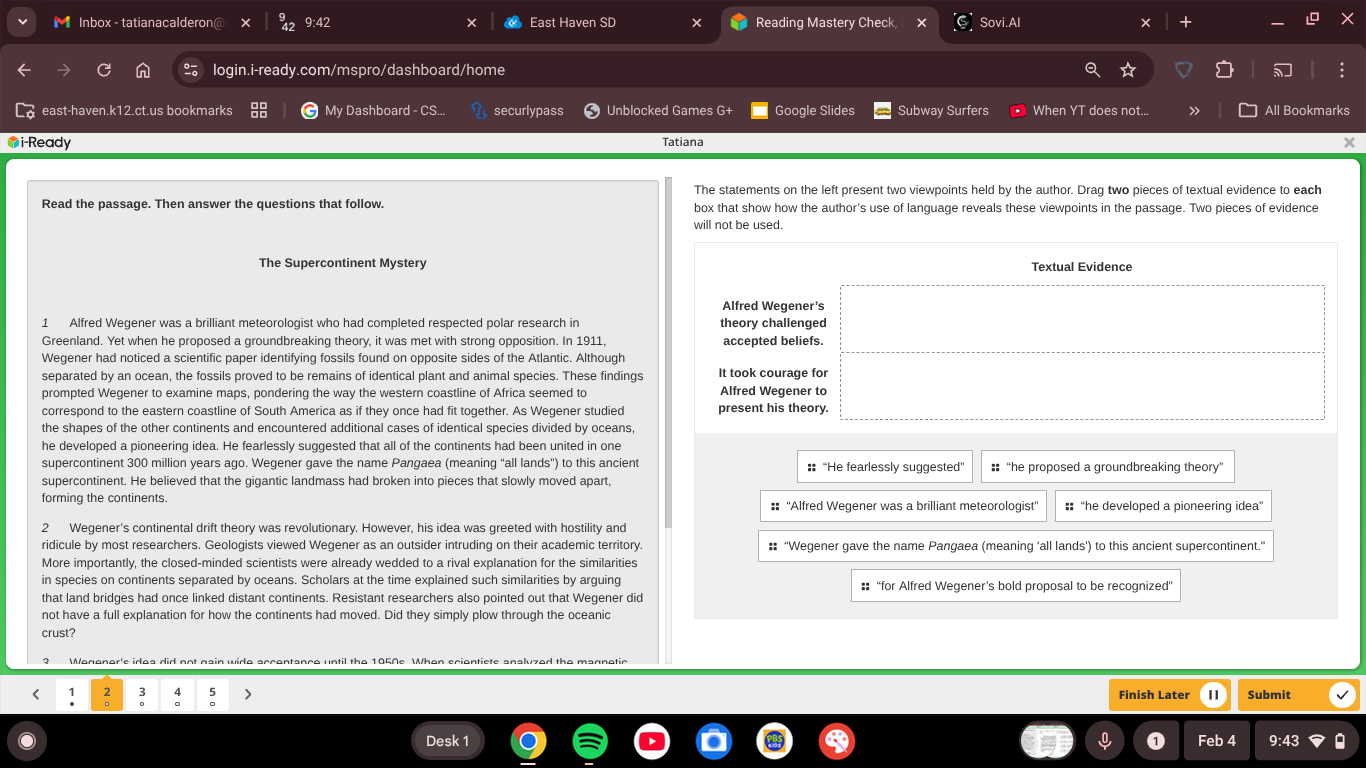
read the passage. then answer the questions that follow.
the supercontinent mystery
1 alfred wegener was a brilliant meteorologist who had completed respected polar research in greenland. yet when he proposed a groundbreaking theory, it was met with strong opposition. in 1911, wegener had noticed a scientific paper identifying fossils found on opposite sides of the atlantic. although separated by an ocean, the fossils proved to be remains of identical plant and animal species. these findings prompted wegener to examine maps, pondering the way the western coastline of africa seemed to correspond to the eastern coastline of south america as if they once had fit together. as wegener studied the shapes of the other continents and encountered additional cases of identical species divided by oceans, he developed a pioneering idea. he fearlessly suggested that all of the continents had been united in one supercontinent 300 million years ago. wegener gave the name pangaea (meaning \all lands\) to this ancient supercontinent. he believed that the gigantic landmass had broken into pieces that slowly moved apart, forming the continents.
2 wegener’s continental drift theory was revolutionary. however, his idea was greeted with hostility and ridicule by most researchers. geologists viewed wegener as an outsider intruding on their academic territory. more importantly, the closed - minded scientists were already wedded to a rival explanation for the similarities in species on continents separated by oceans. scholars at the time explained such similarities by arguing that land bridges had once linked distant continents. resistant researchers also pointed out that wegener did not have a full explanation for how the continents had moved. did they simply plow through the oceanic crust?
the statements on the left present two viewpoints held by the author. drag two pieces of textual evidence to each box that show how the author’s use of language reveals these viewpoints in the passage. two pieces of evidence will not be used.
textual evidence
alfred wegener’s theory challenged accepted beliefs.
it took courage for alfred wegener to present his theory.
- “he fearlessly suggested” - “he proposed a groundbreaking theory”
- “alfred wegener was a brilliant meteorologist” - “he developed a pioneering idea”
- “wegener gave the name pangaea (meaning ‘all lands’) to this ancient supercontinent.”
- “for alfred wegener’s bold proposal to be recognized”
To solve this, we analyze each viewpoint and match with textual evidence:
Viewpoint 1: Alfred Wegener’s theory challenged accepted beliefs.
- "he proposed a groundbreaking theory": A "groundbreaking theory" implies it went against existing (accepted) ideas.
- "he developed a pioneering idea": A "pioneering idea" is new and would challenge established beliefs.
Viewpoint 2: It took courage for Alfred Wegener to present his theory.
- "He fearlessly suggested": "Fearlessly" shows courage in presenting his idea (despite opposition).
- "for Alfred Wegener’s bold proposal to be recognized": "Bold proposal" implies courage was needed to present it (given the hostility he faced).
Unused Evidence:
- "Alfred Wegener was a brilliant meteorologist": Describes his expertise, not the viewpoints.
- "Wegener gave the name Pangaea...": Describes naming the supercontinent, not the viewpoints.
Final Drag-and-Drop:
- Alfred Wegener’s theory challenged accepted beliefs: Drag "he proposed a groundbreaking theory" and "he developed a pioneering idea".
- It took courage for Alfred Wegener to present his theory: Drag "He fearlessly suggested" and "for Alfred Wegener’s bold proposal to be recognized".
(Note: The exact drag-and-drop action is performed by moving the selected text boxes to the corresponding viewpoints in the interface.)

Snap & solve any problem in the app
Get step-by-step solutions on Sovi AI
Photo-based solutions with guided steps
Explore more problems and detailed explanations
To solve this, we analyze each viewpoint and match with textual evidence:
Viewpoint 1: Alfred Wegener’s theory challenged accepted beliefs.
- "he proposed a groundbreaking theory": A "groundbreaking theory" implies it went against existing (accepted) ideas.
- "he developed a pioneering idea": A "pioneering idea" is new and would challenge established beliefs.
Viewpoint 2: It took courage for Alfred Wegener to present his theory.
- "He fearlessly suggested": "Fearlessly" shows courage in presenting his idea (despite opposition).
- "for Alfred Wegener’s bold proposal to be recognized": "Bold proposal" implies courage was needed to present it (given the hostility he faced).
Unused Evidence:
- "Alfred Wegener was a brilliant meteorologist": Describes his expertise, not the viewpoints.
- "Wegener gave the name Pangaea...": Describes naming the supercontinent, not the viewpoints.
Final Drag-and-Drop:
- Alfred Wegener’s theory challenged accepted beliefs: Drag "he proposed a groundbreaking theory" and "he developed a pioneering idea".
- It took courage for Alfred Wegener to present his theory: Drag "He fearlessly suggested" and "for Alfred Wegener’s bold proposal to be recognized".
(Note: The exact drag-and-drop action is performed by moving the selected text boxes to the corresponding viewpoints in the interface.)