QUESTION IMAGE
Question
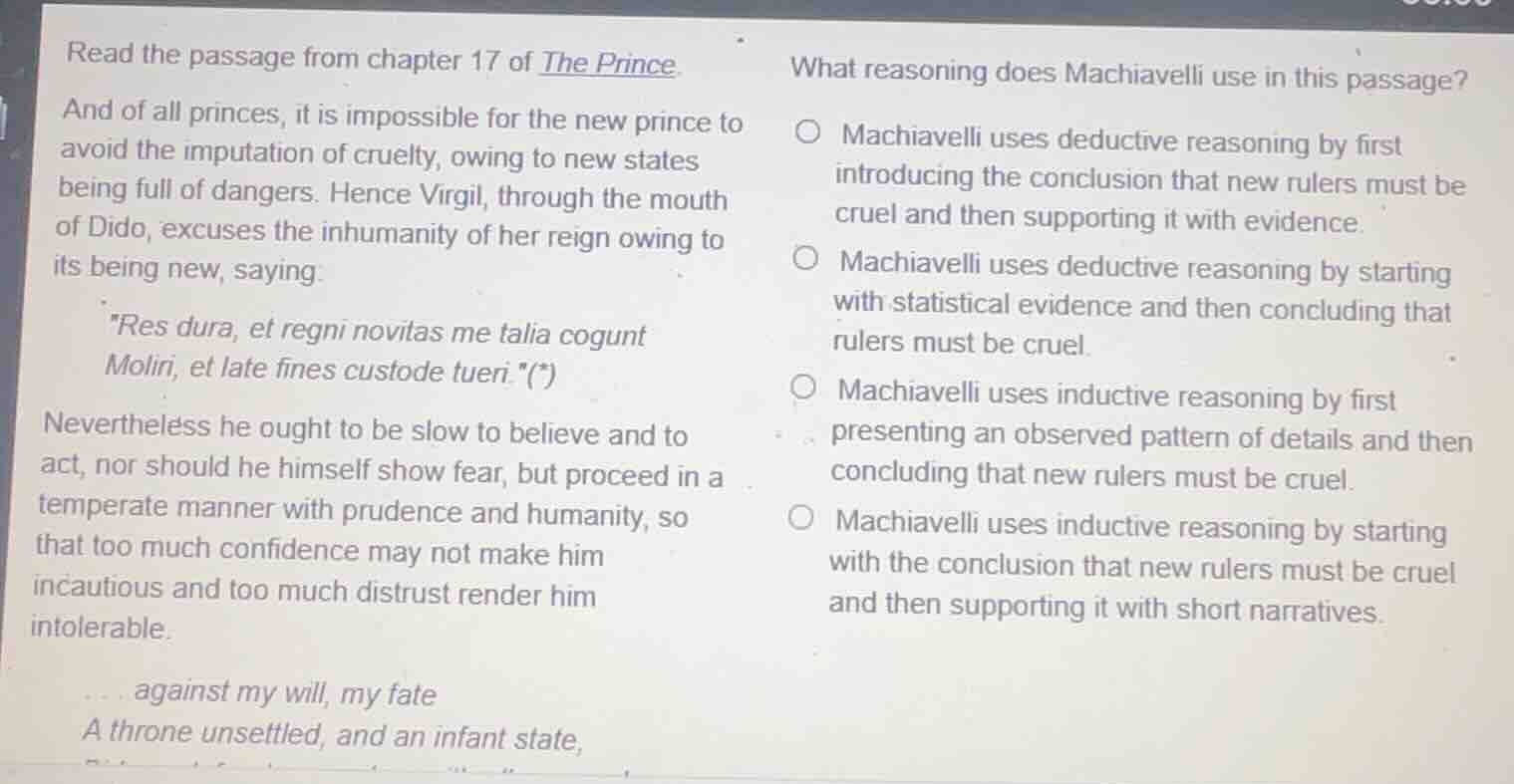
read the passage from chapter 17 of the prince. and of all princes, it is impossible for the new prince to avoid the imputation of cruelty, owing to new states being full of dangers. hence virgil, through the mouth of dido, excuses the inhumanity of her reign owing to its being new, saying:
es dura, et regni novitas me talia cogunt moliri, et late fines custode tueri.\(*) nevertheless he ought to be slow to believe and to act, nor should he himself show fear, but proceed in a temperate manner with prudence and humanity, so that too much confidence may not make him incautious and too much distrust render him intolerable.... against my will, my fate a throne unsettled, and an infant state, what reasoning does machiavelli use in this passage? machiavelli uses deductive reasoning by first introducing the conclusion that new rulers must be cruel and then supporting it with evidence. machiavelli uses deductive reasoning by starting with statistical evidence and then concluding that rulers must be cruel. machiavelli uses inductive reasoning by first presenting an observed pattern of details and then concluding that new rulers must be cruel. machiavelli uses inductive reasoning by starting with the conclusion that new rulers must be cruel and then supporting it with short narratives.
Deductive reasoning starts with a general conclusion, then supports it with evidence. Machiavelli first states new princes cannot avoid being seen as cruel (conclusion), then uses Virgil's Dido example as evidence. Inductive reasoning starts with specific observations to form a conclusion, which does not match here. Statistical evidence is not used, and the passage does not start with details/patterns.

Snap & solve any problem in the app
Get step-by-step solutions on Sovi AI
Photo-based solutions with guided steps
Explore more problems and detailed explanations
A. Machiavelli uses deductive reasoning by first introducing the conclusion that new rulers must be cruel and then supporting it with evidence.