QUESTION IMAGE
Question
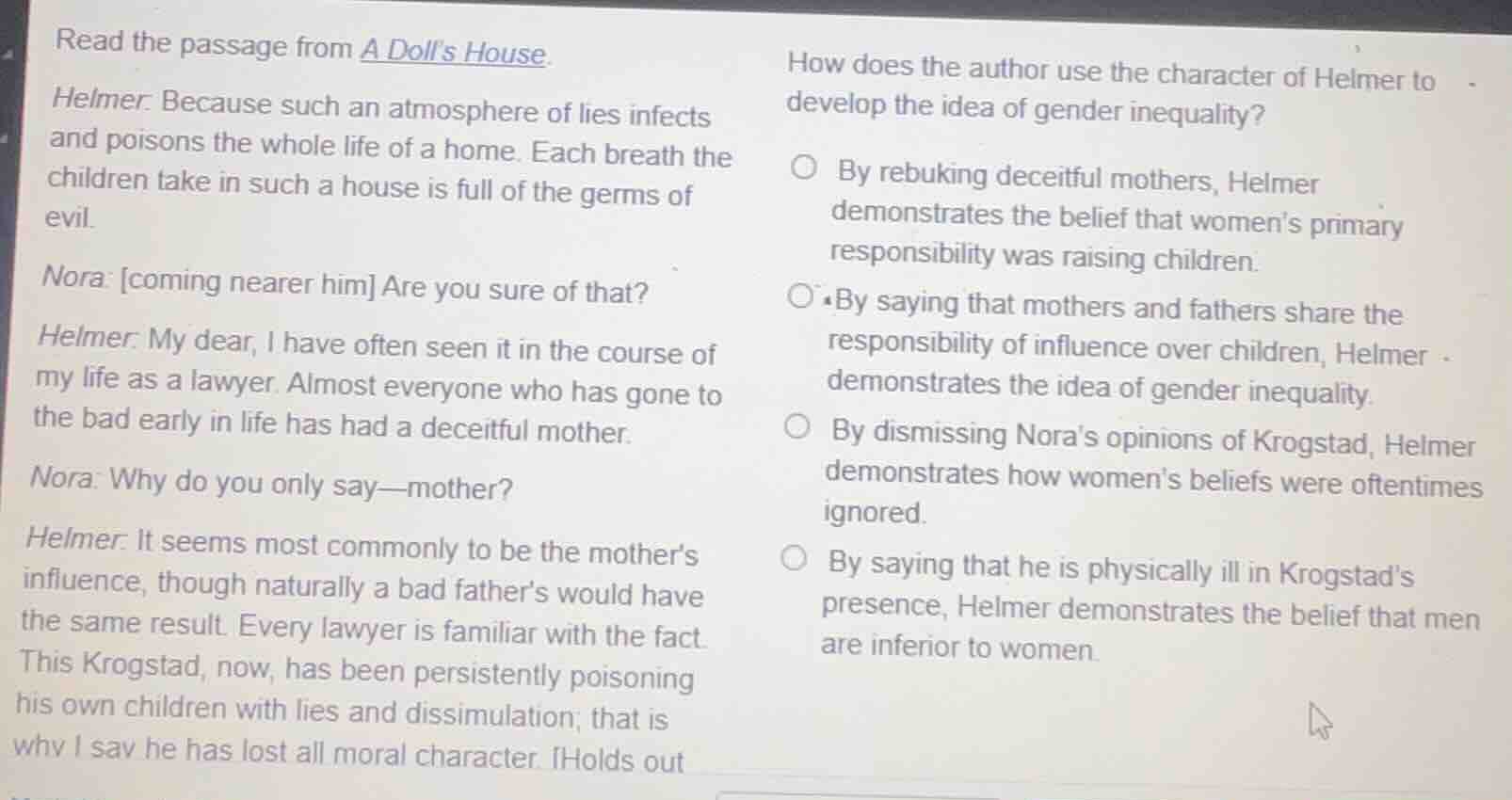
read the passage from a dolls house. helmer: because such an atmosphere of lies infects and poisons the whole life of a home. each breath the children take in such a house is full of the germs of evil. nora: coming nearer him are you sure of that? helmer: my dear, i have often seen it in the course of my life as a lawyer. almost everyone who has gone to the bad early in life has had a deceitful mother. nora: why do you only say—mother? helmer: it seems most commonly to be the mothers influence, though naturally a bad fathers would have the same result. every lawyer is familiar with the fact. this krogstad, now, has been persistently poisoning his own children with lies and dissimulation; that is why i say he has lost all moral character. holds out how does the author use the character of helmer to develop the idea of gender inequality? by rebuking deceitful mothers, helmer demonstrates the belief that womens primary responsibility was raising children. by saying that mothers and fathers share the responsibility of influence over children, helmer demonstrates the idea of gender inequality. by dismissing noras opinions of krogstad, helmer demonstrates how womens beliefs were oftentimes ignored. by saying that he is physically ill in krogstads presence, helmer demonstrates the belief that men are inferior to women.
Helmer attributes childhood moral failings primarily to deceitful mothers, even when Nora questions why he only singles out mothers. This reflects the gendered belief that women bear the main responsibility for children's moral development, which is a form of gender inequality. The other options are incorrect: he does not claim shared responsibility, the passage does not mention dismissing Nora's opinions of Krogstad, and he never states men are inferior to women.

Snap & solve any problem in the app
Get step-by-step solutions on Sovi AI
Photo-based solutions with guided steps
Explore more problems and detailed explanations
A. By rebuking deceitful mothers, Helmer demonstrates the belief that women's primary responsibility was raising children.