QUESTION IMAGE
Question
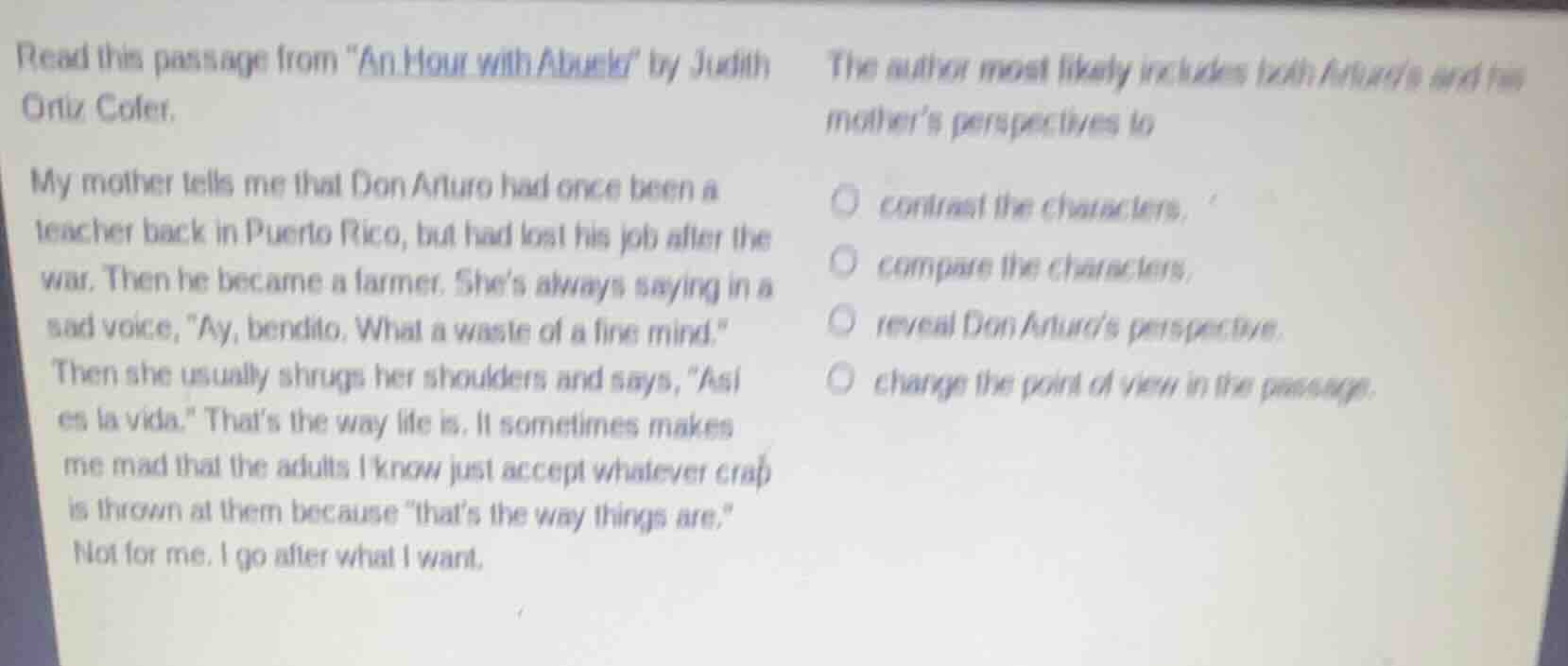
read this passage from \an hour with abuelo\ by judith ortiz cofer.
my mother tells me that don arturo had once been a teacher back in puerto rico, but had lost his job after the war. then he became a farmer. shes always saying in a sad voice, \ay, bendito. what a waste of a fine mind.\ then she usually shrugs her shoulders and says, \así es la vida.\ thats the way life is. it sometimes makes me mad that the adults i know just accept whatever crap is thrown at them because \thats the way things are.\ not for me. i go after what i want.
the author most likely includes both arturos and his mothers perspectives to
○ contrast the characters.
○ compare the characters.
○ reveal don arturos perspective.
○ change the point of view in the passage.
The mother accepts life's circumstances (e.g., "Así es la vida") while the narrator (Arturo's perspective? Wait, the narrator here is the child, but the options have "reveal Don Arturo's perspective"—no, wait, the mother's perspective is accepting, and the narrator's (maybe Arturo? No, the narrator is the child) or the two perspectives: mother accepts, narrator (child) is frustrated. Wait, the options: "contrast the characters"—mother is accepting, narrator (child) is not. Wait, no, the two perspectives: mother's (accepting) and the narrator's (frustrated). Wait, the question is why include both Arturo's (wait, no, the passage: mother's perspective and the narrator's (the child, maybe Arturo? No, the passage: "My mother tells me..." then the narrator's thoughts. Wait, the options: "contrast the characters"—mother is accepting, narrator is not. So contrasting their attitudes. Alternatively, "compare" but contrast is about differences, compare about similarities. The mother accepts, the narrator is mad, so contrasting. Wait, but the options: "contrast the characters"—so the author includes mother's (accepting) and narrator's (frustrated) to contrast their outlooks. Wait, but the options: let's re-examine. The mother says "Así es la vida" (accepting), the narrator says "It sometimes makes me mad... Not for me. I go after what I want." So two perspectives: mother (resigned) and narrator (determined). So contrasting their characters (attitudes). So the answer is to contrast the characters. Wait, but the options: "contrast the characters" is an option. Alternatively, "compare" but contrast is difference. So the correct answer is to contrast the characters. Wait, but let's check the options again. The options are: contrast the characters, compare, reveal Don Arturo's perspective, change point of view. Reveal Don Arturo's perspective? No, the mother is talking about Don Arturo, but the two perspectives are mother and the narrator. Wait, maybe I misread. The passage: mother's perspective on Don Arturo (she feels sorry for his wasted mind) and the narrator's (the child's) perspective on adults accepting things. Wait, no, the question is "the author most likely includes both Arturo's and his mother's perspectives"—wait, maybe a typo, maybe "the narrator's (Arturo) and his mother's". So mother accepts, Arturo (narrator) does not. So contrasting their characters (attitudes). So the answer is to contrast the characters.

Snap & solve any problem in the app
Get step-by-step solutions on Sovi AI
Photo-based solutions with guided steps
Explore more problems and detailed explanations
A. contrast the characters