QUESTION IMAGE
Question
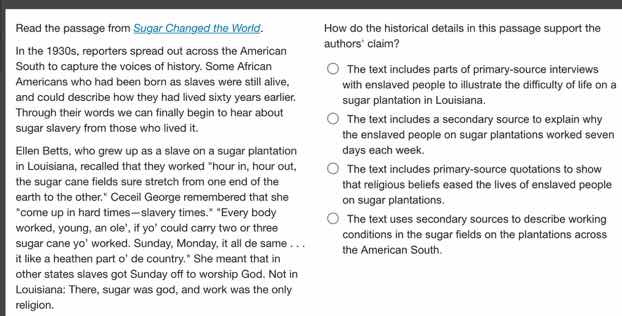
read the passage from sugar changed the world. in the 1930s, reporters spread out across the american south to capture the voices of history. some were still americans who had been born as slaves were alive, and could describe how they had lived sixty years earlier. through their words we finally begin to hear about sugar slavery from those who lived it. ellen betts, who grew up as a slave on a sugar plantation in louisiana, recalled that they worked \hour in, hour out, the sugar cane fields stretch from one end of the earth to the other.\ cecile george remembered that she \come up in hard times—slavery times.\ \every body sugar cane yo worked. sunday, monday, it all do same... it like a heathen part o de country.\ she meant that, in other states slaves got sunday off to worship god. not in louisiana: there, sugar was god, and work was the only religion. how do the historical details in this passage support the authors claim? the text includes parts of primary - source interviews with enslaved people to illustrate the difficulty of life on a sugar plantation in louisiana. the text includes a secondary source to explain why the enslaved people on sugar plantations worked seven days each week. the text includes primary - source quotations to show that religious beliefs eased the lives of enslaved people on sugar plantations. the text uses secondary sources to describe working conditions in the sugar fields on the plantations across the american south.
To solve this, we analyze each option:
- Option 1: The passage has direct quotes from enslaved people (Ellen Betts, Ceceil George) – these are primary - source interviews. The details (like working “hour in, hour out” and “Sunday, Monday, it all de same”) illustrate the difficulty of life on a sugar plantation in Louisiana.
- Option 2: The text does not include a secondary source to explain the seven - day workweek; it uses primary sources.
- Option 3: The quotes show the harshness of work, not that religious beliefs eased lives (Ceceil George’s quote about no “breathers” or “Sunday” for worship implies the opposite).
- Option 4: The text uses primary (not secondary) sources (quotes from enslaved people) to describe working conditions.
The passage includes direct quotes (primary - source interviews) from enslaved people (Ellen Betts, Ceceil George) describing their difficult lives on a Louisiana sugar plantation (e.g., non - stop work, no rest or worship time). Other options are incorrect: no secondary source explains the workweek, quotes don't show religion eased lives, and primary (not secondary) sources are used.

Snap & solve any problem in the app
Get step-by-step solutions on Sovi AI
Photo-based solutions with guided steps
Explore more problems and detailed explanations
A. The text includes parts of primary - source interviews with enslaved people to illustrate the difficulty of life on a sugar plantation in Louisiana.