QUESTION IMAGE
Question
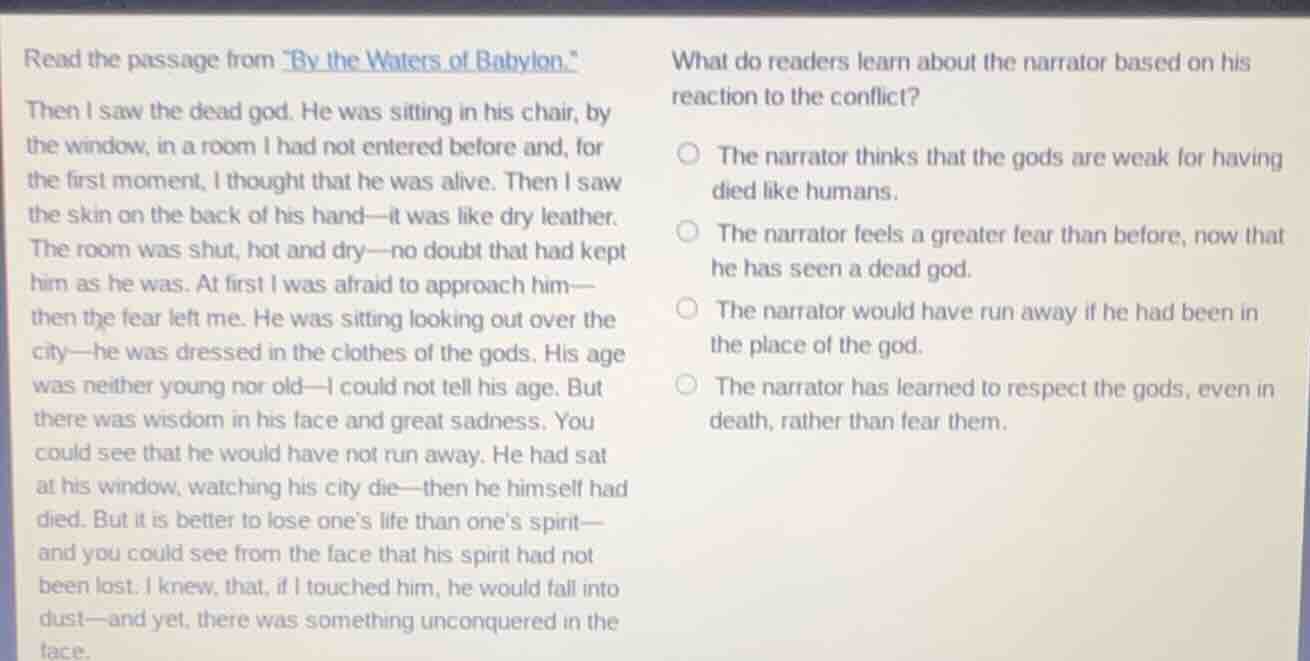
read the passage from \by the waters of babylon.\ then i saw the dead god. he was sitting in his chair, by the window, in a room i had not entered before and, for the first moment, i thought that he was alive. then i saw the skin on the back of his hand—it was like dry leather. the room was shut, hot and dry—no doubt that had kept him as he was. at first i was afraid to approach him—then the fear left me. he was sitting looking out over the city—he was dressed in the clothes of the gods. his age was neither young nor old—i could not tell his age. but there was wisdom in his face and great sadness. you could see that he would have not run away. he had sat at his window, watching his city die—then he himself had died. but it is better to lose one’s life than one’s spirit—and you could see from the face that his spirit had not been lost. i knew, that, if i touched him, he would fall into dust—and yet, there was something unconquered in the face. what do readers learn about the narrator based on his reaction to the conflict? the narrator thinks that the gods are weak for having died like humans. the narrator feels a greater fear than before, now that he has seen a dead god. the narrator would have run away if he had been in the place of the god. the narrator has learned to respect the gods, even in death, rather than fear them.
The narrator initially fears the dead god but quickly loses that fear. He observes the god's wisdom, sadness, and unconquered spirit, concluding it is better to lose life than spirit. This shows he shifts from fear to respect for the god even in death, rather than seeing weakness or feeling increased fear, and there is no indication he would have run away in the god's place.

Snap & solve any problem in the app
Get step-by-step solutions on Sovi AI
Photo-based solutions with guided steps
Explore more problems and detailed explanations
D. The narrator has learned to respect the gods, even in death, rather than fear them.